. 1998 Feb;72(2):1280-6.
doi: 10.1128/JVI.72.2.1280-1286.1998.

Polyadenylation of influenza virus mRNA transcribed in vitro from model virion RNA templates: requirement for 5' conserved sequences

Affiliations

Polyadenylation of influenza virus mRNA transcribed in vitro from model virion RNA templates: requirement for 5' conserved sequences

D C Pritlove et al. J Virol. 1998 Feb.

Abstract

Here we report the development of two independent assays which demonstrate for the first time that exogenous model RNA templates based on influenza virus virion RNA (vRNA) are transcribed in vitro to produce polyadenylated mRNA. We investigated the activities of mutated templates with known polymerase binding properties to test our model that polyadenylation occurs when a polymerase complex, which is bound to conserved 5' sequences of vRNA, prevents read-through of the U track at which polyadenylation subsequently occurs by reiterative copying. Mutated templates with perturbed polymerase binding sites (i.e., a deletion mutant lacking the first 4 5' residues and a U-->A point mutant at the third residue) initiated transcription in the in vitro assay but failed to produce polyadenylated transcripts, whereas an A-->U point mutant at the fourth residue, which retained polymerase binding properties similar to those of the wild type, produced polyadenylated transcripts. Our results show that nucleotides within the conserved 5' sequence are required for polyadenylation and support the hypothesis that polymerase binding to 5' sequences of the template is required for mRNA synthesis.


Figures
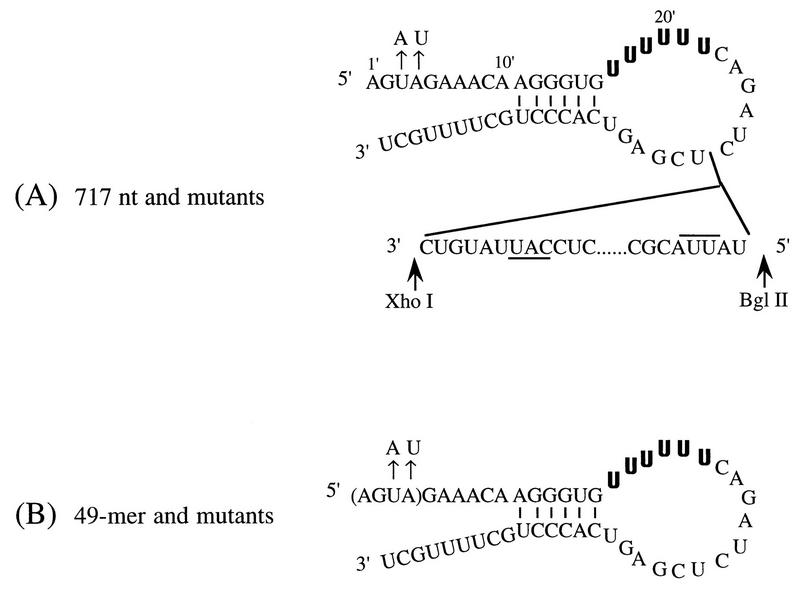
FIG. 1
FIG. 1
RNA templates used in in vitro influenza virus transcription reactions. Vertical lines indicate the proposed base-paired region in the RNA fork model (3, 4). The U6 track, the proposed poly(A) site, is in bold. Nucleotides are numbered as primed numbers (3), starting from the 5′ end. The point mutations at positions 3′ and 4′ are indicated above those positions. (A) Sequence of 717-nt template. The sites for XhoI and BglII in plasmid pBXPCAT1 are indicated by arrows. The complements of the initiation and termination codons of the CAT gene are underlined and overlined, respectively. (B) Sequence of 49-mer template. The four residues in parentheses were absent in the deletion mutant.
FIG. 2
FIG. 2
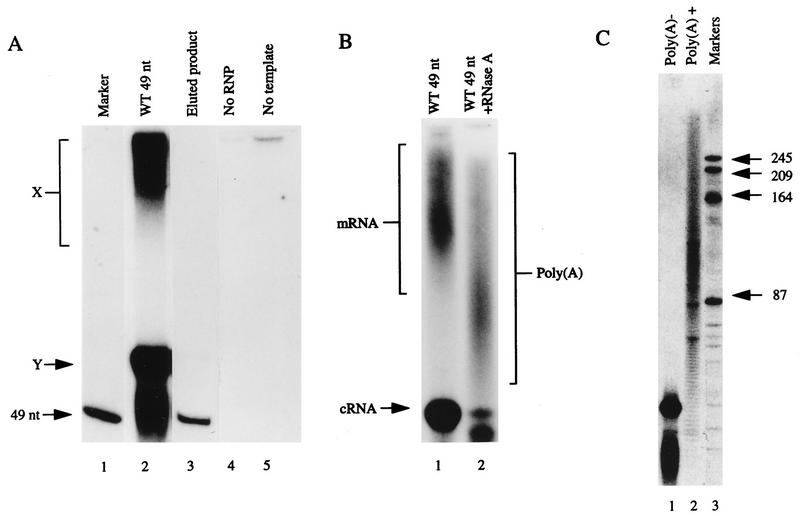
Development of the [α-32P]ATP incorporation assay with the 49-mer template. (A) Autoradiograph of 16% polyacrylamide–7 M urea gel. Lane 1, 49-nt vRNA marker; lane 2, complete reaction (see Materials and Methods), showing high-molecular-weight products (X) and low-molecular-weight cRNA products, with one near the 49-nt vRNA marker and the other nearby (Y); lane 3, rerun product Y (eluted product); lanes 4 and 5, transcription in the absence of RNP and template, respectively. The weak signal at the origin in lane 5 is thought to be due to transcription of residual endogenous RNP and/or nonspecific binding of radiolabel. WT, wild type. (B) Polyacrylamide gel electrophoresis analysis as described for panel A, showing products of transcription before (lane 1) and after (+; lane 2) RNase A digestion. The mRNA, cRNA, and poly(A) products are indicated. A trace of the cRNA product and a partial digestion product are seen at the bottom of lane 2, and most of the poly(A) signal remains. (C) Analysis on a 10% polyacrylamide–7 M urea gel of unbound (poly(A) [lane 1]) and bound (poly(A)+ [lane 2]) RNA isolated by oligo(dT)-cellulose separation; lane 3, RNA markers (in nucleotides).
FIG. 3
FIG. 3
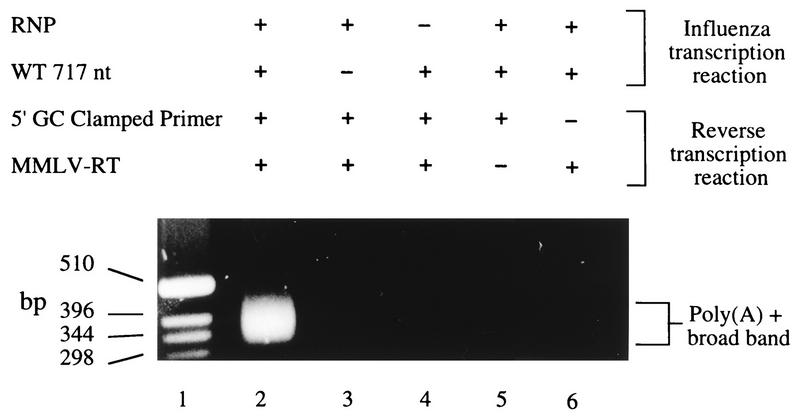
Development of the RT-PCR assay with a 5′-GC-clamped T20 primer and a 717-nt vRNA template. Lane 1, DNA markers; lane 2, complete reaction, showing a broad poly(A)+ band (see Materials and Methods); lanes 3 through 6, reactions without (−) template, RNP, Moloney murine leukemia virus RT, and 5′-GC-clamped T20 primer, respectively. WT 717 nt, wild-type influenza virus-like 717-nt vRNA.
FIG. 4
FIG. 4
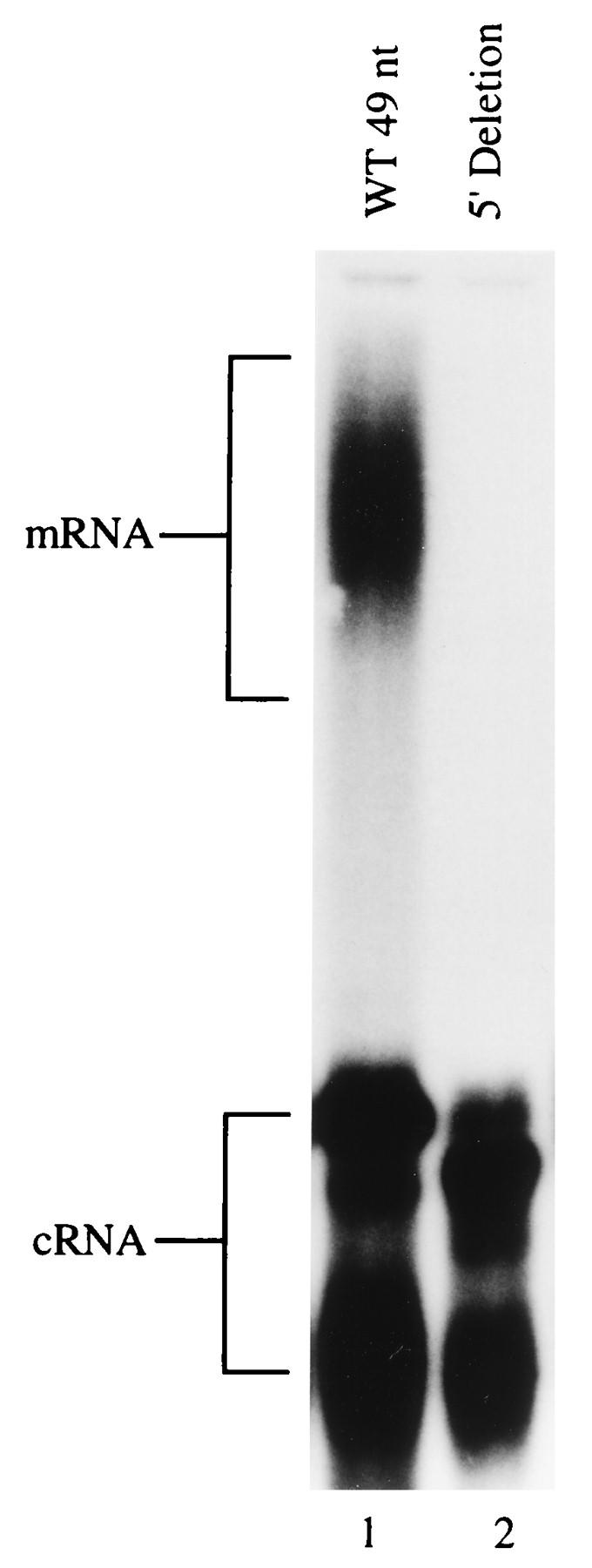
Effect of deleting the first 4 residues of the 5′ strand on polyadenylation activity. The [α-32P]ATP incorporation assay was used to examine transcription products from the wild-type (WT) 49-mer vRNA template (lane 1) and the 5′ deletion mutant (lane 2).
FIG. 5
FIG. 5
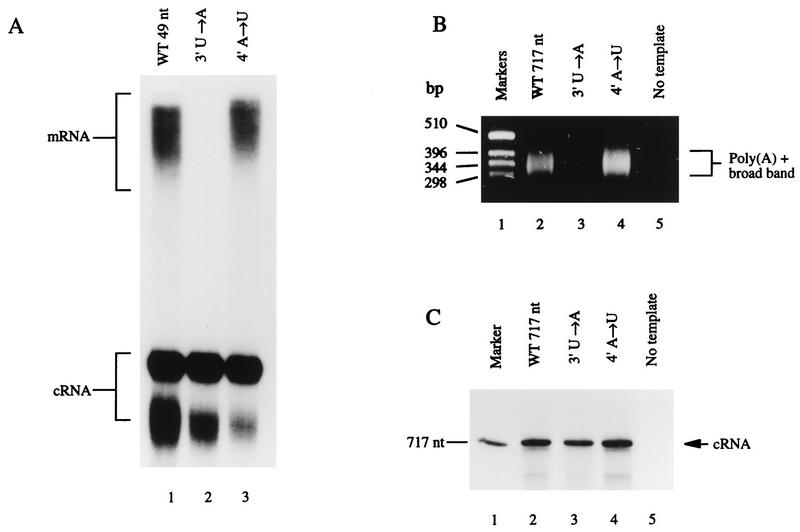
Effect of point mutations at positions 3′ and 4′ in the 5′ strand of the RNA fork on polyadenylation activity. (A) [α-32P]ATP incorporation assay of the wild-type (WT) 49-mer vRNA (lane 1) and point mutants (lanes 2 and 3). (B) RT-PCR assay with the 5′-GC-clamped T20 primer and 717-nt vRNA. Lane 1, DNA markers; lane 2, wild-type (WT) 717-nt vRNA; lanes 3 and 4, point mutants; lane 5, no template. (C) In vitro transcription reactions of wild-type (WT) 717-nt vRNA and point mutants examined by [α-32P]CTP assay for cRNA. Lane 1, 717-nt RNA marker; lane 2, WT 717-nt vRNA; lanes 3 and 4, point mutants; lane 5, no template.

References

    1. Cianci C, Tiley L, Krystal M. Differential activation of the influenza virus polymerase via template RNA binding. J Virol. 1995;69:3995–3999. - PMC - PubMed
    1. Desselberger U, Racaniello V R, Zazra J J, Palese P. The 3′ and 5′ terminal sequences of influenza A, B and C virus RNA segments are highly conserved and show partial inverted complementarity. Gene. 1980;8:315–328. - PubMed
    1. Fodor E, Pritlove D C, Brownlee G G. The influenza virus panhandle is involved in the initiation of transcription. J Virol. 1994;68:4092–4096. - PMC - PubMed
    1. Fodor E, Pritlove D C, Brownlee G G. Characterization of the RNA-fork model of the virion RNA in the initiation of transcription in influenza A virus. J Virol. 1995;69:4012–4019. - PMC - PubMed
    1. Hagen M, Chung T D Y, Butcher J A, Krystal M. Recombinant influenza virus polymerase: requirement of both 5′ and 3′ viral ends for endonuclease activity. J Virol. 1994;68:1509–1515. - PMC - PubMed

Publication types

LinkOut - more resources