. 1998 Feb;72(2):1324-33.
doi: 10.1128/JVI.72.2.1324-1333.1998.

The application of a homologous recombination assay revealed amino acid residues in an LTR-retrotransposon that were critical for integration

Affiliations

The application of a homologous recombination assay revealed amino acid residues in an LTR-retrotransposon that were critical for integration

A Atwood et al. J Virol. 1998 Feb.

Abstract

Retroviruses and their relatives, the LTR-retrotransposons, possess an integrase protein (IN) that is required for the insertion of reverse transcripts into the genome of host cells. Schizosaccharomyces pombe is the host of Tf1, an LTR-retrotransposon with integration activity that can be studied by using techniques of yeast genetics. In this study, we sought to identify amino acid substitutions in Tf1 that specifically affected the integration step of transposition. In addition to seeking amino acid substitutions in IN, we also explored the possibility that other Tf1 proteins contributed to integration. By comparing the results of genetic assays that monitored both transposition and reverse transcription, we were able to seek point mutations throughout Tf1 that blocked transposition but not the synthesis of reverse transcripts. These mutant versions of Tf1 were candidates of elements that possessed defects in the integration step of transposition. Five mutations in Tf1 that resulted in low levels of integration were found to be located in the IN protein: two substitutions in the N-terminal Zn domain, two in the catalytic core, and one in the C-terminal domain. These results suggested that each of the three IN domains was required for Tf1 transposition. The potential role of these five amino acid residues in the function of IN is discussed. Two of the mutations that reduced integration mapped to the RNase H (RH) domain of Tf1 reverse transcriptase. The Tf1 elements with the RH mutations produced high levels of reverse transcripts, as determined by recombination and DNA blot analysis. These results indicated that the RH of Tf1 possesses a function critical for transposition that is independent of the accumulation of reverse transcripts.


Figures
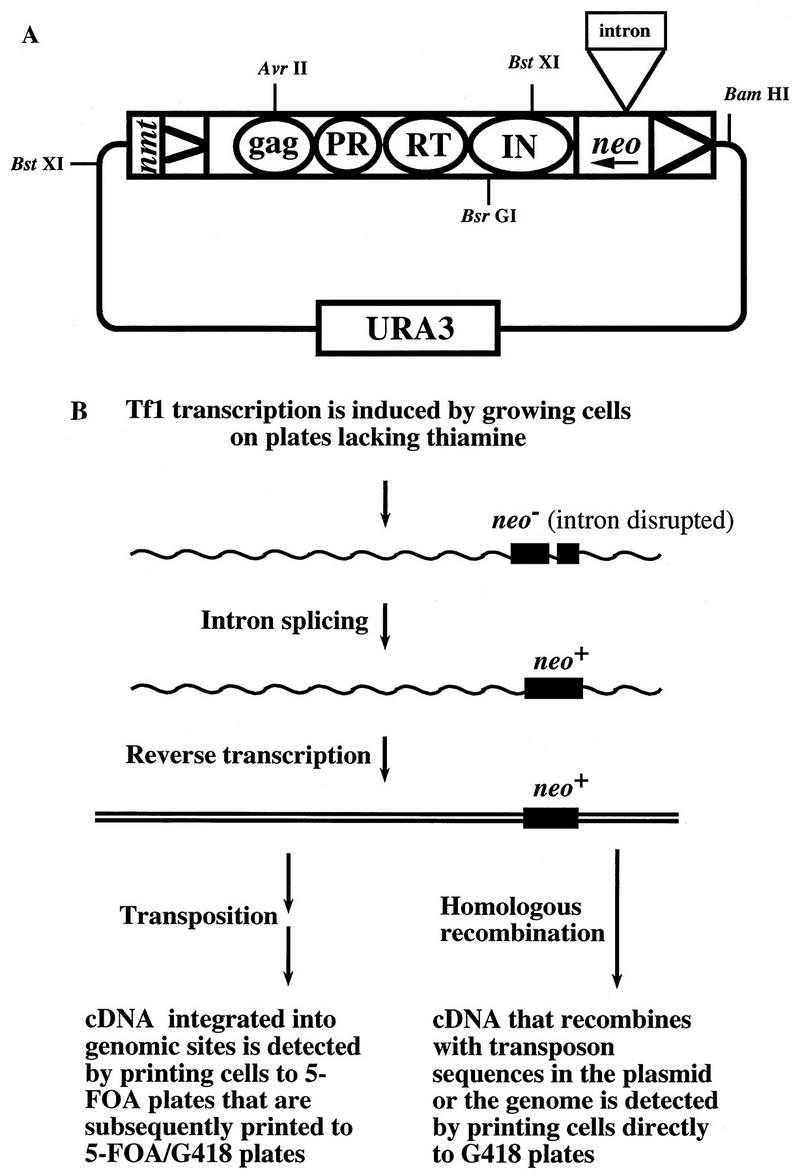
FIG. 1
FIG. 1
Genetic assays for measuring transposition and homologous recombination of Tf1. (A) Plasmid pHL449-1 was transformed into S. pombe cells and served as the source of Tf1 mRNA and protein for the transposition and recombination assays. The LTR sequences are represented by triangles, the Gag, PR, RT, and IN coding sequences are indicated by circles, and the neo, URA3, and intron positions are marked by rectangles. The arrow indicates that neo transcription proceeds in the opposite direction from Tf1 transcription. The position of the nmt1 promoter is indicated by nmt. The BstXI restriction sites were used for the DNA blot analysis of cDNA production, and the positions of restriction sites used to subclone mutations are shown. (B) Role of the artificial intron in the homologous recombination assay. The neo gene disrupted by the artificial intron is depicted by two adjacent rectangles. The wavy lines represent the Tf1 mRNA, and the double straight lines are the double-stranded cDNA. After splicing and reverse transcription, the neo gene was functional and was used to detect either the integration of the cDNA into genomic sequences or the homologous recombination of the cDNA with other sources of transposon sequences. The diagram also indicates that the differences in the protocols for these two assays were the agar media that the cells were grown on after Tf1 transcription was induced.
FIG. 2
FIG. 2
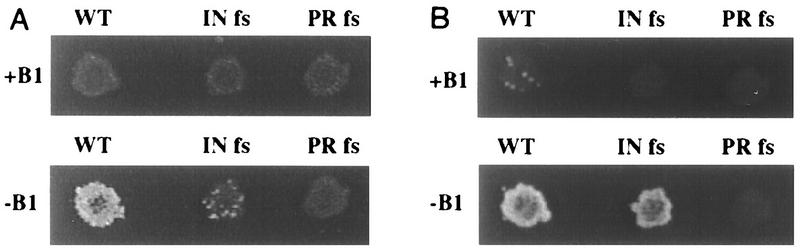
Transposition and recombination activities of wild-type Tf1 and of two versions with frameshift mutations. (A) Results of transposition assays of S. pombe strains that were either induced for Tf1 transcription (bottom) or repressed (top). The three strains tested contained versions of Tf1 that were either wild type (WT) or contained a frameshift (fs) mutation in IN or PR. The cells were first induced for transcription on medium that lacked vitamin B1 (B1). The induced cells were printed to plates that contained FOA to select against the presence of the Tf1-neoAI plasmid. The FOA-resistant cells were then replica printed onto plates that contained FOA and G418 to measure the frequency of transposition. (B) Results of recombination assays of S. pombe strains that were either induced for Tf1 transcription (bottom) or repressed (top). The cells were treated as described in the transposition assay except that after growth on medium lacking vitamin B1, the cells were replica printed directly onto medium containing G418.
FIG. 3
FIG. 3
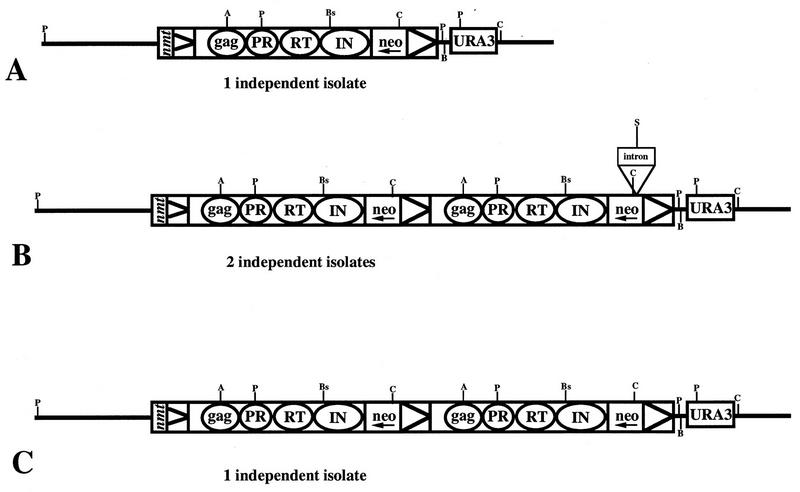
Rearranged versions of the Tf1-neoAI plasmid with the IN frameshift were selected during the recombination assay. The LTR sequences are represented by triangles, the Gag, PR, RT, and IN coding sequences are indicated by circles, and the neo, URA3, and intron positions are marked by rectangles. The arrow indicates that neo transcription proceeds in the opposite direction from Tf1 transcription. The position of the nmt1 promoter is indicated by nmt. Positions of the restriction sites that were used to reveal the structure of these plasmids are shown. Enzymes used: A, AvrII; P, PstI; Bs, BsrGI; C, ClaI; S, SpeI; B, BamHI. (A) One plasmid isolated from a G418r strain of S. pombe was identical to the parent except that the intron was absent. (B) Two other plasmids isolated from G418r strains of S. pombe were identical and contained tandem duplications of the transposon. The downstream copies of the neo genes contained introns, while the upstream copies lacked introns. (C) Another plasmid isolated from a G418r strain of S. pombe contained a tandem duplication of Tf1. Neither copy of neo in this plasmid contained intron sequence.
FIG. 4
FIG. 4
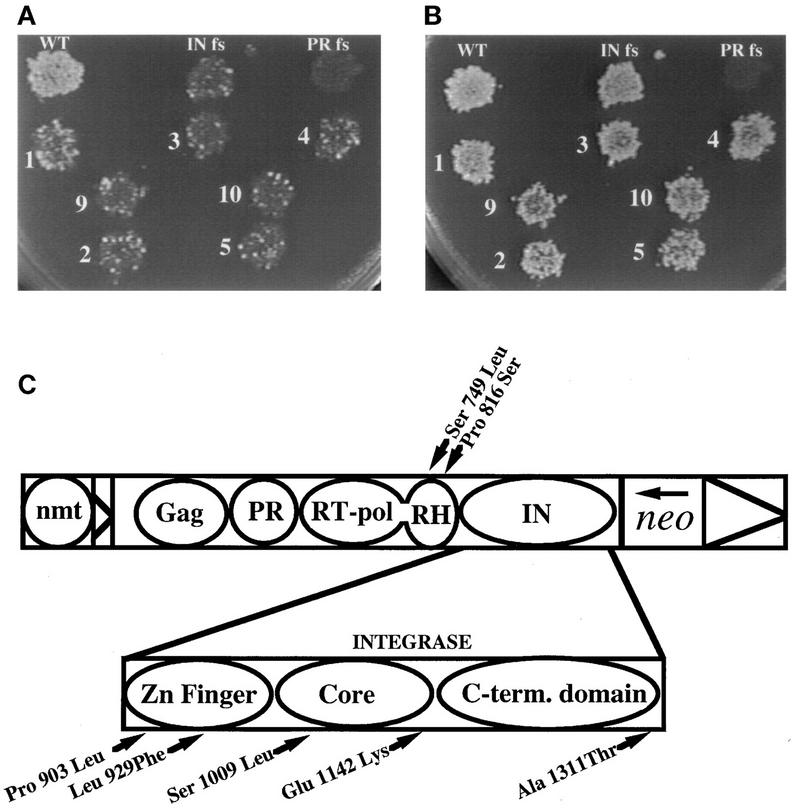
Transposition and recombination activities of seven mutated versions of Tf1. (A) Seven versions of Tf1 with mutations and three control strains were measured for transposition activity. The plate contained FOA plus G418 so that the level of growth represented the transposition activity of each strain. Each patch of cells is labeled with its mutation number or the nature of the control plasmid that it contained. fs, frameshift. (B) The same strains were also tested for homologous recombination activity. The plate shown contained G418, and the level of growth represented the level of cDNA recombination produced by each strain.
FIG. 5
FIG. 5
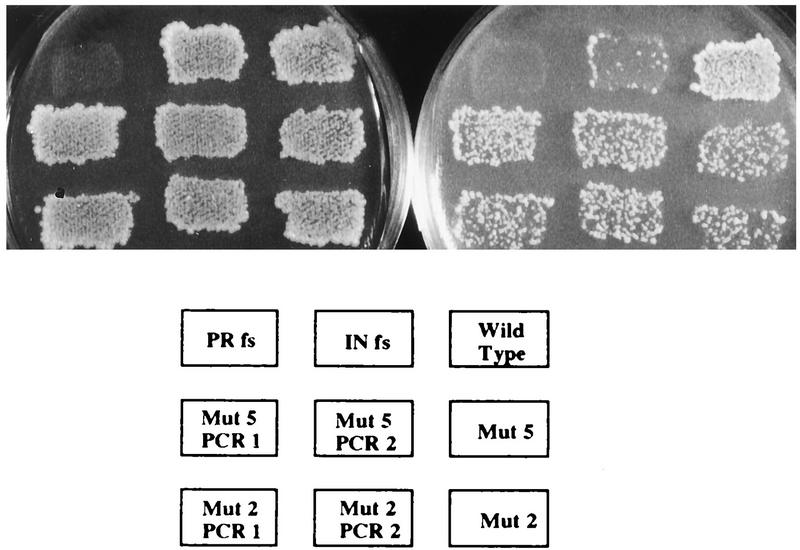
Transposition and recombination activities of the Tf1 elements with the original substitutions in RH, mutations (Mut) 2 and 5, and activities of equivalent elements reconstructed by PCR. The strains on each plate are identified by the template shown below the photograph. The plate on the left contained G418 and shows the results of the recombination assay; the plate on the right contained FOA plus G418 and shows the results of the transposition assay. fs, frameshift.
FIG. 6
FIG. 6
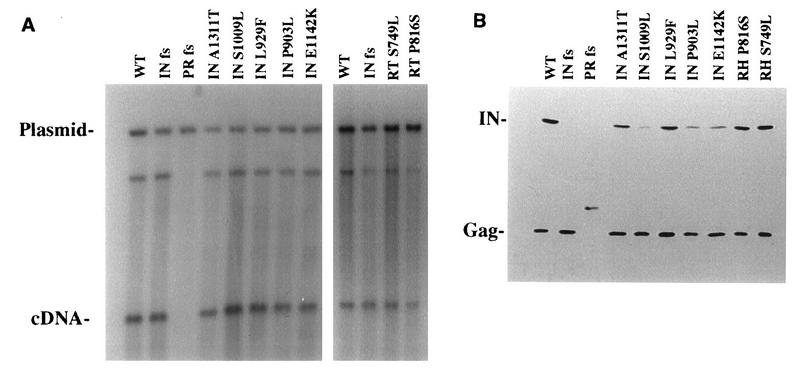
Effects of mutations in Tf1 on the accumulation of IN protein and cDNA were measured. (A) The results of DNA blot analysis were used to detect the effects of mutations in RH and IN on the accumulation of cDNA. Total DNA was extracted from S. pombe strains induced for Tf1 expression. The DNA was digested with BstXI and probed with neo-specific sequence. The 9.5-kb band was produced by vector sequence, and the 2.1-kb band was generated by Tf1 cDNA. The additional band is likely derived from single-LTR circles; however, this identification has not been definitively shown. The panel on the left contained DNA from cells grown in liquid culture, and the panel on the right contained DNA from cells grown on agar plates. WT, wild type. (B) The levels of Tf1 Gag and IN accumulated in strains with the Tf1 mutations were determined by immunoblot analysis. Equal amounts of total protein from each strains was subjected to immunoblot analysis, and the resulting membrane was probed simultaneously with anti-Gag and anti-IN antisera.

References

    1. Atwood A, Lin J, Levin H. The retrotransposon Tf1 assembles virus-like particles with excess Gag relative to integrase because of a regulated degradation process. Mol Cell Biol. 1996;16:338–346. - PMC - PubMed
    1. Atwood, A. Unpublished data.
    1. Boeke J D, Trueheart J, Natsoulis G, Fink G R. 5-Fluoro-orotic acid as a selective agent in yeast molecular genetics. Methods Enzymol. 1987;154:164–175. - PubMed
    1. Brown P O, Bowerman B, Varmus H E, Bishop J M. Correct integration of retroviral DNA in vitro. Cell. 1987;49:347–356. - PubMed
    1. Brown P O, Bowerman B, Varmus H E, Bishop J M. Retroviral integration: structure of the initial covalent product and its precursor, and a role for the viral IN protein. Proc Natl Acad Sci USA. 1989;86:2525–2529. - PMC - PubMed

LinkOut - more resources