


Analysis of damage tolerance pathways in Saccharomyces cerevisiae: a requirement for Rev3 DNA polymerase in translesion synthesis
- PMID: 9447993
- PMCID: PMC108808
- DOI: 10.1128/MCB.18.2.960
Analysis of damage tolerance pathways in Saccharomyces cerevisiae: a requirement for Rev3 DNA polymerase in translesion synthesis
Abstract
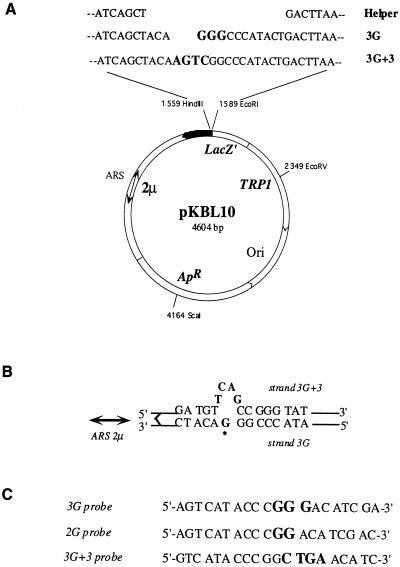
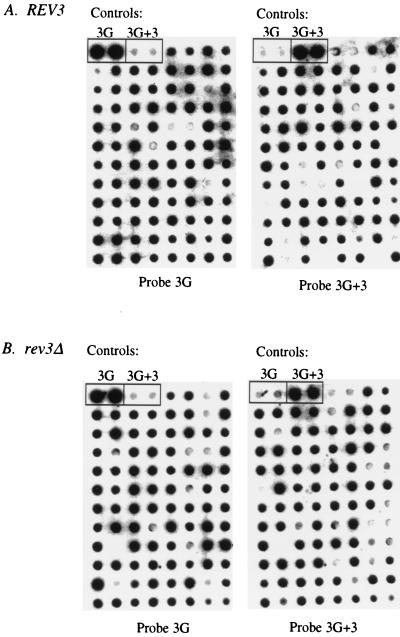
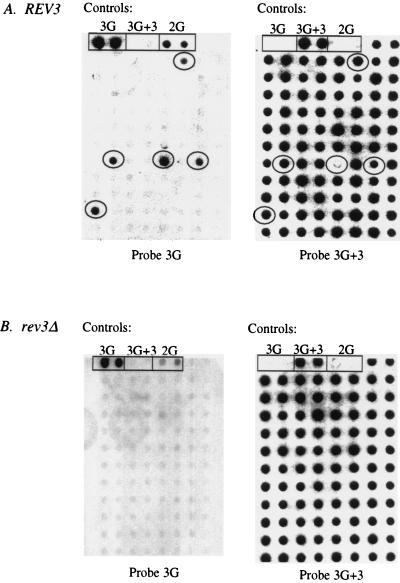
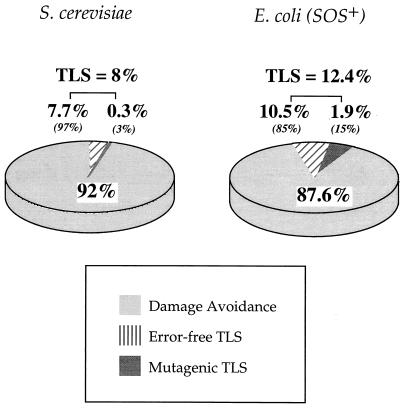
The replication of double-stranded plasmids containing a single N-2-acetylaminofluorene (AAF) adduct located in a short, heteroduplex sequence was analyzed in Saccharomyces cerevisiae. The strains used were proficient or deficient for the activity of DNA polymerase zeta (REV3 and rev3delta, respectively) in a mismatch and nucleotide excision repair-defective background (msh2delta rad10delta). The plasmid design enabled the determination of the frequency with which translesion synthesis (TLS) and mechanisms avoiding the adduct by using the undamaged, complementary strand (damage avoidance mechanisms) are invoked to complete replication. To this end, a hybridization technique was implemented to probe plasmid DNA isolated from individual yeast transformants by using short, 32P-end-labeled oligonucleotides specific to each strand of the heteroduplex. In both the REV3 and rev3delta strains, the two strands of an unmodified heteroduplex plasmid were replicated in approximately 80% of the transformants, with the remaining 20% having possibly undergone prereplicative MSH2-independent mismatch repair. However, in the presence of the AAF adduct, TLS occurred in only 8% of the REV3 transformants, among which 97% was mostly error free and only 3% resulted in a mutation. All TLS observed in the REV3 strain was abolished in the rev3delta mutant, providing for the first time in vivo biochemical evidence of a requirement for the Rev3 protein in TLS.
Figures
References
-
- Bailly V, Lauders S, Prakash S, Prakash L. Yeast DNA repair proteins Rad6 and Rad18 form a heterodimer that has ubiquitin conjugating, DNA binding, and ATP hydrolytic activities. J Biol Chem. 1997;272:23360–23365. - PubMed
-
- Banerjee S K, Borden A, Christensen R B, LeClerc J E, Lawrence C W. SOS-dependent replication past a single trans-syn T-T cyclobutane dimer gives a different mutation spectrum and increased error rate compared with replication past this lesion in uninduced cells. J Bacteriol. 1990;172:2105–2112. - PMC - PubMed
-
- Baynton, K., and A. Bresson-Roy. Unpublished data.
-
- Belguise-Valladier P, Maki H, Sekiguchi M, Fuchs R P P. Effect of single DNA lesions on in vitro replication with DNA polymerase III holoenzyme. Comparison with other polymerases. J Mol Biol. 1994;236:151–164. - PubMed
Publication types
MeSH terms
Substances
LinkOut - more resources
Full Text Sources
Other Literature Sources
Molecular Biology Databases
Miscellaneous
