Review
. 1998 Feb 3;95(3):876-82.
doi: 10.1073/pnas.95.3.876.

Components of verbal working memory: evidence from neuroimaging

Affiliations
Review

Components of verbal working memory: evidence from neuroimaging

E E Smith et al. Proc Natl Acad Sci U S A. .

Abstract

We review research on the neural bases of verbal working memory, focusing on human neuroimaging studies. We first consider experiments that indicate that verbal working memory is composed of multiple components. One component involves the subvocal rehearsal of phonological information and is neurally implemented by left-hemisphere speech areas, including Broca's area, the premotor area, and the supplementary motor area. Other components of verbal working memory may be devoted to pure storage and to executive processing of the contents of memory. These studies rest on a subtraction logic, in which two tasks are imaged, differing only in that one task presumably has an extra process, and the difference image is taken to reflect that process. We then review studies that show that the previous results can be obtained with experimental methods other than subtraction. We focus on the method of parametric variation, in which a parameter that presumably reflects a single process is varied. In the last section, we consider the distinction between working memory tasks that require only storage of information vs. those that require that the stored items be processed in some way. These experiments provide some support for the hypothesis that, when a task requires processing the contents of working memory, the dorsolateral prefrontal cortex is disproportionately activated.


Figures
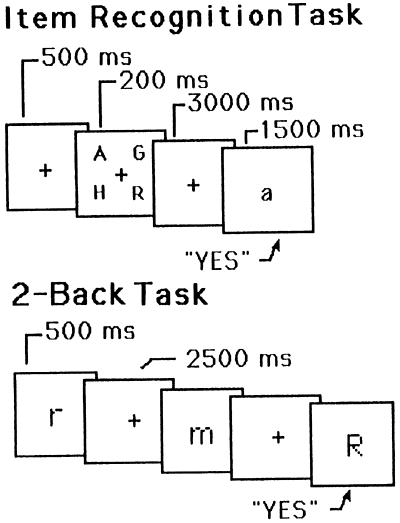
Figure 1
Figure 1
Schematic representations of trials in two different WM tasks. (Upper) A sample trial for the item-recognition task. It includes the following events: (i) fixation point, (ii) four uppercase letters, (iii) blank delay interval, and (iv) a lowercase probe letter. The subject’s task was to decide whether the probe names one of the four target letters. (Lower) A sample trial for the 2-back task. Each letter is followed by a blank delay interval. The subject’s task was to decide whether each letter has the same name as the one that occurred two back in the sequence The durations for each trial event are shown.
Figure 2
Figure 2
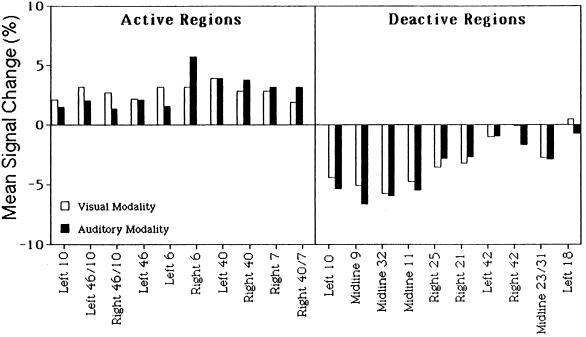
Activation and deactivation in the memory-minus-control subtraction for 10 different regions of interest, separately for visual presentation (empty bars) and auditory presentation (filled bars). The regions of interest were based on activations and deactivations obtained in a previous 3-back verbal WM task. Values are mean changes in activation across spheres of 10-mm radius. Adapted from Schumacher et al. (16).
Figure 3
Figure 3
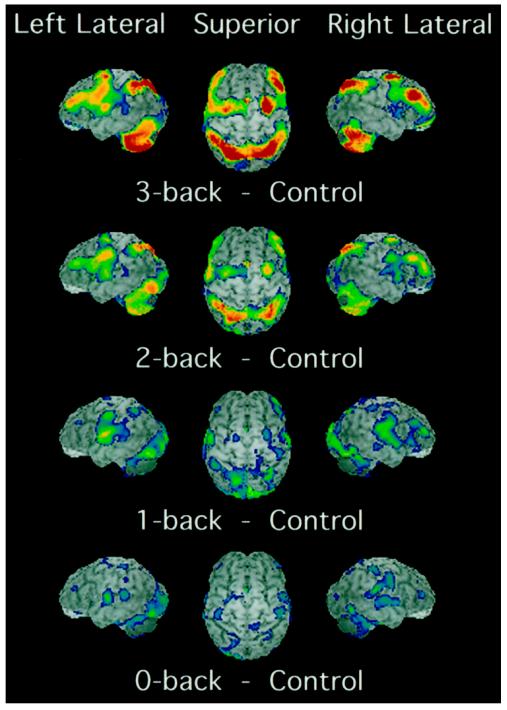
PET activations for the four memory tasks in the 0-, 1-, 2-, 3-back experiment (20). In addition to the memory conditions, the experiment included a baseline condition, in which letters were presented in sequence and subjects pressed a key when a letter appeared. This baseline was subtracted from each memory condition to produce the images displayed. Shown are left and right lateral views as well as a superior view. The PET activations, shown in color, are superimposed on a surface rendering of a brain created from a standard MRI image. The color scale representing activations ranges from blue (lowest) to red (highest). The scale reflects the activation’s significance, with t values ranging from 1.65 to 7.00, with values above 7.00 displayed at the peak red color. Adapted from Smith and Jonides (21).
Figure 4
Figure 4
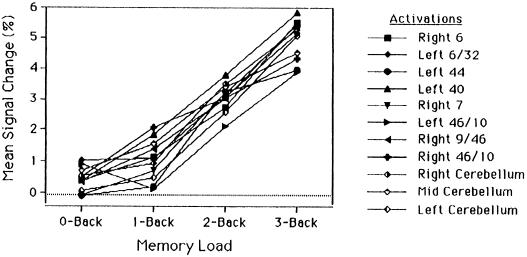
Percentage change in activation in the Jonides et al. (20) 0-, 1-, 2-, 3-back PET study, as a function of memory load, separately for 11 regions of interest. The regions are ones that have been found active in previous studies of verbal WM using back tasks (10, 16). Values are the mean changes in activation across spheres of 5.4-mm radius. Adapted from Jonides et al. (20).
Figure 5
Figure 5
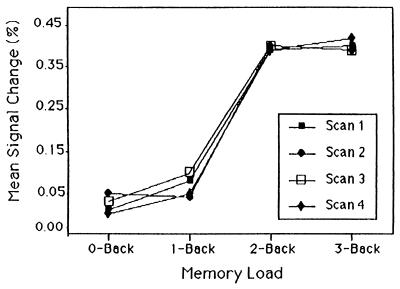
Percentage fMRI signal change in activation in a DLPFC region as a function of WM load, with temporal interval as the parameter. Adapted from Cohen et al. (22).

References

    1. Newell A. Unified Theories of Cognition. Cambridge, MA: Harvard Univ. Press; 1990.
    1. Carpenter P A, Just M A, Shell P. Psychol Rev. 1990;97:404–431. - PubMed
    1. Baddeley A. Proc Natl Acad Sci USA. 1996;93:13468–13472. - PMC - PubMed
    1. Jonides J, Reuter-Lorenz P, Smith E E, Awh E, Barnes L, Drain M, Glass J, Lauber E, Patalano A, Schumacher E H. In: The Psychology of Learning and Motivation. Medin D, editor. New York: Academic; 1996. pp. 43–88.
    1. Posner M I, Peterson S E, Fox P T, Raichle M E. Science. 1988;240:1627–1631. - PubMed

Publication types