


Tissues of MSH2-deficient mice demonstrate hypermutability on exposure to a DNA methylating agent
- PMID: 9448296
- PMCID: PMC18694
- DOI: 10.1073/pnas.95.3.1126
Tissues of MSH2-deficient mice demonstrate hypermutability on exposure to a DNA methylating agent
Abstract
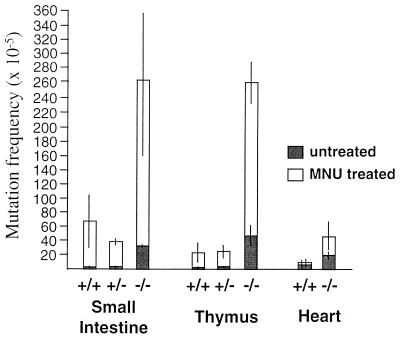
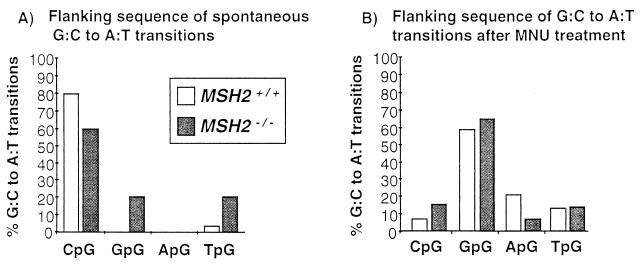
The mutational response of mismatch repair-deficient animals to the alkylating agent N-methyl-N-nitrosourea was evaluated by using a transgenic lacI reporter system. Although the mutations detected in MSH2 heterozygotes were similar to those of controls, MSH2-/- animals demonstrated striking increases in mutation frequency in response to this agent. G:C to A:T transitions at GpG sites, as opposed to CpG sites, dominated the mutational spectrum of both MSH2+/+ and MSH2-/- N-methyl-N-nitrosourea -treated animals. Extrapolating to humans with hereditary non-polyposis colorectal cancer, the results suggest that MSH2 heterozygotes are unlikely to be at increased risk of mutation, even when exposed to potent DNA methylating agents. In contrast, mismatch repair-deficient cells spontaneously arising within individuals with hereditary non-polyposis colorectal cancer would likely exhibit hypermutability in response to such mutagens, an outcome predicted to accelerate the pace of tumorigenesis.
Figures
References
-
- Kolodner R D. Trends Biochem Sci. 1995;20:397–401. - PubMed
-
- Fishel R A, Lescoe M K, Rao M R S, Copeland N G, Jenkins N A, Garber J, Kane M, Kolodner R. Cell. 1993;75:1027–1038. - PubMed
-
- Leach F S, Nicolaides N C, Papadopoulos N, Liu B, Jen J, et al. Cell. 1993;75:1215–1225. - PubMed
-
- Kinzler K W, Vogelstein B. Cell. 1996;87:159–170. - PubMed
-
- Reitmair A H, Schmits R, Ewel A, Bapat B, Redston M, Mitri A, Waterhouse P, Mittrucker H-W, Wakeham A, Liu B, Thomason A, Griesser H, Gallinger S, Ballhausen W G, Fishel R, Mak T W. Nat Genet. 1995;11:64–70. - PubMed
Publication types
MeSH terms
Substances
LinkOut - more resources
Full Text Sources
Other Literature Sources
Miscellaneous
