. 1998 Feb 3;95(3):1189-94.
doi: 10.1073/pnas.95.3.1189.

Inhibition of HPV-16 E6/E7 immortalization of normal keratinocytes by hairpin ribozymes

Affiliations

Inhibition of HPV-16 E6/E7 immortalization of normal keratinocytes by hairpin ribozymes

L M Alvarez-Salas et al. Proc Natl Acad Sci U S A. .

Abstract

HPV-16 E6 and E7 genes are required to efficiently immortalize a broad spectrum of cell types including cervical keratinocytes. Therefore, the E6/E7 genes can be considered relevant targets for anti-cancer therapy. We produced several engineered hairpin (HP) ribozymes to specifically disrupt HPV-16 E6/E7 mRNA. After extensive biochemical characterization, one anti-E6 HP ribozyme (R434) was selected for in vivo testing because of its superior catalytic capabilities. When expressed in cis, R434 efficiently inhibited E6 in vitro translation. Cis-expression of the HP ribozyme with HPV-16 E6/E7 genes in normal human keratinocytes reduced the growth rate and prevented immortalization. RNA analysis by reverse transcription-PCR showed that E6/E7 transcripts were cleaved in post-transfected cells and virtually were eliminated after long term expression. Of interest, an inactive version of the HP also was able to significantly affect the immortalizing ability of E6/E7, probably through passive hybridization. The combination of passive and cleaving antisense RNA therefore is established as an effective inhibitor of HPV-16 E6/E7 immortalization.


Figures
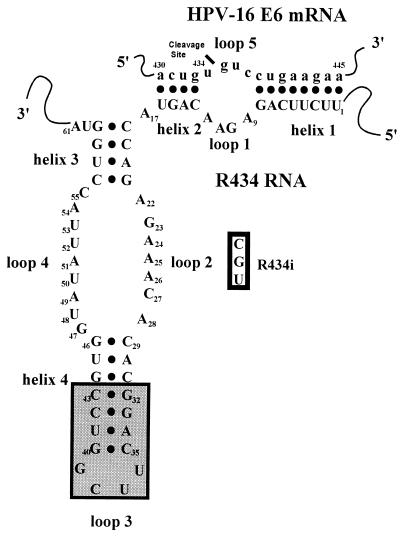
Figure 1
Figure 1
HP ribozyme R434 substrate two-dimensional model. The model contains the standard four helices (helix 1–4) and five loops (loops 1–5) named as originally described for the −sTRSV hairpin ribozyme (44). Ribozyme substrate HPSE62 of the HPV-16 E6 gene is indicated by lowercase letters (a430-a445). The shaded box contains the modifications to R434 helix 4. The open box contains the specific base changes included in the inactive ribozyme R434i (A24-C, A25-G, and A26-U). •, Watson–Crick base pairs. The model is modified from the originally proposed L-shaped configuration (42, 64).
Figure 2
Figure 2
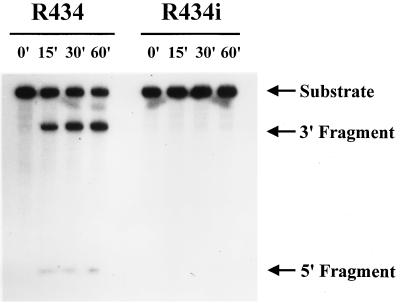
Ribozymes R434 and R434i biochemical analysis. The R434 and R434i ribozymes were produced by in vitro transcription from linear or covalently closed circular DNA templates with the conditions described in Materials and Methods. Ribozymes were incubated with the 32P-labeled HPSE62 substrate in a 1:2 M ratio at 37°C for up to 60 min. The substrate RNA and processed fragments are indicated.
Figure 3
Figure 3
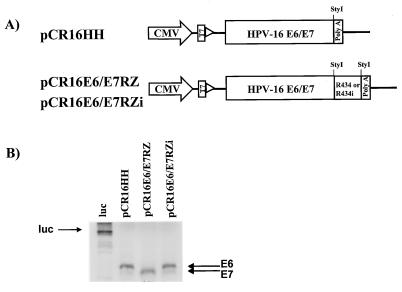
Cis-expression of R434 ribozyme inhibits HPV-16E6/E7 in vitro translation. (A) Map of HPV-16E6/E7 cis-expression constructs with R434 and R434i ribozymes. PCR-amplified fragments containing the entire HPV-16 E6/E7 genes (nucleotides 97–868) linked to R434 (pCR16E6/E7RZ) or R434i (pCR16E6/E7RZi) ribozymes were cloned in the pCR3.1 vector. The pCR16HH plasmid contains only the HPV-16E6/E7 genes. The relative positions of the StyI sites used for cloning the ribozymes and the vector poly(A) signal are shown. (B) The protein products produced by plasmids pCR16HH, pCR16E6/E7RZ, and pCR16E6/E7RZi were examined by in vitro translation reactions using T7 RNA polymerase and rabbit reticulocyte lysates in the presence of [35S]methionine. ←, the position of E6 and E7 proteins. Luc, luciferase protein reaction control.
Figure 4
Figure 4
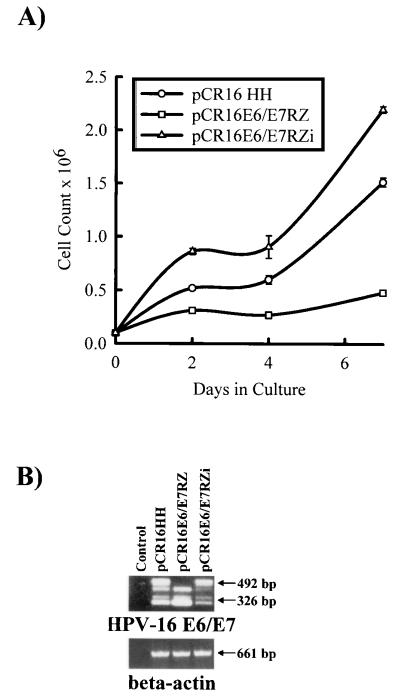
Short term growth inhibition of HPV-16 E6/E7-transfected HKc by cis-expressed R434. (A) HKc were transfected with the pCR16HH, pCR16E6/E7RZ, or pCR16E6/E7RZi constructs and were kept in G418 (200 μg/ml) for 2 wk, and 105 cells were seeded for counting in 6-well dishes. The graphics are the mean of three experiments. (B) RT-PCR analysis of RNA from HKc transfected with HPV-16 E6/E7 (pCR16HH) and cis-expressed active and inactive ribozymes (pCR16E6/E7RZ and pCR16E6/E7RZi, respectively). Total RNA (1 μg) was subjected to a coupled RT-PCR reaction with primers specific to both sides of the ribozyme cleavage site as described in Material and Methods. A contamination control without reverse transcriptase (control) was included. Separate RT-PCR reactions were performed by using the same RNA sample with primers specific to the human β-actin gene to show RNA integrity. The HPV-16 E6/E7-amplified products (492 and 326 bp) were separated through agarose gel electrophoresis and visualized with ethidium bromide staining. The arrows indicate the position and size of the amplified products.
Figure 5
Figure 5
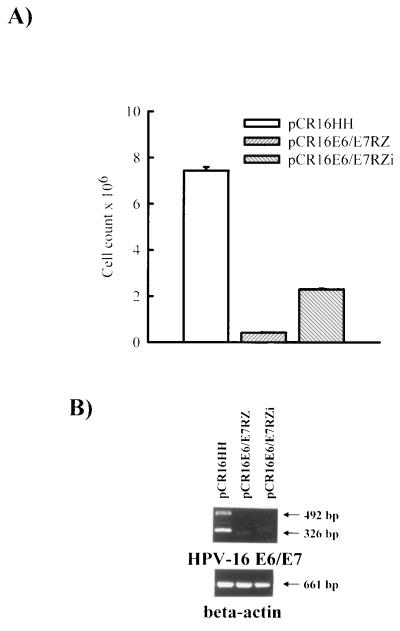
Cis-expression of R434 ribozyme inhibits immortalization by HPV-16 E6/E7 mRNA in vivo. (A) HKc were transfected with the pCR16HH, pCR16E6/E7RZ, or pCR16E6/E7RZi constructs and selected with G418 (200 μg/ml) for 4 days. Transfected cells were counted after 8 wk of continuous growth. The results are the mean of three experiments. (B) Total RNA was isolated from transfected HKc 8 wk after transfection, and coupled RT-PCR reactions for HPV-16 E6/E7 and β-actin genes were performed as described in the legend of Fig. 4B.

References

    1. DiPaolo J A, Popescu N C, Alvarez L, Woodworth C D. Crit Rev Oncog. 1993;4:337–360. - PubMed
    1. Zur Hausen H, de Villiers E M. Annu Rev Microbiol. 1994;48:427–447. - PubMed
    1. Schiffman M H. J Natl Cancer Inst. 1995;87:1345–1347. - PubMed
    1. Hawley-Nelson P, Vousden K H, Hubbert N L, Lowy D R, Schiller J T. EMBO J. 1989;8:3905–3910. - PMC - PubMed
    1. Phelps W C, Yee C L, Munger K, Howley P M. Cell. 1988;53:539–547. - PubMed

MeSH terms