


Susceptibility and serologic response of healthy adults to reinfection with Cryptosporidium parvum
- PMID: 9453592
- PMCID: PMC107924
- DOI: 10.1128/IAI.66.2.441-443.1998
Susceptibility and serologic response of healthy adults to reinfection with Cryptosporidium parvum
Abstract
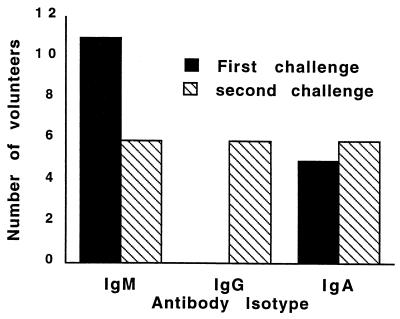
Healthy adults are susceptible to infection with small numbers of Cryptosporidium parvum oocysts, resulting in self-limited infection. We investigated if infection of humans with C. parvum is protective 1 year after primary exposure. At 1 year after a primary challenge with 30 to 10(6) oocysts, 19 healthy immunocompetent adults were rechallenged with 500 oocysts and monitored for the development of infection and/or illness. Oocyst excretion was quantitated by direct immunofluorescence with a C. parvum-specific monoclonal antibody, and anti-C. parvum antibodies in serum were detected by an enzyme-linked immunosorbent assay. Fewer subjects shed oocysts after the second exposure (3 of 19; 16%) than after the first exposure (12 of 19; 63%) (P < 0.005). Although the rates of diarrhea were comparable after each of the two exposures, the clinical severity as determined by the mean number of unformed stools passed was lower after reexposure (11.25 versus 8.62; P < 0.05). The number of anti-Cryptosporidium immunoglobulin G and A seroconversions increased after secondary exposure. However, the C. parvum serum antibody response did not correlate with the presence or absence of infection.
Figures
References
Publication types
MeSH terms
Substances
Grants and funding
LinkOut - more resources
Full Text Sources
Other Literature Sources
Medical
