. 1998 Feb;66(2):760-4.
doi: 10.1128/IAI.66.2.760-764.1998.

Increased resistance to Taenia crassiceps murine cysticercosis in Qa-2 transgenic mice

Affiliations

Increased resistance to Taenia crassiceps murine cysticercosis in Qa-2 transgenic mice

G Fragoso et al. Infect Immun. 1998 Feb.

Abstract

We previously reported important differences in resistance to Taenia crassiceps murine cysticercosis between BALB/c substrains. It was suggested that resistance might correlate with expression of the nonclassic class I major histocompatibility complex (MHC) Qa-2 antigen; BALB/cAnN is Qa-2 negative and highly susceptible to T. crassiceps, whereas BALB/cJ expresses Qa-2 and is highly resistant. In this study, we investigated the role of Qa-2 in mediating resistance to cysticercosis by linkage analysis and infection of Qa-2 transgenic mice. In BALB/cAnN x (C57BL/6J x BALB/cAnN)F1 and BALB/cAnN x (BALB/cJ x BALB/cAnN)F1 backcrosses, the expression of Qa-2 antigen correlated with resistance to cysticercosis. Significantly fewer parasites were recovered from infected Qa-2 transgenic male and female mice than from nontransgenic mice of similar genetic background. These results clearly demonstrate that the Qa-2 MHC antigen is involved in resistance to T. crassiceps cysticercosis.


Figures
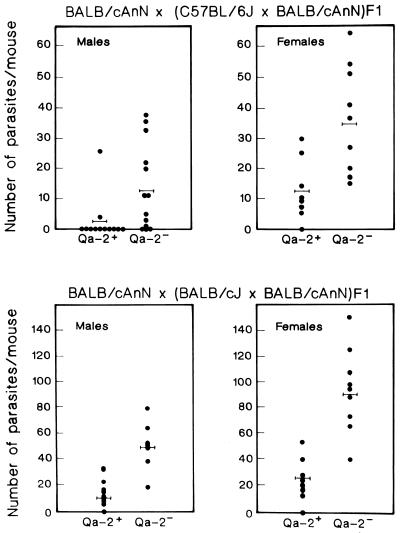
FIG. 1
FIG. 1
Association between Qa-2 expression and resistance to T. crassiceps cysticercosis in BALB/cAnN × (C57BL/6J × BALB/cAnN)F1 and BALB/cAnN × (BALB/cJ × BALB/cAnN)F1 backcross male and female mice. Mice were classified according to the expression of Qa-2 protein as determined by flow cytometric analysis. Each point corresponds to the individual number of parasites recovered from each mouse 30 days after intraperitoneal infection with 10 T. crassiceps cysticerci. The bars represent mean parasite numbers for each experimental group. The numbers of cysticerci found in Qa-2+ mice were statistically lower (P < 0.01) than those found in Qa-2 null mice.
FIG. 2
FIG. 2
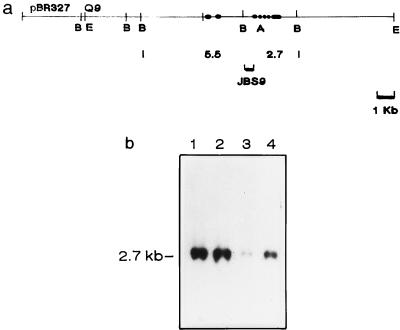
Southern blot analysis of transgenic mice produced by injection of the Q9 gene in (C57BL/6J × BALB/cAnN)F1 embryos. (A) Map of microinjected Q9 gene. Relevant restriction sites: B, BamHI; A, ApaI; E, EcoRI. The JBS9 probe is a 500-bp BamHI-SalI fragment corresponding to a segment of the large intron between exons 3 and 4 (16) which hybridizes with a 2.7-kb BamHI fragment. (B) Genomic DNA isolated from tail biopsies was digested with BamHI and hybridized with the JBS9 probe. Lane 1, DNA from a Q9 transgenic Tg1 male mouse; lane 2, DNA from a Q9 transgenic Tg2 male mouse; lane 3, DNA from a nontransgenic littermate mouse; lane 4, DNA from a C57BL6/J mouse.
FIG. 3
FIG. 3
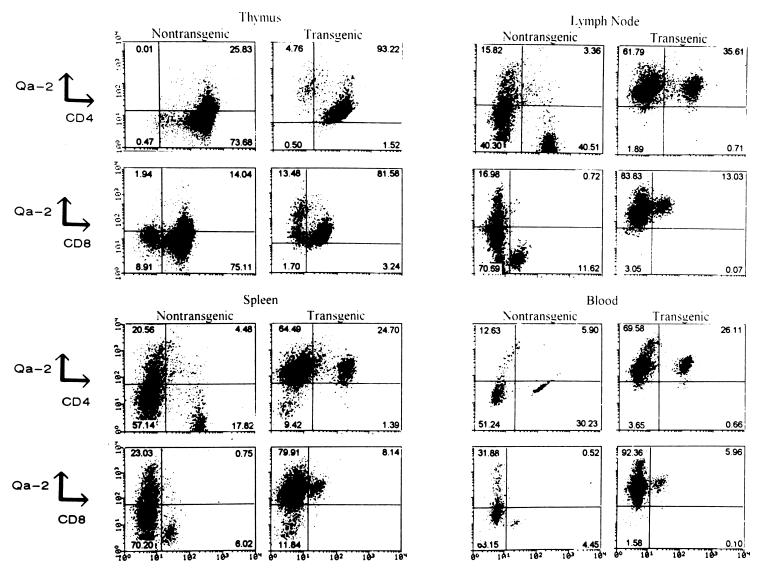
Two-color FACS analysis of thymus, spleen, lymph nodes, and blood cells from transgenic and nontransgenic mice. Cells were stained with monoclonal antibodies for Qa-2, CD4, and CD8 to identify the expression of Qa-2 protein in both T-cell types. The percentage of cells in each quadrant is indicated. Equal numbers of events are plotted for each staining.
FIG. 4
FIG. 4
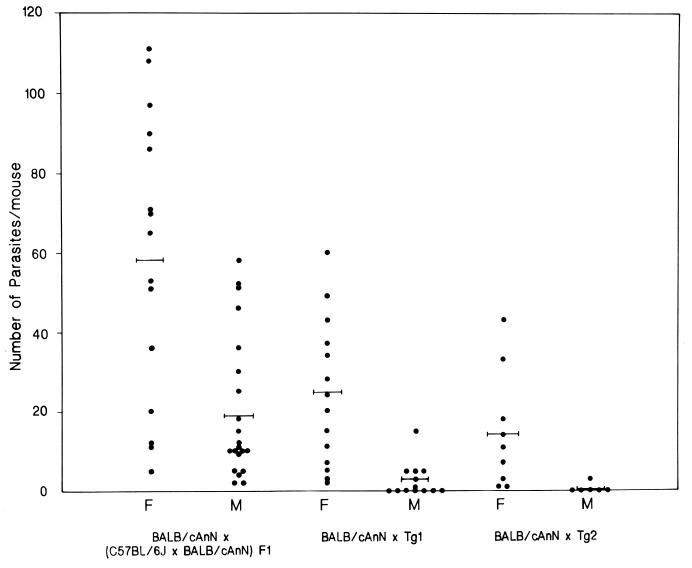
Individual numbers of parasites recovered from Qa-2 transgenic and nontransgenic mice. Cysticerci in the peritoneal cavity were counted 30 days after infection. Tg1 and Tg2 transgenic founder mice were (C57BL/6J × BALB/cAnN)F1 males. Both female (F) and male (M) progeny from transgenic and nontransgenic (C57BL/6J × BALB/cAnN)F1 male mice backcrossed to BALB/cAnN females were infected. The bars represent mean parasite numbers for each experimental group. The numbers of cysticerci found in Tg1- and Tg2-derived mice were statistically lower (P < 0.01) than those in nontransgenic mice.

References

    1. Aluja A. Frequency of porcine cysticercosis in Mexico. In: Flisser A, Willms K, Laclette J P, Larralde C, Ridaura C, Beltrán F, editors. Cysticercosis: present state of knowledge and perspectives. New York, N.Y: Academic Press; 1982. pp. 53–62.
    1. Fragoso G, Lamoyi E, Mellor A, Lomelí C, Govezensky T, Sciutto E. Genetic control of susceptibility to Taenia crassiceps cysticercosis. Parasitology. 1996;112:119–124. - PubMed
    1. Freeman R S. Studies of the biology of Taenia crassiceps (Zeder, 1800) Rudolphi, 1810 (Cestoda) Can J Zool. 1962;40:969–990.
    1. Hogan B, Costantini F, Lacy E. Manipulating the mouse embryo. A laboratory manual. Cold Spring Harbor Laboratory, N.Y: Cold Spring Harbor Laboratory; 1986.
    1. Joyce S, Tabaczewski P, Hogue Angeletti R, Nathenson S G, Stroynowski I. A nonpolymorphic major histocompatibility complex class Ib molecule binds a large array of diverse self-peptides. J Exp Med. 1994;179:579–588. - PMC - PubMed

Publication types

Substances