Heterogeneity of immunoglobulin G response to Helicobacter pylori measured by the unweighted pair group method with averages
- PMID: 9455883
- PMCID: PMC121394
- DOI: 10.1128/CDLI.5.1.70-73.1998
Heterogeneity of immunoglobulin G response to Helicobacter pylori measured by the unweighted pair group method with averages
Abstract
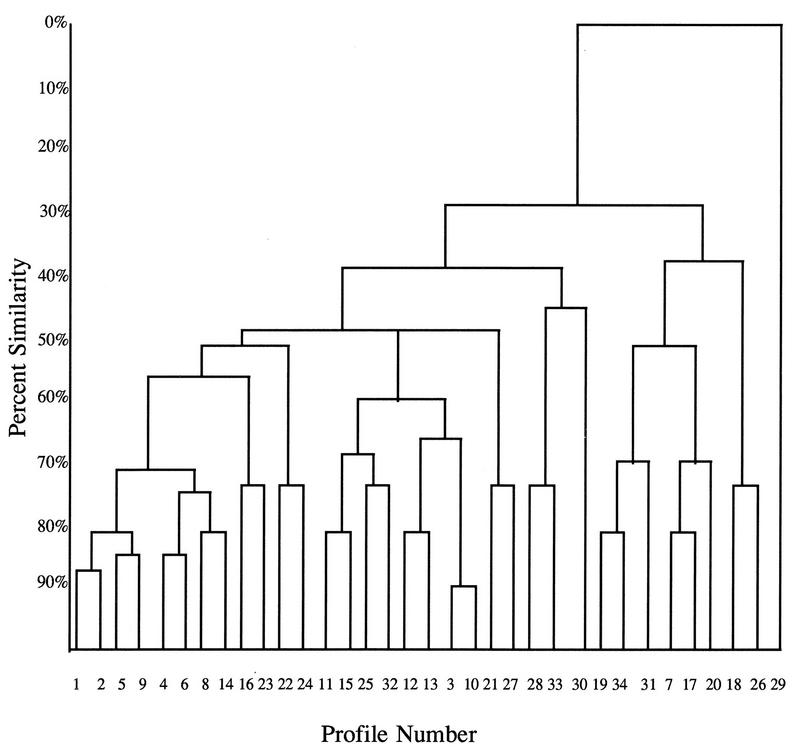
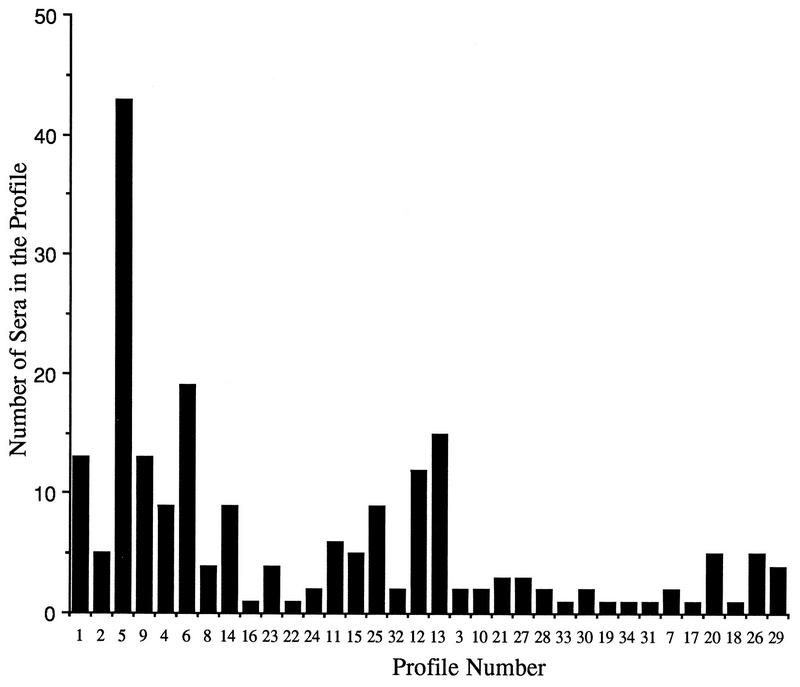
The heterogeneity of the immune response to Helicobacter pylori has always been noticed but has never been evaluated by obtaining a quantitative measure. For this purpose, sera were tested by enzyme-linked immunosorbent assay, and 207 positive serum specimens were subsequently tested by immunoblotting. The presence or absence of six specific bands was noted. The homology of the different profiles of bands was measured by calculating the Dice coefficient, and a dendrogram was constructed. Thirty-four profiles were found, with each profile containing from 1 to 43 serum specimens. At a level of 72% similarity, 115 of the serum specimens studied fell into eight profiles. At a level of 48% similarity, 186 of the serum specimens studied fell into 22 profiles. The difference in immunoblot profiles was probably linked to the host immune response, but infection with strains carrying different antigens cannot be ruled out.
Figures
References
-
- Andersen L P. The antibody response to Helicobacter pylori infection, and the value of serologic tests to detect H. pylori and for post-treatment monitoring. In: Goodwin C S, Worsley B W, editors. Helicobacter pylori: biology and clinical practice. Boca Raton, Fla: CRC Press, Inc.; 1993. pp. 285–305.
-
- Burnette W N. Western blotting: electrophoretic transfer of proteins from sodium dodecyl sulfate-polyacrylamide gels to unmodified nitrocellulose and radiographic detection with antibody and radioiodinated protein. Anal Biochem. 1981;56:480–488. - PubMed
MeSH terms
Substances
LinkOut - more resources
Full Text Sources
Medical