. 1998 Mar 1;18(5):1904-12.
doi: 10.1523/JNEUROSCI.18-05-01904.1998.

Presynaptic nicotinic receptors facilitate monoaminergic transmission

Affiliations

Presynaptic nicotinic receptors facilitate monoaminergic transmission

X Li et al. J Neurosci. .

Abstract

Nicotine is reported to increase arousal and attention and to elevate mood, effects that are most often associated with changes in the function of monoaminergic neuromodulatory systems (Feldman et al., 1997). Recent studies have shown a nicotinic receptor-mediated presynaptic enhancement of fast glutamatergic (McGehee et al., 1995; Gray et al., 1996) and GABAergic (Lena and Changeux, 1997) transmission. However, the mechanism of nicotinic effects on metabotropic-mediated transmission in general, and on monoaminergic transmission in particular, is less well understood. We have examined nicotinic effects on dorsal raphe neurons of rats using whole-cell current and voltage-clamp recording techniques in vitro. In the majority of these neurons, activation of presynaptic nicotinic receptors induced a depolarization mediated by norepinephrine acting on alpha1 receptors. Blockade of this response revealed a hyperpolarization mediated by serotonin acting on 5-HT1A receptors. Because the norepinephrine effect was sensitive to methyllycaconitine (100 nM), it is concluded that nicotinic receptors with an alpha7 subunit can facilitate release of norepinephrine to activate metabotropic receptors. In contrast, methyllycaconitine-insensitive nicotinic receptors can induce 5-HT release in the dorsal raphe nucleus.


Figures
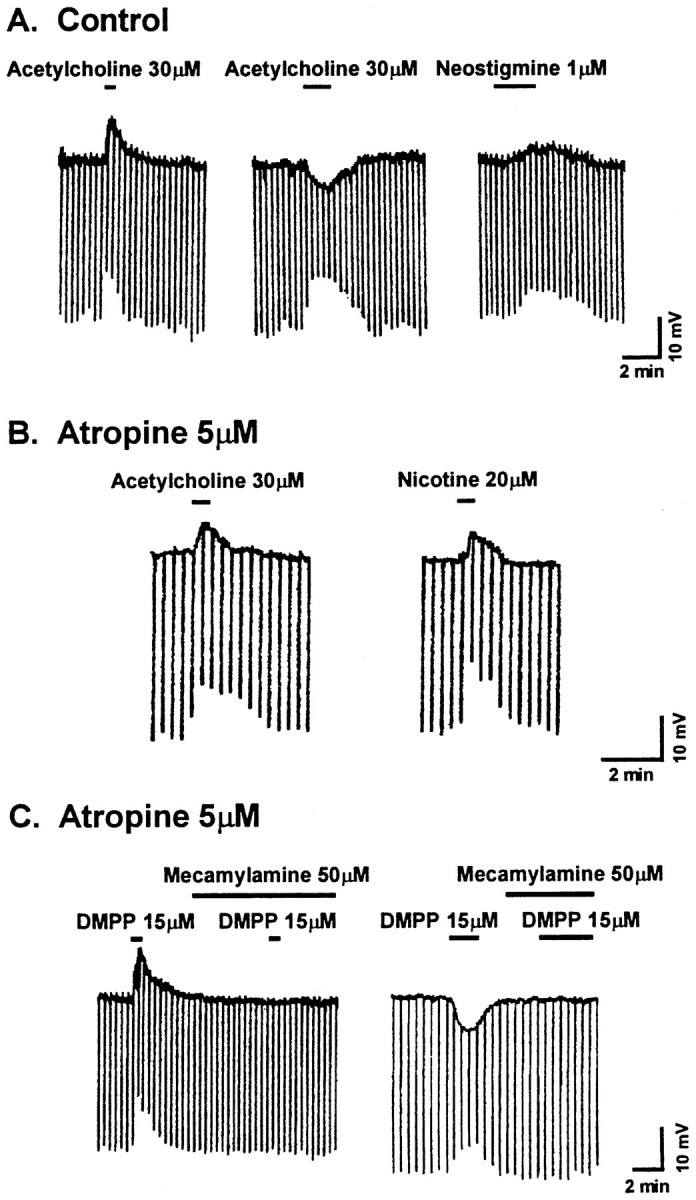
Fig. 1.
Fig. 1.
Acetylcholine activates nicotinic responses in dorsal raphe neurons. A, Three voltagetraces show typical depolarizing and hyperpolarizing membrane potential responses to acetylcholine and a depolarizing response to neostigmine from three different neurons. All responses are associated with a decrease in input resistance, measured with intracellular current injection (600 msec in duration; 50 pA in amplitude; downward deflections in all traces).B, In the presence of the muscarinic antagonist atropine, acetylcholine and nicotine both induce a membrane depolarization, suggesting activation of nicotinic receptors.C, The role of nicotinic receptors in the cholinergic responses is supported further by blockade of both depolarizing and hyperpolarizing responses to the nicotinic agonist DMPP by the nicotinic antagonist mecamylamine in two different neurons in the presence of atropine. The depolarizing response recovers by >50% after a 10 min wash in control medium, and the hyperpolarizing response recovers by >90% after a 6 min wash.
Fig. 2.
Fig. 2.
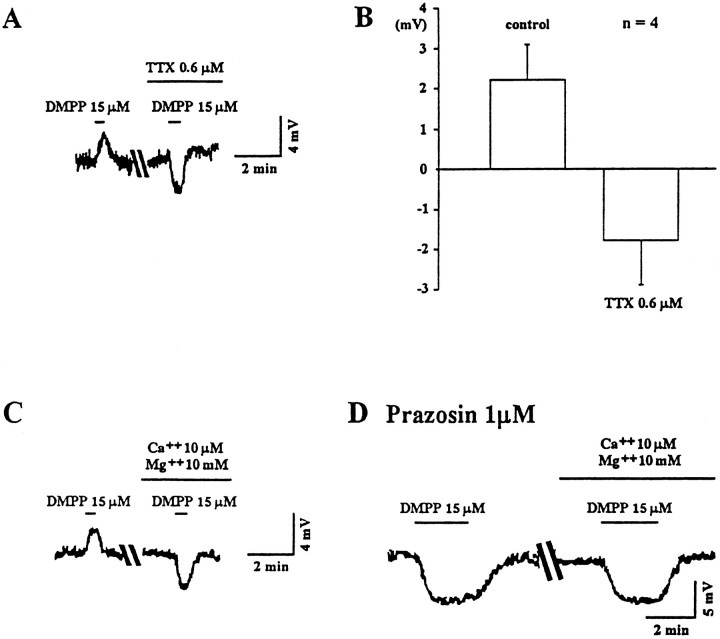
The two nicotinic responses are selectively affected by either TTX or low calcium and high magnesium in the perfusion medium. A, Two voltage tracesfrom the same neuron before and during exposure to TTX show a TTX-dependent blockade of the depolarizing response that reveals a TTX-insensitive hyperpolarizing response to the nicotinic agonist DMPP.B, A histogram of the average of the voltage amplitude of the nicotinic response from the same neurons before (control) and during exposure to TTX demonstrates the reversal of polarity of this response.C, Voltage traces show that the addition of low calcium and high magnesium to the perfusion medium also reverses the polarity of the nicotinic response. D, In the presence of prazosin (1 μm), the nicotinic response is hyperpolarizing, and the hyperpolarization is unaffected by low calcium and high magnesium.
Fig. 3.
Fig. 3.
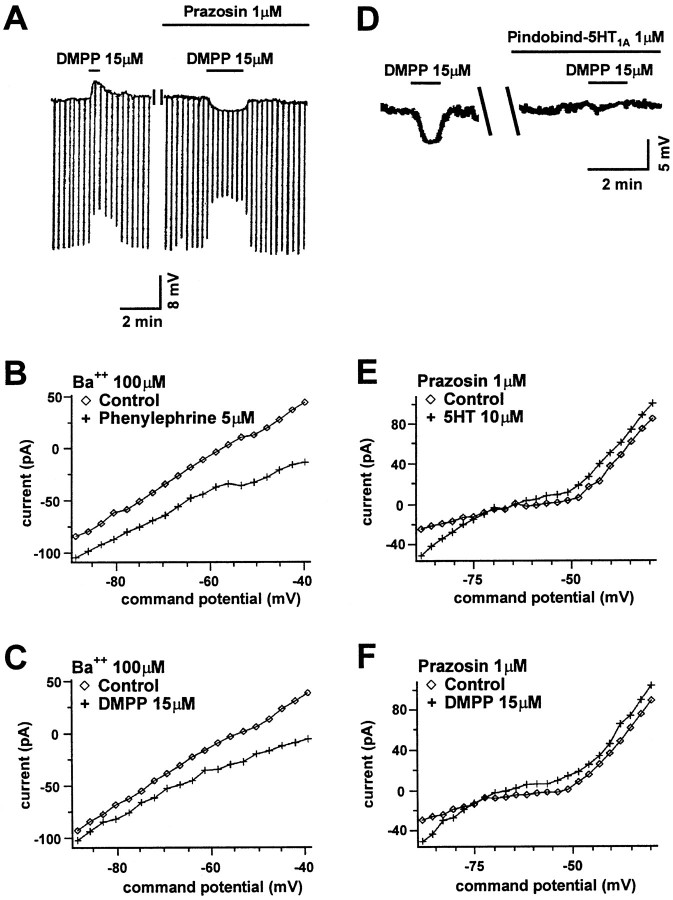
Both pharmacological and electrophysiological evidence suggests that noradrenergic α1 receptors and serotonergic 5-HT1A receptors mediate the nicotinic depolarizing and hyperpolarizing responses, respectively. A, Two voltagetraces illustrate a blockade of the DMPP-induced depolarizing response that reveals a hyperpolarizing response by exposure to the α1 antagonist prazosin added to the bath medium.B, A graph of current versus membrane potential shows the change in the neuronalIV relationship when the α1 agonist phenylephrine is applied to the perfusion medium. C, Agraph similar to that described in B is shown except that DMPP was used in place of phenylephrine to show the similarity of the change induced in theIV curves by these two agonists. (Barium was present in B and C to block the hyperpolarizing response.) D, Two voltagetraces taken during perfusion with prazosin (1 μm) show the DMPP-induced hyperpolarization that is blocked by the 5-HT1A antagonist pindobind-5-HT1A. E, F, Agraph of IV curves shows the effect of 5-HT (E) and can be compared with the IV curves showing the effect of the hyperpolarizing response to DMPP (F). In both cases, the agonists induce an inwardly rectifying current that reverses near the potassium equilibrium potential.
Fig. 4.
Fig. 4.
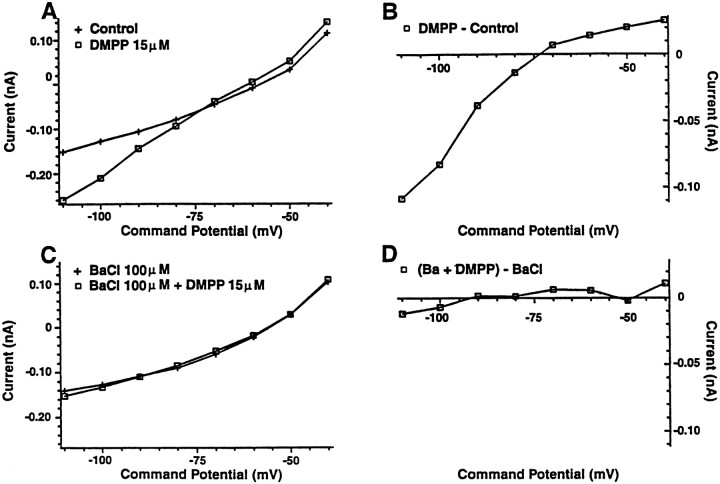
The inwardly rectifying current induced by DMPP is completely blocked by barium (100 μm). A, A graph of the whole-cell current [prazosin (1 μm) was present at all times] versus the membrane potential at which it was measured is shown with two curves. Thecontrol curve was obtained before exposure to DMPP (15 μm), and the curve labeled DMPP was obtained during the exposure. B, The curve shown was calculated by subtraction of the control curve from theDMPP curve to give the current generated by DMPP. An inward rectification of the current similar to that evoked by 5-HT1A agonists is apparent. C,D, The two graphs are similar to those inA and B except that barium (100 μm) was present. The current induced by DMPP was completely blocked.
Fig. 5.
Fig. 5.
Antagonism of the noradrenaline and serotonin transporters prolongs the depolarizing and hyperpolarizing nicotinic responses, respectively. A, Two voltagetraces of the depolarizing DMPP response, in the presence of barium to block the hyperpolarizing response, show a decreased decay rate when the noradrenaline transport inhibitor nisoxetine is added to the perfusion medium. B, In the presence of prazosin to block the DMPP depolarizing response, the decay rate of the hyperpolarizing response is slowed by exposure to the serotonin transport inhibitor fluoxetine.
Fig. 6.
Fig. 6.
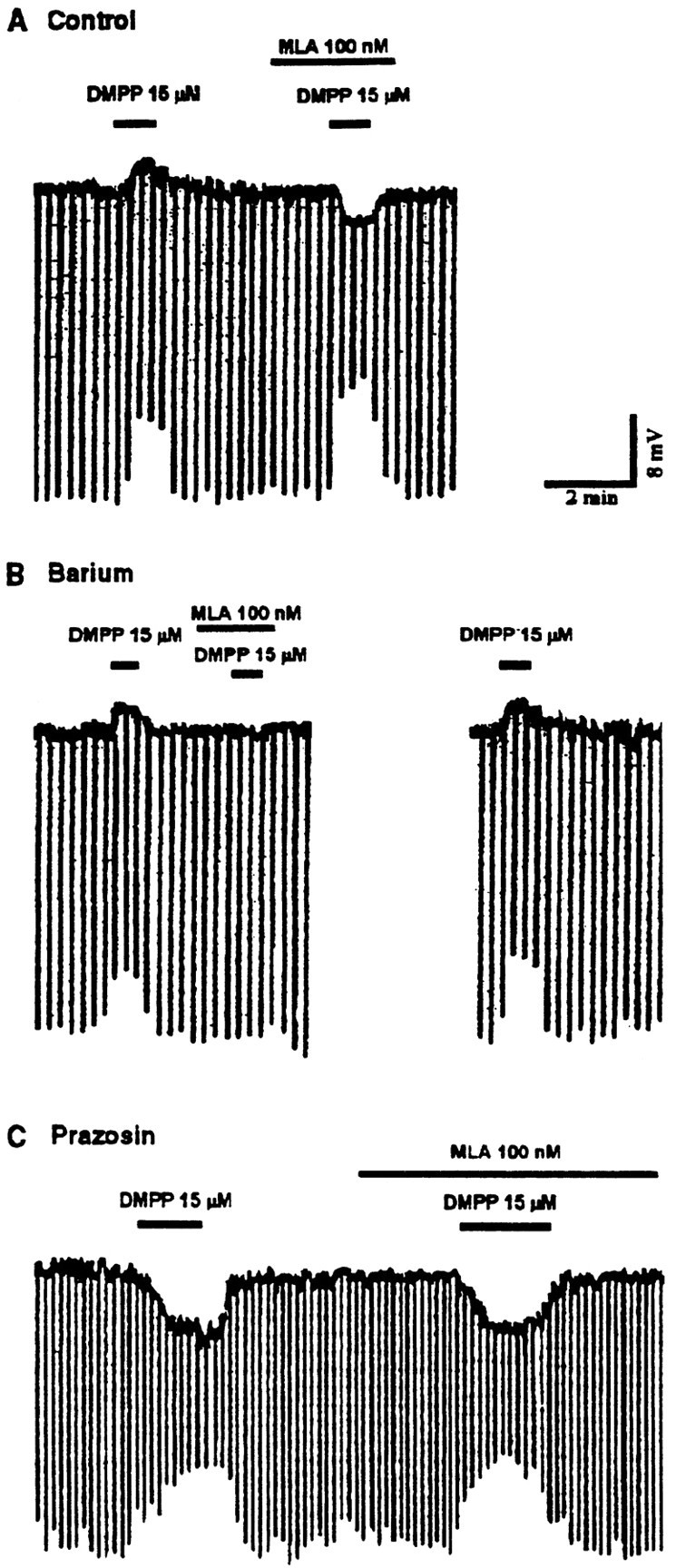
Methyllycaconitine selectively blocks the NE depolarizing response. A, A voltage traceshowing the blockade of the depolarizing response to DMPP by MLA reveals a hyperpolarizing response to DMPP. B, In the presence of barium (100 μm), the hyperpolarizing response to DMPP is blocked, and the depolarizing response can be seen in isolation. Under these conditions, the complete blockade of the response by MLA is confirmed. C, In the presence of prazosin (1 μm), the hyperpolarizing response to DMPP can be seen in isolation. Under these conditions, the response is unaffected by MLA.
Fig. 7.
Fig. 7.
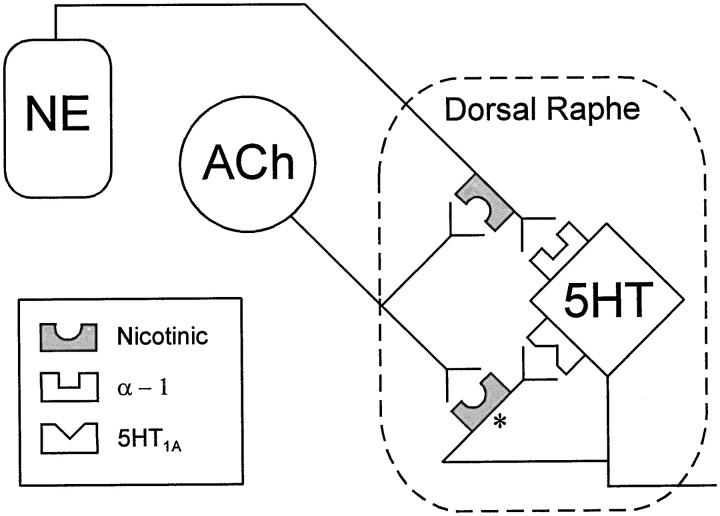
Schematic of postulated mechanism of nicotinic receptor activation in the dorsal raphe nucleus. Cholinergic fibers from the cholinergic neurons of the laterodorsal and pedunculopontine nuclei may activate presynaptic nicotinic receptors located on both noradrenergic neurons from the locus coeruleus and serotonergic dorsal raphe neurons to facilitate release of noradrenaline and serotonin onto dorsal raphe neurons. The release of serotonin (*) may be from either dendritic or axonal sources or both.

References

    1. Aghajanian GK, Haigler HJ, Bloom FE. Lysergic acid diethylamide and serotonin: direct actions on serotonin-containing neurons in rat brains. Life Sci [I] 1972;11:615–622. - PubMed
    1. Aizenman E, Tang L-H, Reynolds IJ. Effects of nicotinic agonists on the NMDA receptor. Brain Res. 1991;551:355–357. - PubMed
    1. Alkondon M, Albuquerque EX. Diversity of nicotinic acetylcholine receptors in rat hippocampal neurons. I. Pharmacological and functional evidence for distinct structural subtypes. J Pharmacol Exp Ther. 1993;265:1455–1473. - PubMed
    1. Alkondon M, Pereira EF, Wonnacott S, Albuquerque EX. Blockade of nicotinic currents in hippocampal neurons defines methyllycaconitine as a potent and specific receptor antagonist. Mol Pharmacol. 1992;41:802–808. - PubMed
    1. Aston-Jones G, Bloom FE. Activity of norepinephrine-containing locus coeruleus neurons in behaving rats anticipates fluctuations in the sleep–waking cycle. J Neurosci. 1981;1:876–886. - PMC - PubMed

Publication types

MeSH terms

LinkOut - more resources