. 1998 Mar 1;18(5):1913-22.
doi: 10.1523/JNEUROSCI.18-05-01913.1998.

Presynaptic GABAB autoreceptor modulation of P/Q-type calcium channels and GABA release in rat suprachiasmatic nucleus neurons

Affiliations

Presynaptic GABAB autoreceptor modulation of P/Q-type calcium channels and GABA release in rat suprachiasmatic nucleus neurons

G Chen et al. J Neurosci. .

Abstract

GABA is the primary transmitter released by neurons of the suprachiasmatic nucleus (SCN), the circadian clock in the brain. Whereas GABAB receptor agonists exert a significant effect on circadian rhythms, the underlying mechanism by which GABAB receptors act in the SCN has remained a mystery. We found no GABAB receptor-mediated effect on slow potassium conductance, membrane potential, or input resistance in SCN neurons in vitro using whole-cell patch-clamp recording. In contrast, the GABAB receptor agonist baclofen (1-100 microM) exerted a large and dose-dependent inhibition (up to 100%) of evoked IPSCs. Baclofen reduced the frequency of spontaneous IPSCs but showed little effect on the frequency or amplitude of miniature IPSCs in the presence of tetrodotoxin. The activation of GABAB receptors did not modulate postsynaptic GABAA receptor responses. The depression of GABA release by GABAB autoreceptors appeared to be mediated primarily through a modulation of presynaptic calcium channels. The baclofen inhibition of both calcium currents and evoked IPSCs was greatly reduced (up to 100%) by the P/Q-type calcium channel blocker agatoxin IVB, suggesting that P/Q-type calcium channels are the major targets involved in the modulation of GABA release. To a lesser degree, N-type calcium channels were also involved. The inhibition of GABA release by baclofen was abolished by a pretreatment with pertussis toxin (PTX), whereas the inhibition of whole-cell calcium currents by baclofen was only partially depressed by PTX, suggesting that G-protein mechanisms involved in GABAB receptor modulation at the soma and axon terminal may not be identical. We conclude that GABAB receptor activation exerts a strong presynaptic inhibition of GABA release in SCN neurons, primarily by modulating P/Q-type calcium channels at axon terminals.


Figures

Fig. 1.
Fig. 1.
Baclofen dose-dependent inhibition of evoked GABA release in a single autaptic SCN neuron. A, Traces showing a dose-dependent inhibition of baclofen on evoked IPSCs.B, Line graph illustrating the time course of baclofen inhibition. C, Histogram showing the dose-dependent inhibition of IPSC amplitude by baclofen. IC50 is between 5 and 10 μm.
Fig. 2.
Fig. 2.
Baclofen inhibition of GABA release is antagonized by 2-hydroxysaclofen. A, Traces show a total elimination of IPSC by 30 μm bicuculline (BIC) and a great reduction of IPSC by 5 μm baclofen. 2-Hydroxysaclofen (SAC) at 500 μm slightly increased IPSCs and largely reduced the baclofen inhibition of IPSC. B, Line graph shows a repeatable inhibition of IPSCs by bicuculline and baclofen and the antagonism of baclofen (BACL) effect by 2-hydroxysaclofen.
Fig. 3.
Fig. 3.
No slow postsynaptic GABAB responses in SCN neurons. A, Evoked autaptic IPSC was totally abolished by 30 μm bicuculline (BIC). Applied together with bicuculline, 2-hydroxysaclofen (SACL, 500 μm) induced no further change.B, In voltage clamp, baclofen (20 μm) greatly reduced spontaneous IPSCs but induced no change in baseline.C, In current-clamp condition, baclofen (20 μm) had no effect on resting membrane potential. Current injection-induced hyperpolarizing potentials were not affected by baclofen, indicating no change in cell membrane conductance after baclofen application.
Fig. 4.
Fig. 4.
GABAB receptors presynaptically modulate GABA release as negative feedback autoreceptors.A, Control trace showing presynaptically evoked IPSC and micropipette GABA application induced postsynaptic response. Thebox illustrates that a brief depolarizing pulse of the recorded single autaptic neuron evoked presynaptic axon release, and that a brief flow pipe GABA application onto the cell induced a postsynaptic response. B, Responses in the presence of baclofen (20 μm). C, Superimposed traces showing a reduction in IPSC by baclofen but little effect on postsynaptic GABA receptor responses. D, Line graph illustrating differential effects of baclofen on presynaptic evoked IPSC and postsynaptic GABA response. E, Bar graph of group data showing specific baclofen inhibition of evoked IPSCs but no inhibition of postsynaptic GABA responses.
Fig. 5.
Fig. 5.
Differential inhibition of baclofen on action potential-dependent large IPSCs and action potential-resistant miniature IPSCs. A1,A2, Consecutive traces (A1) and amplitude distribution histogram (A2) illustrating substantial baclofen inhibition of large-amplitude IPSCs. B1,B2, Consecutive traces (B1) and amplitude distribution histogram (B2) showing little effect of baclofen on the amplitude of mIPSCs in the presence of TTX (no significant difference by Kolmogorov–Smirnov test). Note the different vertical scale bars between A1 and B1.
Fig. 6.
Fig. 6.
Baclofen dose-dependent inhibition of calcium currents. A, Recording traces and line graph showing the abolition of ICa by Cd and strong inhibition of ICa by baclofen (10 μm) in the same neuron. B, Traces and histogram showing dose-dependent inhibition of ICa by baclofen. IC50 is between 1 and 10 μm.
Fig. 7.
Fig. 7.
Baclofen modulation of non-L-, non-N-type calcium currents. A, In the presence of 4 μmnimodipine (blocking L-type ICa) and 2 μm conotoxin GVIA (CgTx, blocking N-typeICa), baclofen (20 μm) inhibited the remaining non-L, non-N ICa.B, Baclofen (20 μm) inhibited IPSCs in the presence of nimodipine or conotoxin GVIA. Nimodipine had no effect on IPSCs.
Fig. 8.
Fig. 8.
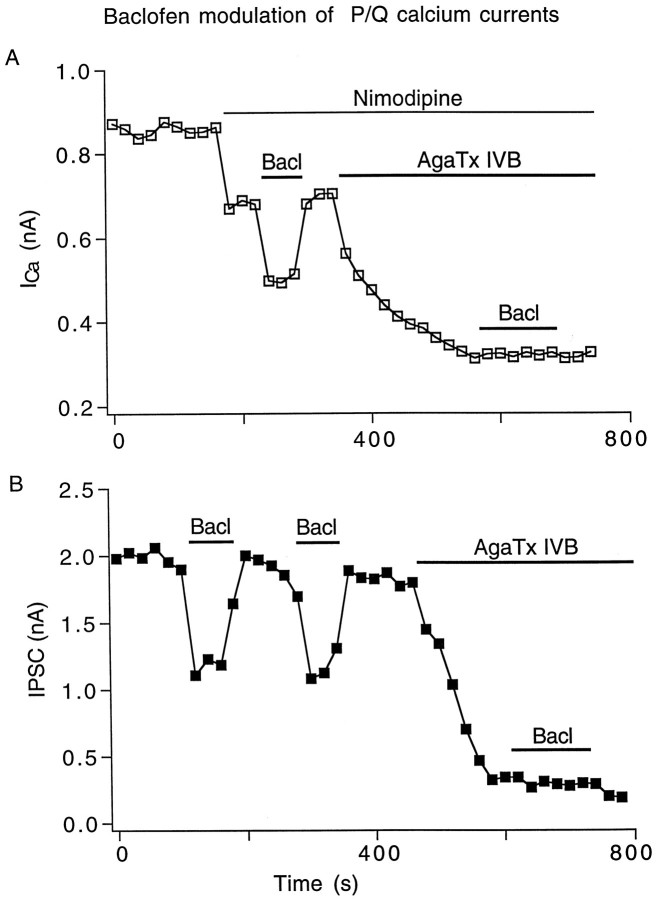
Baclofen modulation of P/Q type calcium currents.A, In the presence of 4 μm nimodipine, baclofen (20 μm) inhibition of the remaining non-LICa disappeared after agatoxin IVB (AgaTx, 500 nm) blockade of P/Q typeICa. B, Repeatable inhibition of IPSCs by baclofen (20 μm) disappeared after agatoxin IVB (500 nm), blocking most of the IPSC.
Fig. 9.
Fig. 9.
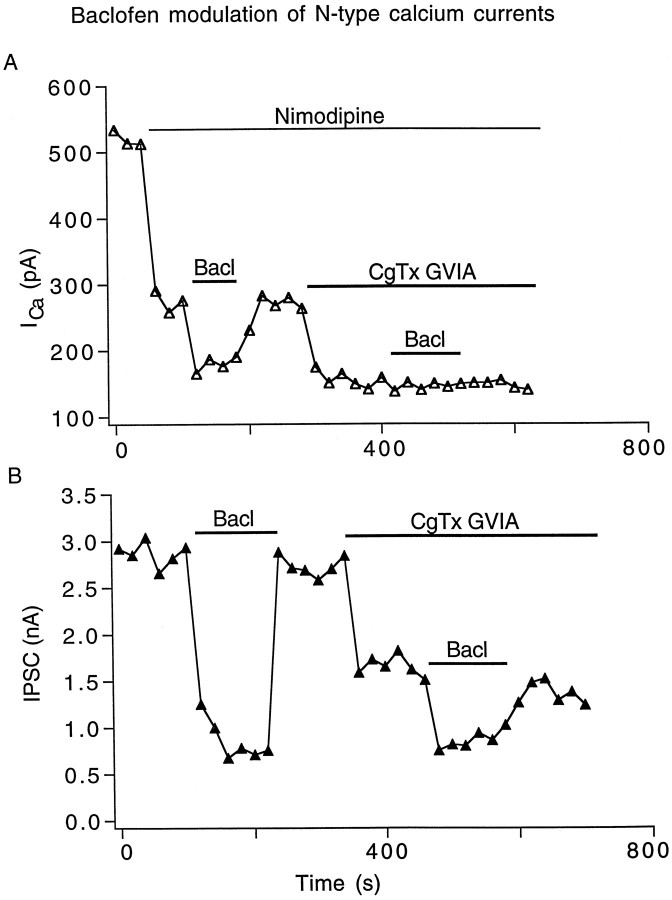
Baclofen modulation of N-type calcium currents.A, In the presence of 4 μm nimodipine, baclofen (20 μm) inhibition of the remaining non-LICa disappeared after 2 μmconotoxin GVIA blocking of N-type ICa.B, Baclofen (20 μm) inhibition of IPSCs was greatly reduced in the presence of 2 μm conotoxin GVIA.
Fig. 10.
Fig. 10.
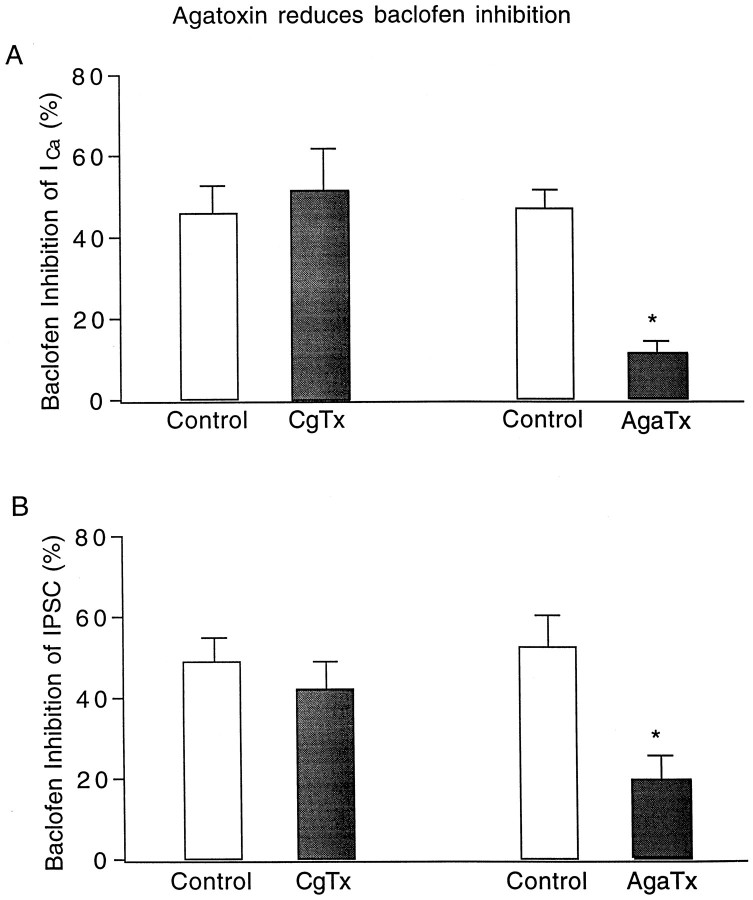
Reduction of baclofen inhibition after blocking P/Q-type calcium channels. A, Comparison of baclofen inhibition of calcium currents before and after conotoxin GVIA and agatoxin IVB. Baclofen inhibition was significantly reduced by application of agatoxin IVB (p < 0.001).B, Comparison of baclofen inhibition of evoked IPSCs before and after conotoxin GVIA and agatoxin IVB. Similar to calcium currents, baclofen inhibition of IPSCs was also reduced by application of agatoxin IVB (p < 0.01).
Fig. 11.
Fig. 11.
Differential G-protein mediation of baclofen inhibition of GABA release and calcium currents. A–C, Line graph (A) and recording traces (B, C) illustrating a differential effect of baclofen (20 μm) on IPSCs and ICa in the same autaptic neuron after treatment PTX. D, Bar graph showing pooled data that PTX abolished the baclofen inhibition of IPSCs but only partially reduced the baclofen inhibition ofICa.
Fig. 12.
Fig. 12.
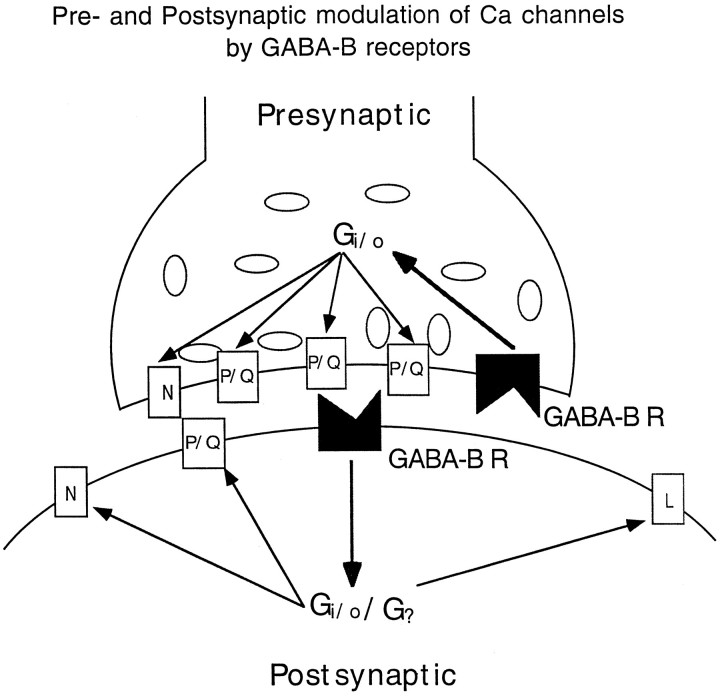
Simplified diagram illustrating G-protein-mediated presynaptic and postsynaptic GABABreceptor (GABAB R) modulation of multiple-type calcium channels.

References

    1. Bean BP. Multiple types of calcium channels in heart muscle and neurons. Modulation by drugs and neurotransmitters. Ann NY Acad Sci. 1989;560:334–345. - PubMed
    1. Bekkers JM, Stevens CF. Excitatory and inhibitory autaptic currents in isolated hippocampal neurons maintained in cell culture. Proc Natl Acad Sci USA. 1991;88:7834–7838. - PMC - PubMed
    1. Bormann J. Electrophysiology of GABAA and GABAB receptor subtypes. Trends Neurosci. 1988;11:112–116. - PubMed
    1. Bowery NG. GABAB receptor pharmacology. Annu Rev Pharmacol Toxicol. 1993;33:109–147. - PubMed
    1. Chen G, van den Pol AN. Multiple NPY receptors coexist in pre- and postsynaptic sites: inhibition of GABA release in isolated self-innervating SCN neurons. J Neurosci. 1996;16:7711–7724. - PMC - PubMed

Publication types

MeSH terms

LinkOut - more resources