. 1998 Feb 17;95(4):1517-22.
doi: 10.1073/pnas.95.4.1517.

A combinatorial approach to the discovery of efficient cationic peptoid reagents for gene delivery

Affiliations

A combinatorial approach to the discovery of efficient cationic peptoid reagents for gene delivery

J E Murphy et al. Proc Natl Acad Sci U S A. .

Abstract

A family of N-substituted glycine oligomers (peptoids) of defined length and sequence are shown to condense plasmid DNA into small particles, protect it from nuclease degradation, and efficiently mediate the transfection of several cell lines. The oligomers were discovered by screening a combinatorial library of cationic peptoids that varied in length, density of charge, side-chain shape, and hydrophobicity. Transfection activity and peptoid-DNA complex formation are shown to be highly dependent on the peptoid structure. The most active peptoid is a 36-mer that contains 12 cationic aminoethyl side chains. This molecule can be synthesized efficiently from readily available building blocks. The peptoid condenses plasmid DNA into uniform particles 50-100 nm in diameter and mediates the transfection of a number of cell lines with efficiencies greater than or comparable to DMRIE-C, Lipofectin, and Lipofectamine. Unlike many cationic lipids, peptoids are capable of working in the presence of serum.


Figures
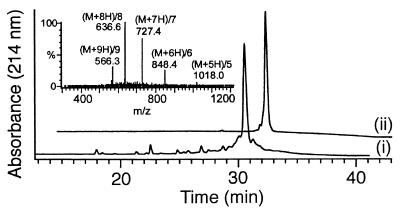
Figure 1
Figure 1
Analysis of the most active cationic peptoid (NaeNpeNpe)12 by reverse-phase HPLC, showing the crude (i) and purified (ii) products, and by electrospray mass spectrometry of the crude product (Inset).
Figure 2
Figure 2
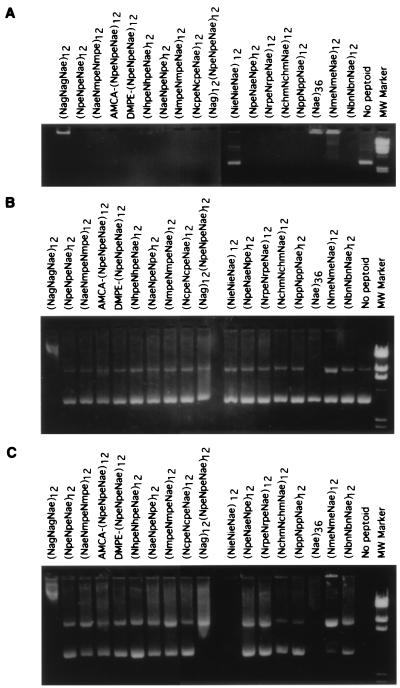
Peptoids interact with DNA and protect from DNase I degradation. The indicated peptoids were complexed with DNA at a 3:1 (+/−) charge ratio and divided into three aliquots: A shows the ability of peptoids to retard the migration of plasmid DNA into the gel; B shows the DNA after the complexes are disrupted with 1% SDS prior to electrophoresis; and C shows the DNA after DNase treatment and SDS disruption.
Figure 3
Figure 3
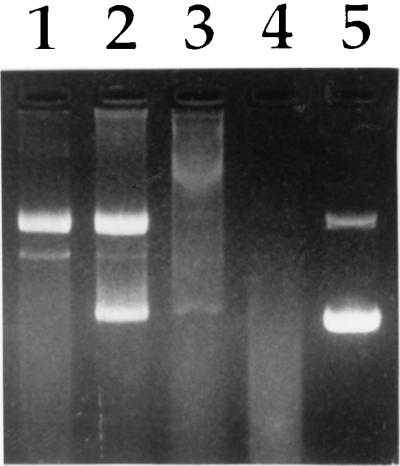
Protection from serum degradation. Lane 1, (Nae)18; lane 2, (Nae)36; lane 3, poly(l-lysine); lane 4, DNA alone; and lane 5, untreated DNA.
Figure 4
Figure 4
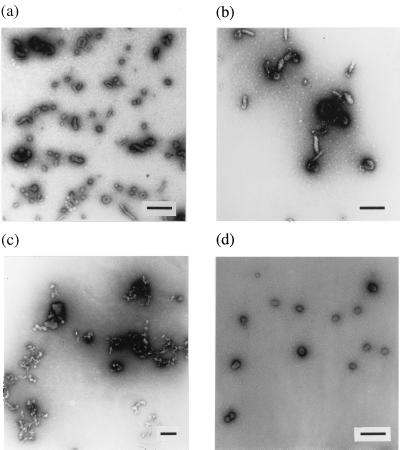
Electron microscopy of peptoid–DNA complexes. (a) (Nae)36. (b) (NmeNmeNae)12. (c) (NhpeNhpeNae)12. (d) (NaeNpeNpe)12. (Bars indicates 200 nm.)
Figure 5
Figure 5
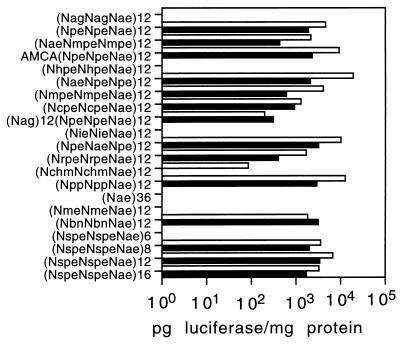
Comparison of peptoid transfection efficiency. Indicated peptoids were formulated with DNA at a 2:1 charge ratio and added to either HT1080 (solid bars) or COS (open bars) in the presence of 10% serum. Luciferase activity was analyzed 48 hr after transfection. Each data point represents the average of two experiments.
Figure 6
Figure 6
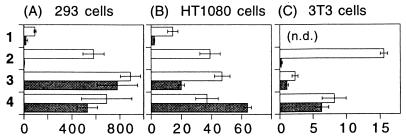
Comparison of (NaeNpeNpe)12 peptoid with commercially available cationic lipids. Transfections were carried out in the presence (solid bar) or absence (open bar) of 10% serum and analyzed 48 hr after transfection. Compound 1 is Lipofectin, 2 is Lipofectamine, 3 is DMRIE-C, and 4 is (NaeNpeNpe)12. Each data point represents the mean ± SEM of three transfections.
Figure 7
Figure 7
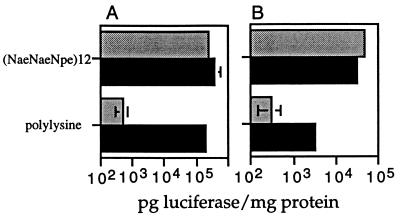
Effect of chloroquine on transfection with (NaeNpeNpe)12. Either 293 (A) or HT1080 (B) cells were transfected in the presence (black bar) or absence (shaded bar) of 100 μM chloroquine. Luciferase activity and total protein content were measured 48 hr after transfection.

References

    1. Mulligan R C. Science. 1993;260:926–932. - PubMed
    1. Ledley F D. Hum Gene Ther. 1995;6:1129–1144. - PubMed
    1. Wu G Y, Wu C H. J Biol Chem. 1987;262:4429–4432. - PubMed
    1. Fritz J D, Herweijer H, Zhang G, Wolff J A. Hum Gene Ther. 1996;7:1395–1404. - PubMed
    1. Mistry A R, Falciola L, Monaco L, Tagliabue R, Acerbis G, Knight A, Harbottle R P, Soria M, Bianchi M E, Coutelle C, Hart S L. BioTechniques. 1997;22:718–729. - PubMed

LinkOut - more resources