. 1998 Feb 17;95(4):1698-702.
doi: 10.1073/pnas.95.4.1698.

Identification of a silencing element in the human 15q11-q13 imprinting center by using transgenic Drosophila

Affiliations

Identification of a silencing element in the human 15q11-q13 imprinting center by using transgenic Drosophila

F Lyko et al. Proc Natl Acad Sci U S A. .

Abstract

Prader-Willi syndrome (PWS) and Angelman syndrome are neurogenetic disorders caused by the lack of a paternal or a maternal contribution from human chromosome 15q11-q13, respectively. Deletions in the transcription unit of the imprinted SNRPN gene have been found in patients who have PWS or Angelman syndrome because of a parental imprint switch failure in this chromosomal domain. It has been suggested that the SNRPN exon 1 region, which is deleted in the PWS patients, contains an imprint switch element from which the maternal and paternal epigenotypes of the 15q11-q13 domain originate. Using the model organism Drosophila, we show here that a fragment from this region can function as a silencer in transgenic flies. Repression was detected specifically from this element and could not be observed with control human sequences. Additional experiments allowed the delineation of the silencer to a fragment of 215 bp containing the SNRPN promoter region. These results provide an additional link between genomic imprinting and an evolutionary conserved silencing mechanism. We suggest that the identified element participates in the long range regulation of the imprinted 15q11-q13 domain or locally represses SNRPN expression from the maternal allele.


Figures
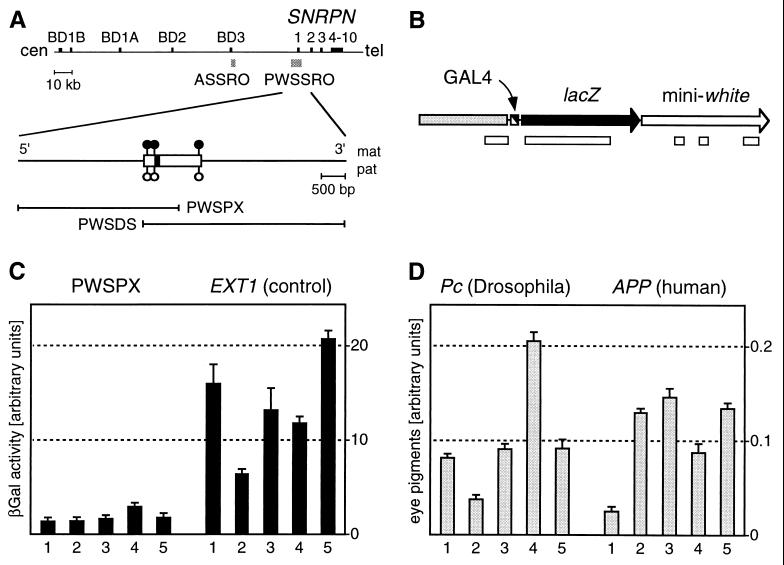
Figure 1
Figure 1
(A) Outline of the SNRPN transcription unit indicating regions deleted in AS and PWS patients (ASSRO and PWSSRO, shaded boxes; refs. –12). The PWSSRO has been narrowed down recently to ≈3 kb (T. Ohta and R. D. Nicholls, personal communication). Exons are shown as black boxes. Filled and open lollipops in the region of the SNRPN CpG island (open box) represent maternally methylated NotI sites (32). Fragments investigated in this study (PWSPX and PWSDS) are indicated. (B) Schematic outline of the PWSPX transgene. A GAL4 binding cassette (black and white box) immediately 5′ to the promoter mediates binding of the activating protein. The direction of transcription is indicated by arrowheads. Open boxes below the construct denote CpG islands as determined by standard procedures (33) by using grail (34). (C) Quantitative determination of lacZ expression in GAL4-induced transgenic larvae carrying the PWSPX fragment or a control fragment from the nonimprinted EXT1 locus. (D) Quantitative determination of mini-white expression in adult transgenic flies carrying a sequence from the Drosophila Pc locus or a sequence from the human APP locus immediately 5′ to mini-white. Error bars indicate the SD; numbers indicate distinct independent strains.
Figure 2
Figure 2
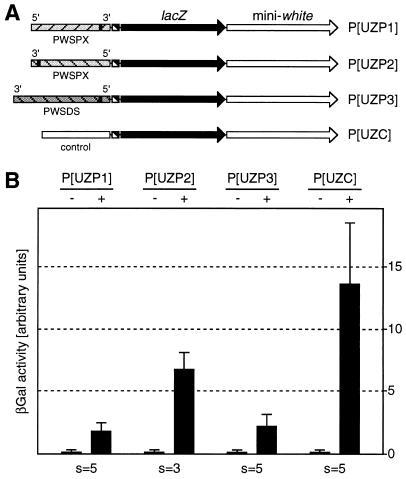
Quantitative determination of lacZ expression in transgenic larvae carrying fragments from the PWS-imprinting control region. (A) Structure of transgenes. (B) Relative β-gal activity in the presence (+) or absence (−) of GAL4. The depicted values are mean values for all strains analyzed. s, number of strains; error bars indicate the SD.
Figure 3
Figure 3
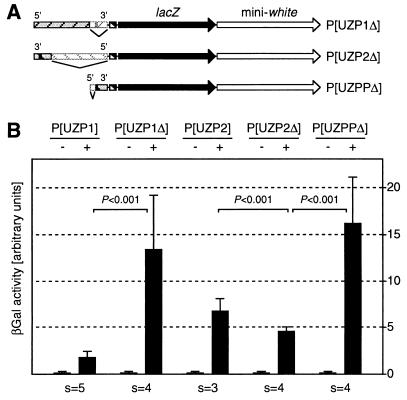
The effect of deletions on PWSPX-dependent silencing. (A) Structure of deleted transgenes. P[UZP1Δ] is derived from P[UZP1] and contains a 740-bp deletion of the region around SNRPN exon 1. P[UZP2Δ] is derived from P[UZP2] and contains a 2.4-kb deletion leaving the 740-bp region around SNRPN exon 1. P[UZPPΔ] is derived from P[UZP2Δ] and contains a 215-bp deletion of the SNRPN promoter region. (B) Quantitative determination of lacZ expression in transgenic larvae carrying deleted constructs. Relative β-gal activity is shown in the presence (+) or absence (−) of GAL4. The depicted values are mean values for all strains analyzed (s, number of strains). Error bars indicate the SD, and P values were determined by the t test.
Figure 4
Figure 4
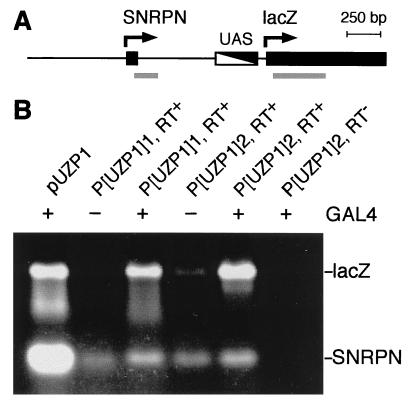
Determination of the transcriptional status of the SNRPN and the lacZ promoters in transgenic larvae carrying the PWSPX fragment. (A) Schematic illustration of the central part of the P[UZP1] transgene. SNRPN exon 1 and the 5′ portion of the lacZ gene are depicted as black boxes, and the GAL4 binding sites (UAS) are depicted as a black and white box. Arrows indicate the direction of transcription. Gray lines designate the sequences amplified by PCR. (B) Result of reverse transcription-PCR from two different strains transgenic for P[UZP1] in the presence (+) or absence (−) of GAL4. PCR products were separated on an agarose gel stained with ethidium bromide. Lane 1 shows control PCR products from a plasmid template, and lane 6 shows the absence of reverse transcription-PCR products when reverse transcriptase was omitted.

References

    1. Lalande M. Annu Rev Genet. 1996;30:173–195. - PubMed
    1. Kishino T, Lalande M, Wagstaff J. Nat Genet. 1997;15:70–73. - PubMed
    1. Matsuura T, Sutcliffe J S, Fang P, Galjaard R-J, Jiang Y-h, Benton C S, Rommens J M, Beaudet A L. Nat Genet. 1997;15:74–77. - PubMed
    1. Özçelik T, Leff S, Robinson W, Donlon T, Lalande M, Sanjines E, Schinzel A, Francke U. Nat Genet. 1992;2:265–269. - PubMed
    1. Glenn C C, Porter K A, Jong M T C, Nicholls R D, Driscoll D J. Hum Mol Genet. 1993;2:2001–2005. - PubMed

Publication types

LinkOut - more resources