


A role for B cells in the development of T cell helper function in a malaria infection in mice
- PMID: 9465085
- PMCID: PMC19169
- DOI: 10.1073/pnas.95.4.1730
A role for B cells in the development of T cell helper function in a malaria infection in mice
Abstract
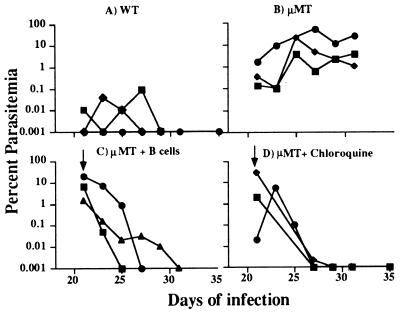
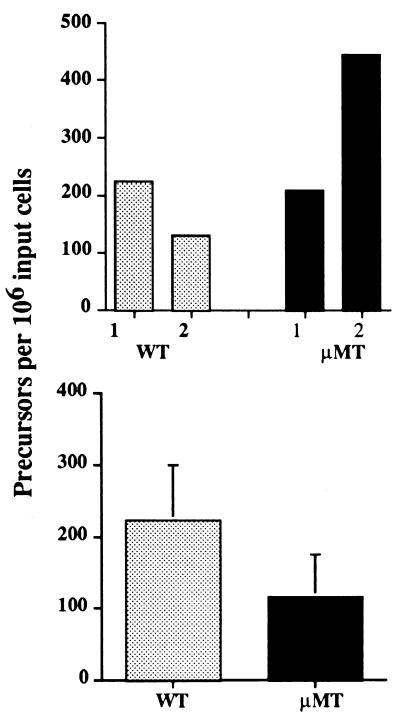
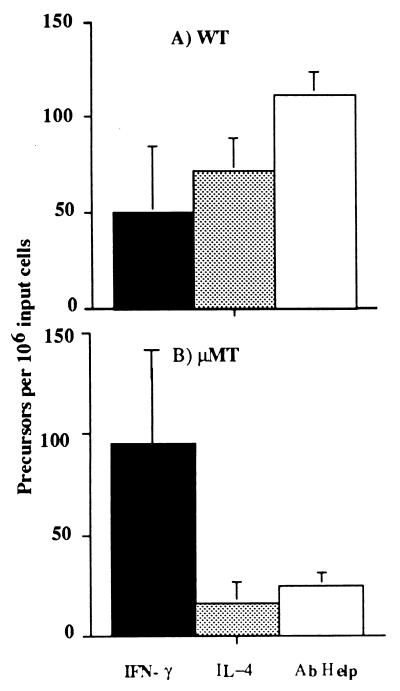
B cell knockout mice are unable to clear a primary erythrocytic infection of Plasmodium chabaudi chabaudi. However, the early acute infection is controlled to some extent, giving rise to a chronic relapsing parasitemia that can be reduced either by drug treatment or by adoptive transfer of B cells. Similar to mice rendered B-cell deficient by lifelong treatment with anti-mu antibodies, B cell knockout mice (muMT) retain a predominant CD4+ Th1-like response to malarial antigens throughout a primary infection. This contrasts with the response seen in control C57BL/6 mice in which the CD4+ T-cell response has switched to that characteristic of Th2 cells at the later stages of infection, manifesting efficient help for specific antibodies in vitro and interleukin 4 production. Both chloroquine and adoptive transfer of immune B cells reduced parasite load. However, the adoptive transfer of B cells resulted in a Th2 response in recipient muMT mice, as indicated by a relative increase in the precursor frequency of helper cells for antibody production. These data support the idea that B cells play a role in the regulation of CD4+ T subset responses.
Figures

References
-
- Macatonia S E, Hsieh C-S, Murphy K M, O’Garra A. Int Immunol. 1993;5:1119–1128. - PubMed
-
- Constant S L, Bottomly K. Annu Rev Immunol. 1997;15:297–322. - PubMed
-
- Seder R A, Paul W E. Annu Rev Immunol. 1994;12:635–637. - PubMed
-
- Langhorne J, Gillard S, Simon B, Slade S, Eichmann K. Int Immunol. 1989;1:416–424. - PubMed
Publication types
MeSH terms
Substances
Grants and funding
LinkOut - more resources
Full Text Sources
Medical
Molecular Biology Databases
Research Materials
