


Review
doi: 10.1128/JCM.36.2.329-334.1998.
Candida dubliniensis: characteristics and identification
Affiliations
- PMID: 9466736
- PMCID: PMC104537
- DOI: 10.1128/JCM.36.2.329-334.1998
Item in Clipboard
Review
Candida dubliniensis: characteristics and identification
J Clin Microbiol.
1998 Feb.
No abstract available
Figures
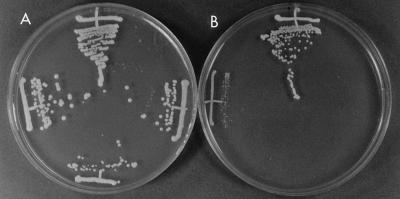
Comparative growth of oral C. dubliniensis and C. albicans on PDA following 48 h of incubation at 37°C (A) and 42°C (B). The growth of the following isolates is shown: C. albicans 132A, C. dubliniensis CD57, C. dubliniensis CD43, and C. dubliniensis CD36 (clockwise from the top in each panel).
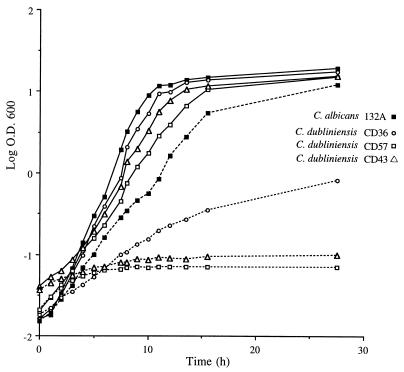
Growth curves of the oral isolates C. dubliniensis CD36, CD57, and CD43 and the oral reference strain C. albicans 132A in YEPD broth medium at 37°C (solid lines) and 42°C (dashed lines). O.D., optical density.
References
-
- Anthony R M, Midgley J, Sweet S P, Howell S A. Multiple strains of Candida albicans in the oral cavity of HIV-positive and HIV-negative patients. Microb Ecol Health Dis. 1995;8:23–30.
-
- Bennett D E, McCreary C E, Coleman D C. Genetic characterization of a phospholipase C gene from Candida albicans: presence of homologous sequences in Candida species other than C. albicans. Microbiology. 1998;144:55–72. - PubMed
-
- Boucher H, Mercure S, Montplaisir S, Lemay G. A novel group I intron in Candida dubliniensis is homologous to a Candida albicans intron. Gene. 1996;180:189–196. - PubMed
Publication types
MeSH terms
LinkOut - more resources
Full Text Sources
Medical
