


Quantitative trait loci and metabolic pathways
- PMID: 9482823
- PMCID: PMC33831
- DOI: 10.1073/pnas.95.5.1996
Quantitative trait loci and metabolic pathways
Abstract
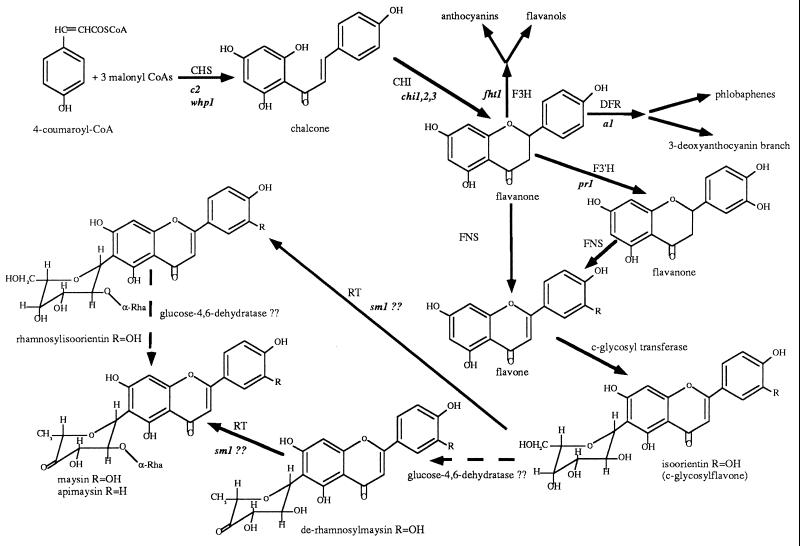
The interpretation of quantitative trait locus (QTL) studies is limited by the lack of information on metabolic pathways leading to most economic traits. Inferences about the roles of the underlying genes with a pathway or the nature of their interaction with other loci are generally not possible. An exception is resistance to the corn earworm Helicoverpa zea (Boddie) in maize (Zea mays L.) because of maysin, a C-glycosyl flavone synthesized in silks via a branch of the well characterized flavonoid pathway. Our results using flavone synthesis as a model QTL system indicate: (i) the importance of regulatory loci as QTLs, (ii) the importance of interconnecting biochemical pathways on product levels, (iii) evidence for "channeling" of intermediates, allowing independent synthesis of related compounds, (iv) the utility of QTL analysis in clarifying the role of specific genes in a biochemical pathway, and (v) identification of a previously unknown locus on chromosome 9S affecting flavone level. A greater understanding of the genetic basis of maysin synthesis and associated corn earworm resistance should lead to improved breeding strategies. More broadly, the insights gained in relating a defined genetic and biochemical pathway affecting a quantitative trait should enhance interpretation of the biological basis of variation for other quantitative traits.
Figures
References
-
- Beavis W D, Smith O S, Grant D, Fincher R. Crop Sci. 1994;34:882–896.
-
- Bohn M, Khairallah M, Gonzalez de Leon D, Hoisington D A, Utz H, Deutsch J A, Jewell D C, Mihm J A, Melchinger A E. Crop Sci. 1996;36:1352–1361.
-
- Ortega A, Vasal S K, Mihm J, Hershey C. In: Breeding Plants Resistant to Insects. Maxwell F G, Jennings P R, editors. New York: Wiley; 1980. pp. 370–419.
-
- Dicke F F, Guthrie W D. In: Corn and Corn Improvement. Sprague G F, Dudley J W, editors. Madison, WI: American Society of Agronomy; 1988. pp. 767–867.
-
- Waiss A C, Jr, Chan B G, Elliger C A, Wiseman B R, McMillian W W, Widstrom N W, Zuber M S, Keaster A J. J Econ Entomol. 1979;72:256–258.
LinkOut - more resources
Full Text Sources
