


Daidzin and its antidipsotropic analogs inhibit serotonin and dopamine metabolism in isolated mitochondria
- PMID: 9482862
- PMCID: PMC19293
- DOI: 10.1073/pnas.95.5.2198
Daidzin and its antidipsotropic analogs inhibit serotonin and dopamine metabolism in isolated mitochondria
Abstract
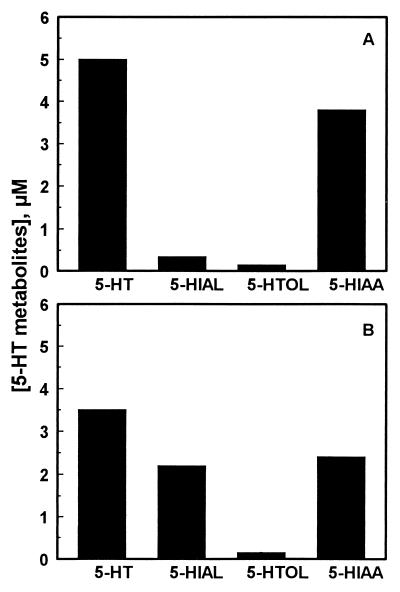
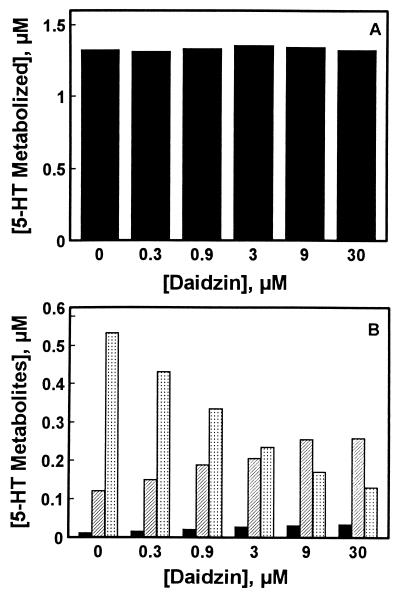
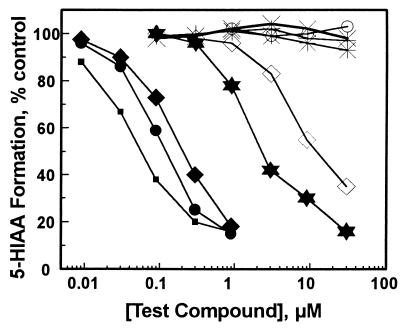
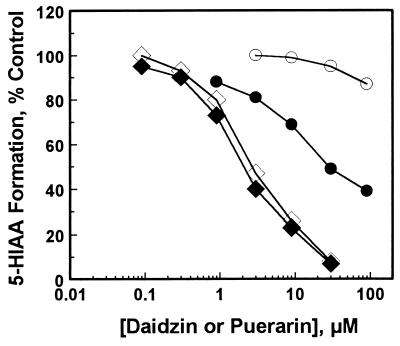
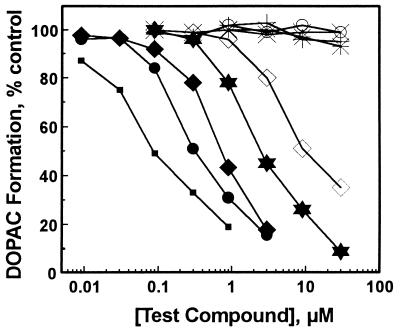
Daidzin, a major active principle of an ancient Chinese herbal treatment (Radix puerariae) for alcohol abuse, selectively suppresses ethanol intake in all rodent models tested. It also inhibits mitochondrial aldehyde dehydrogenase (ALDH-2). Studies on ethanol intake suppression and ALDH-2 inhibition by structural analogs of daidzin established a link between these two activities and suggested that daidzin may suppress ethanol intake by inhibiting ALDH-2. ALDH-2 is a principal enzyme involved in serotonin (5-HT) and dopamine (DA) metabolism. Thus, daidzin may act by inhibiting 5-HT and DA metabolism. To evaluate this possibility, we have studied the effect of daidzin and its analogs on 5-HT and DA metabolism in isolated hamster and rat liver mitochondria. Daidzin potently inhibits the formation of 5-hydroxyindole-3-acetic acid (5-HIAA) and 3,4-dihydroxyphenylacetic acid (DOPAC) from their respective amines in isolated mitochondria. Inhibition is concentration-dependent and is accompanied by a concomitant accumulation of 5-hydroxyindole-3-acetaldehyde and 3, 4-dihydroxyphenylacetaldehyde. Daidzin analogs that suppress hamster ethanol intake also inhibit 5-HIAA and DOPAC formation. Comparing their effects on mitochondria-catalyzed 5-HIAA or DOPAC formation and hamster ethanol intake reveals a positive correlation-the stronger the inhibition on 5-HIAA or DOPAC formation, the greater the ethanol intake suppression. Daidzin and its active analogs, at concentrations that significantly inhibit 5-HIAA formation, have little or no effect on mitochondria-catalyzed 5-HT depletion. It appears that the antidipsotropic action of daidzin is not mediated by 5-HT (or DA) but rather by its reactive intermediates 5-hydroxyindole-3-acetaldehyde and, presumably, 3, 4-dihydroxyphenylacetaldehyde as well, which accumulates in the presence of daidzin.
Figures
References
-
- Keung W M, Vallee B L. EXS. 1994;71:1254–1260. - PubMed
-
- Heyman G M, Keung W M, Vallee B L. Alcohol Clin Exp Res. 1996;20:1083–1087. - PubMed
-
- Overstreet D H, Lee Y W, Rezvani A H, Pei Y H, Criswell H E, Janowsky D S. Alcohol Clin Exp Res. 1996;20:221–227. - PubMed
-
- Overstreet D H, Rezvani A H, Lee Y W. Alcohol Clin Exp Res. 1996;20:16A. - PubMed
Publication types
MeSH terms
Substances
LinkOut - more resources
Full Text Sources
Other Literature Sources
Molecular Biology Databases
Miscellaneous
