. 1998 Mar 3;95(5):2227-32.
doi: 10.1073/pnas.95.5.2227.

Brome mosaic virus RNA replication protein 1a dramatically increases in vivo stability but not translation of viral genomic RNA3

Affiliations

Brome mosaic virus RNA replication protein 1a dramatically increases in vivo stability but not translation of viral genomic RNA3

M Janda et al. Proc Natl Acad Sci U S A. .

Abstract

Brome mosaic virus (BMV), a positive-strand RNA virus in the alphavirus-like superfamily, encodes two RNA replication proteins: 1a, which contains a helicase-like domain and a domain implicated in RNA capping, and 2a, which contains a polymerase-like domain. To further explore their functions, we expressed 1a and 2a individually and together in yeast also expressing replicatable transcripts of BMV genomic RNA3. Complementing prior results that 1a and 2a are required jointly for positive-strand RNA synthesis, both also were required for negative-strand RNA synthesis. Nevertheless, in the absence of 2a, 1a expression increased the accumulation of DNA-derived RNA3 transcripts 8-fold. Increased accumulation was specific for RNA3: none of a diverse set of yeast mRNAs tested showed increased accumulation in the presence of 1a. Increased RNA3 accumulation was not due to increased DNA transcription, but to a 20- to 40-fold increase in the in vivo half-life of RNA3 from 5-10 min in the absence of 1a to more than 3 hr in the presence of 1a. Although (1a+2a)-dependent RNA replication selectively amplified the natural viral 5' end from among multiple transcription starts of DNA-derived RNA3 transcripts, 1a-induced stabilization affected all RNA3 transcripts, without specificity for the precise viral 5' end. Increased RNA3 accumulation did not increase expression of a directly translatable, 5'-proximal gene in RNA3, implying that 1a-induced stabilization blocked rather than facilitated RNA3 translation. These and other results suggest that the striking, 1a-induced stabilization of RNA3 may reflect an interaction involved in recruiting viral RNA templates into RNA replication while diverting them from the competing processes of translation and degradation.


Figures
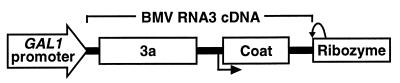
Figure 1
Figure 1
Schematic of the BMV RNA3 cDNA region in yeast centromeric plasmid pB3. The 3a and coat protein genes are indicated. The GAL1 promoter fused to the 5′ end of RNA3 cDNA allows gal-induced in vivo transcription of RNA3, and the hepatitis δ ribozyme cleaves the transcript at the natural 3′ end of RNA3. The bent arrow below the diagram shows the start of sequences for the subgenomic coat protein mRNA, RNA4, which is transcribed from the negative-strand RNA3 replication intermediate.
Figure 2
Figure 2
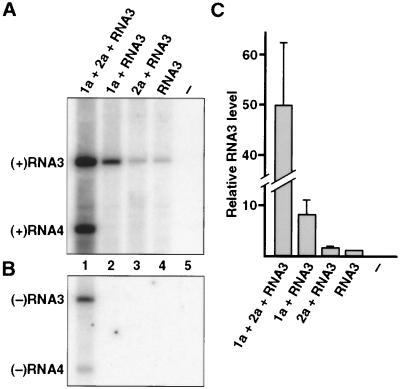
Northern blot analysis of BMV RNA3 accumulation in yeast expressing the indicated BMV components. To ensure full induction and equilibration of RNA3 transcription from pB3, yeast cells were passaged three times in gal-containing medium and total RNA was extracted. Equal amounts of total RNA per sample were denatured with glyoxal, run on a 0.8% agarose gel, transferred to nylon membranes, and hybridized to 32P-labeled in vitro transcript probes. (A) RNA3-derived positive-strand RNAs detected with a probe complementary to the 3′ 200 bases of BMV RNA3. (B) RNA3-derived negative-strand RNAs, as detected with a probe corresponding to 500 bases of coat protein coding sequence. (C) Positive-strand RNA3 levels in the indicated yeast strains were measured with a Molecular Dynamics PhosphorImager and normalized to the level in yeast expressing RNA3 alone. Averages and standard deviations from five independent experiments are shown.
Figure 3
Figure 3
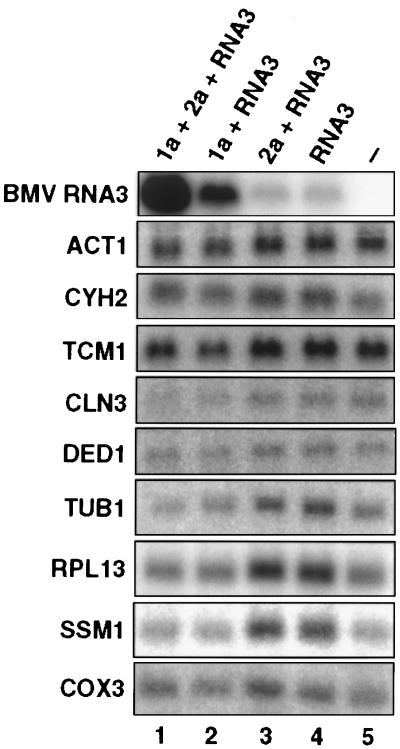
Protein 1a does not increase accumulation of varied yeast mRNAs. Yeast cells expressing the indicated BMV components were grown and total RNA was extracted as in Fig. 2. Equal amounts of total RNA per sample were loaded in parallel on multiple formaldehyde gels (13) and transferred to nylon membranes, and individual membranes were probed for positive-strand BMV RNA3 (Top) or with random-primed, 32P-labeled DNA fragments from yeast genes ACT1, CYH2, TCM1, CLN3, DED1, TUB1, RPL13A, SSM1b, and COX3, as indicated.
Figure 4
Figure 4
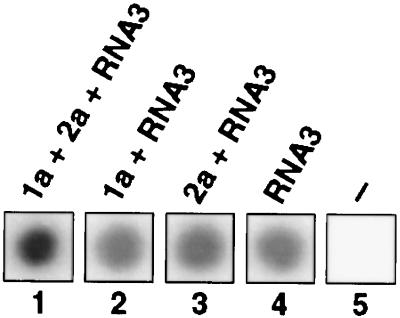
Nuclear run-on analysis of DNA-dependent RNA3 transcription. Yeast expressing the indicated BMV components were grown in gal-containing medium and permeabilized with sarkosyl, and nuclear RNA transcripts were labeled by incubating the permeabilized cells with [α-32P]UTP for 10 min (14). Total RNA then was extracted and used to probe activated nylon membranes on which equal amounts of full-length, negative-strand, in vitro transcripts of RNA3 had been spotted and immobilized.
Figure 5
Figure 5
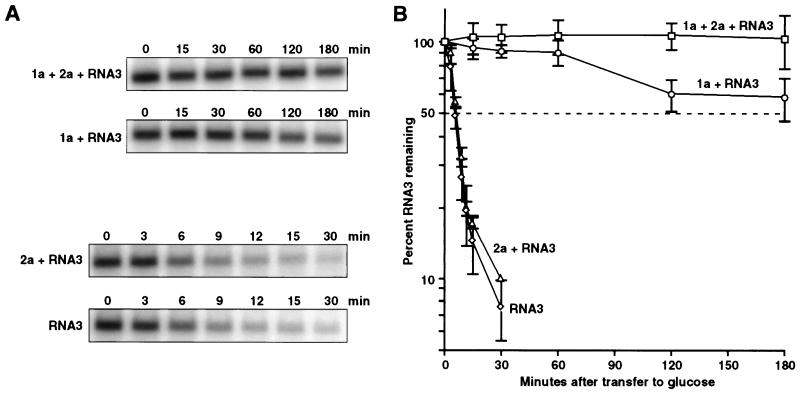
Protein 1a extends RNA3 half-life. (A) Yeast expressing the indicated BMV components were grown in defined, gal-containing medium to induce RNA3 transcription from the pB3 GAL1 promoter. At time zero, these strains were transferred to defined, glc-containing medium to repress RNA3 transcription. For each strain, equal aliquots of cells were removed at the indicated times after transfer to glc medium and frozen at −70°C to stop further decay. Total RNA was then extracted, and equal amounts of total RNA from each sample were analyzed by Northern blotting, as in Fig. 2A, to follow the decay of positive-strand RNA3. Note the different time intervals used for sampling yeast containing or lacking 1a. For comparison, exposures were adjusted to provide similarly intense starting signals for all strains. (B) For three independent experiments as in A, positive-strand RNA3 levels were measured with a Molecular Dynamics PhosphorImager, expressed for each strain as a percentage of the RNA3 level at time zero, and plotted on a semilogarithmic plot vs. time after transfer to glc medium. Averages and standard deviations are shown. RNA3 half-life corresponds to the time at which each curve intersects 50% (dotted line).
Figure 6
Figure 6
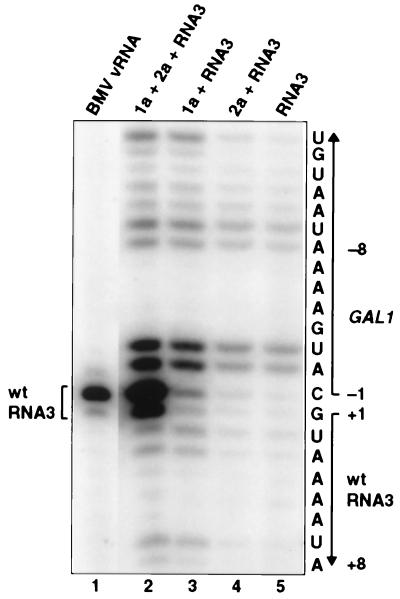
Primer extension analysis of the 5′ ends of RNA3 species in yeast expressing the indicated BMV components. Yeast were grown and total RNA was extracted as in Fig. 2, and primer extension was performed with an oligonucleotide complementary to RNA3 bases 30–44 (10). Nucleotide position relative to the RNA3 cDNA sequence is shown at right. Lane 1 shows equivalent analysis of natural BMV virion RNA.
Figure 7
Figure 7
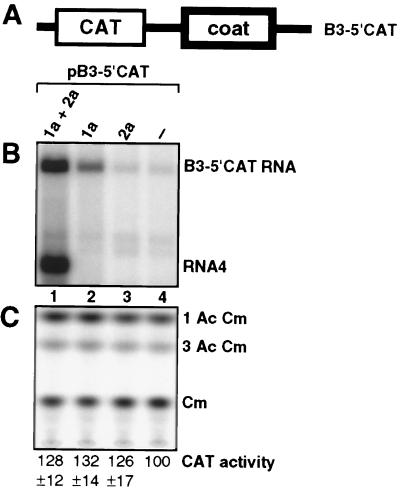
1a-stimulated RNA3 accumulation does not increase expression of a gene translated from RNA3. (A) Schematic of B3–5′CAT, an RNA3 derivative in which the 5′ half of the 3a gene has been replaced by the CAT gene. (B) Representative Northern blot analysis of positive-strand B3–5′CAT RNA accumulation in yeast expressing the indicated BMV components, performed as in Fig. 2A. (C) CAT expression in the yeast of Fig. 7B. Total protein was extracted from a portion of each of the same cultures used for RNA analysis in Fig. 7B. Equal aliquots of each sample were analyzed for CAT activity by using 14C-chloramphenicol and thin-layer chromatography, and ensuring that all sample activities were within the linear range of the assay (9, 10). The positions of chloramphenicol (Cm) and its acetylated derivatives (1AcCm, 3AcCm) are shown. CAT activity for each strain was normalized to expression in B3–5′CAT-expressing yeast lacking 1a and 2a, averaged over four, independent experiments, and presented with standard deviation below each lane.

References

    1. Ahlquist P. Curr Op Genet Dev. 1992;2:71–76. - PubMed
    1. Mise K, Ahlquist P. Virology. 1995;206:276–286. - PubMed
    1. Kao C C, Quadt R, Hershberger R P, Ahlquist P. J Virol. 1992;66:6322–6329. - PMC - PubMed
    1. Kao C C, Ahlquist P. J Virol. 1992;66:7293–7302. - PMC - PubMed
    1. Restrepo-Hartwig M, Ahlquist P. J Virol. 1996;70:8908–8916. - PMC - PubMed

Publication types

LinkOut - more resources