. 1998 Mar 3;95(5):2366-71.
doi: 10.1073/pnas.95.5.2366.

beta-D-glucosyl-hydroxymethyluracil is a conserved DNA modification in kinetoplastid protozoans and is abundant in their telomeres

Affiliations

beta-D-glucosyl-hydroxymethyluracil is a conserved DNA modification in kinetoplastid protozoans and is abundant in their telomeres

F van Leeuwen et al. Proc Natl Acad Sci U S A. .

Abstract

The unusual DNA base beta-D-glucosyl-hydroxymethyluracil, called "J, " replaces approximately 0.5-1% of Thy in DNA of African trypanosomes but has not been found in other organisms thus far. In Trypanosoma brucei, J is located predominantly in repetitive DNA, and its presence correlates with the silencing of telomeric genes. Using antibodies specific for J, we have developed sensitive assays to screen for J in a range of organisms and have found that J is not limited to trypanosomes that undergo antigenic variation but is conserved among Kinetoplastida. In all kinetoplastids tested, including the human pathogens Leishmania donovani and Trypanosoma cruzi, J was found to be abundantly present in the (GGGTTA)n telomere repeats. Outside Kinetoplastida, J was found only in Diplonema, a small phagotrophic marine flagellate, in which we also identified 5-MeCyt. Fractionation of Diplonema DNA showed that the two modifications are present in a common genome compartment, which suggests that they may have a similar function. Dinoflagellates appear to contain small amounts of modified bases that may be analogs of J. The evolutionary conservation of J in kinetoplastid protozoans suggests that it has a general function, repression of transcription or recombination, or a combination of both. T. brucei may have recruited J for the control of genes involved in antigenic variation.


Figures
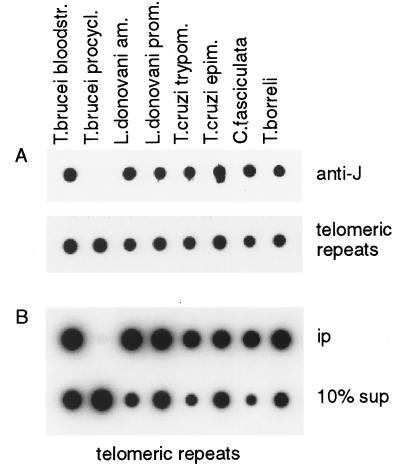
Figure 1
Figure 1
Conservation of J in telomeric repeats of Kinetoplastida. (A) Dot blot with 200 ng of DNA of each kinetoplastid sample indicated was incubated with anti-J antiserum (anti-J). Abbreviations of the organisms and the life cycle stages are explained in Table 1. Bound antibodies were detected with a second antibody conjugated to horseradish peroxidase and were visualized by enhanced chemiluminescence. After stripping the blot, DNA loading was checked by hybridization by using a (GGGTTA)5-telomeric repeat oligo as a common probe (telomeric repeats). J also was found in L. tarentolae, L. donovani chagasi, L. brasiliensis, L. mexicana, and T. vivax (data not shown). (B) An anti-J immunoprecipitation of sonicated DNA. Modified DNA bound by antibody (ip) and 10% of the supernatant (10% sup) were blotted and analyzed by hybridization with the telomeric repeat probe.
Figure 2
Figure 2
Screening for J in DNA with a zoo blot. Southern blot of a 1% agarose gel with ≈200 ng of total DNA of each sample was incubated with antiserum 539αJ, and bound antibodies were indirectly detected by enhanced chemiluminescence (anti-J). Black lines indicate the position of the slots. Lanes: 1, bloodstream form T. brucei; 2, procyclic (insect form) T. brucei; 3–6, human blood, sperm, breast tumor, and ovarian tumor; 7–8, mouse testis and lung; 9, calf thymus; 10–11, human cell lines HeLa and G401; 12–14, human DNAs enriched ≈100-fold for telomeric repeats; 12, telomeric tracts from HeLa cells;13, matrix-attached DNA from HeLa cells;14, telomeric tracts from G401 cells;15, D. melanogaster (also contained RNA); 16, Sf9 cells; 17, C. elegans; 18–19, S. cerevisiae strains M398 and BJ1991; 20, P. pastoris; 21, P. micans; 22, C. cohnii; 23, P. falciparum; 24, T. gondii; 25, E. histolytica; 26, Diplonema; 27, T. vaginalis; 28, G. lamblia; and 29, E. coli. Because no common probe was available, DNA loading was checked by the staining of the gel with ethidium bromide (EtBr).
Figure 3
Figure 3
Phylogenetic tree of eukaryotes tested for the presence of J. This phylogenetic tree inferred from 16S-like rRNA sequence similarities is modified from Sogin (39). The position of Diplonema (dashed line) is still unclear (see text). J was found in the order Kinetoplastida and in Diplonema (underlined).
Figure 4
Figure 4
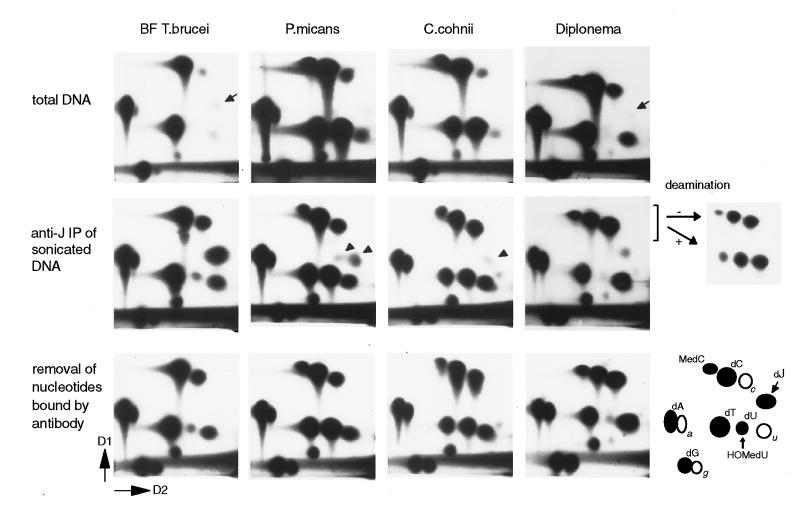
Detection of J in Diplonema and J-like modifications in dinoflagellates. Analysis of bloodstream form T. brucei, P. micans, C. cohnii, and Diplonema by 32P-nucleotide postlabeling combined with 2D-TLC (D1 and D2 are indicated). The position of the labeled 5′-deoxynucleotidemonophosphates (dN) is explained in the right bottom corner. a, c, u, and g indicate contaminating ribonucleotides. dU and HOMedU nucleotides comigrate under these conditions. (Top) Labeling of total DNA. J is indicated with small arrows. (Middle) Analysis of samples after anti-J immunoprecipitation of sonicated DNA fragments. Arrowheads indicate nucleotides in dinoflagellates that migrate close to, but differently from, J. To test whether the nucleotide close to dC in Diplonema is 5-Me-dCMP, it was isolated together with dCMP and CMP, chemically deaminated (+), and rerun on 2D-TLC, mixed with nondeaminated input (−). Deamination of 5-Me-dCMP, dCMP, and CMP results in dTMP, dUMP, and UMP, respectively. (Bottom) Labeled nucleotides from the Middle were incubated with anti-J antibodies coupled to ProtA beads to specifically remove nucleotides recognized by the antibodies. The supernatant was analyzed by 2D-TLC.

Comment in

  • A base called J.
    Simpson L. Simpson L. Proc Natl Acad Sci U S A. 1998 Mar 3;95(5):2037-8. doi: 10.1073/pnas.95.5.2037. Proc Natl Acad Sci U S A. 1998. PMID: 9482833 Free PMC article. Review. No abstract available.

References

    1. Gommers-Ampt J H, van Leeuwen F, de Beer A L, Vliegenthart J F, Dizdaroglu M, Kowalak J A, Crain P F, Borst P. Cell. 1993;75:1129–1136. - PubMed
    1. Gommers-Ampt J, Lutgerink J, Borst P. Nucleic Acids Res. 1991;19:1745–1751. - PMC - PubMed
    1. van Leeuwen F, Wijsman E R, Kuyl-Yeheskiely E, van der Marel G, van Boom J H, Borst P. Nucleic Acids Res. 1996;24:2476–2482. - PMC - PubMed
    1. van Leeuwen F, Wijsman E R, Kieft R, van der Marel G A, van Boom J H, Borst P. Genes Dev. 1997;11:3232–3241. - PMC - PubMed
    1. Bernards A, van Harten-Loosbroek N, Borst P. Nucleic Acids Res. 1984;12:4153–4170. - PMC - PubMed

Publication types

LinkOut - more resources