


doi: 10.1073/pnas.95.5.2469.
The role of inducible nitric oxide synthase in the host response to Coxsackievirus myocarditis
Affiliations
- PMID: 9482909
- PMCID: PMC19377
- DOI: 10.1073/pnas.95.5.2469
Item in Clipboard
The role of inducible nitric oxide synthase in the host response to Coxsackievirus myocarditis
Proc Natl Acad Sci U S A.
.
Abstract
The host response to Coxsackievirus infection is complex, including T lymphocytes, B lymphocytes, natural killer cells, and macrophages. Although Coxsackievirus infection induces expression of inducible nitric oxide synthase (NOS2; EC 1.14.13.39) in macrophages, the precise role of NOS2 in the host response to Coxsackievirus myocarditis has been unclear. We show, by using mice homozygous for a disrupted NOS2 allele, that Coxsackievirus replicates to higher titers in NOS2(-/-) mice, that the host lacking NOS2 clears virus more slowly than the wild-type host, and that myocarditis is much more severe in infected NOS2(-/-) mice. These data show that NOS2 is crucial for the host response to Coxsackievirus in the mouse.
Figures
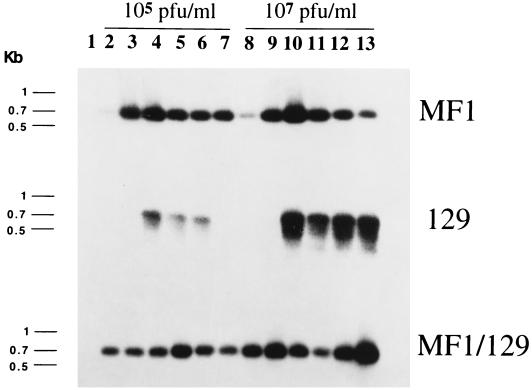
CVB3 infection induces NOS2 mRNA in hearts. Wild-type mice (MF1, 129, and MF1/129 hybrid F2) were infected with 105 or 107 pfu of CVB3. Hearts were harvested from noninfected animals (lane 1) or from infected mice at times 1, 3, 5, 7, 10, and 15 days after infection (lanes 2–7 and lanes 8–13). NOS2 expression was analyzed by Southern analysis of RT-PCR from total RNA (n = 3 mice per RT-PCR).
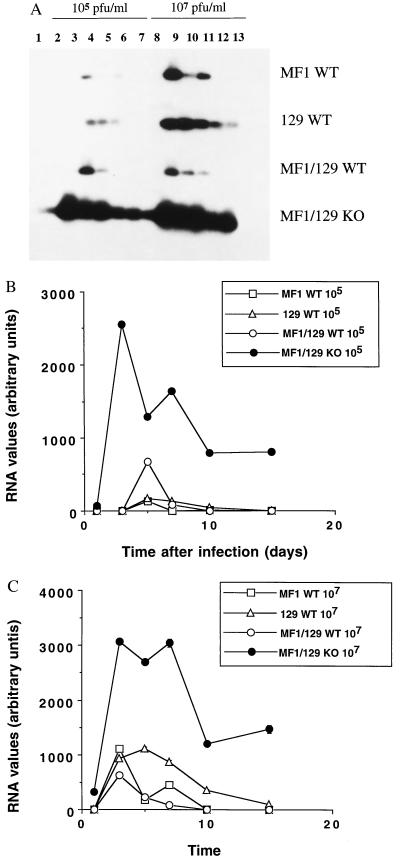
CVB3 RNA is present in hearts of infected mice. Wild-type mice (MF1, 129, and MF1/129 hybrid F2) and NOS2 null mice (MF1/129 KO) were infected with 105 or 107 pfu of CVB3. Hearts were harvested from noninfected animals (lane 1) or from infected mice at times 1, 3, 5, 7, 10, and 15 days after infection (lanes 2–7 and lanes 8–13). The CVB3 genome was analyzed by Southern analysis of RT-PCR from total RNA (A). The Southern blot was quantitated by densitometry for mice infected with (B) 105 pfu CVB3 or (C) 107 pfu CVB3. For B and C the differences between the NOS2 null mice and the MF1/129 wild-type mice at each time point have a P < 0.001 (n = 3 mice per RT-PCR ± SD although the error bars are not visible).
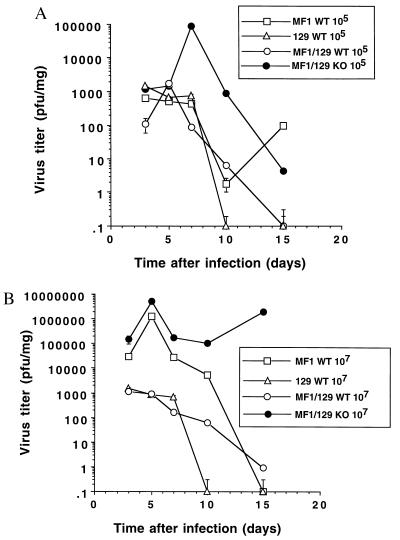
CVB3 infectious particles are present in hearts of infected mice. Wild-type mice (MF1, 129, and MF1/129 hybrid F2) and NOS2 null mice (MF1/129 KO) were infected with (A) 105 or (B) 107 pfu CVB3. Hearts were harvested from noninfected animals or from infected mice at times 1, 3, 5, 7, 10, and 15 days after infection. The amount of CVB3 pfu/mg of tissue was determined by the plaque assay. For A the differences between the NOS2 null mice and the MF1/129 wild-type mice at days 7, 10, and 15 have a P < 0.01. For B the differences between the NOS2 null mice and all other mice at all time points have a P < 0.001 (n = triplicate measurements from each of 3 mice ± SD).
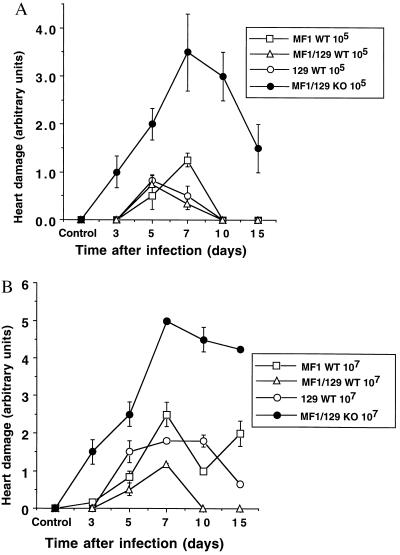
Severity of myocarditis in infected mice. Wild-type mice (MF1, 129, and MF1/129 hybrid F2) and NOS2 null mice (MF1/129 KO) were infected with (A) 105 or (B) 107 pfu of CVB3. Hearts were harvested from noninfected animals or from infected mice at times 1, 3, 5, 7, 10, and 15 days after infection. Tissue sections were stained with hematoxylin and eosin, and the severity of the myocarditis was graded. For A the differences between the NOS2 null mice and all other wild-type controls for day 5 are P < 0.05 and for days 7–15 are P < 0.001. For B the differences between the NOS2 null mice and all other wild-type controls are P < 0.005. (n = 3 sections from each of 3 mice ± SD.)
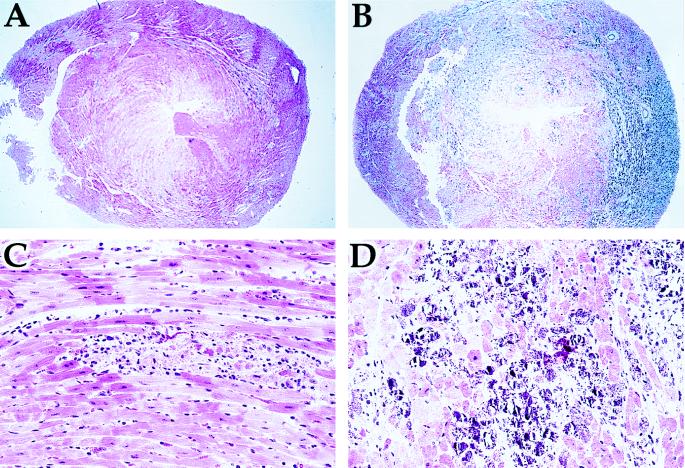
Myocarditis in wild-type and NOS2 null mice. Wild-type mice (A and C) and NOS2 null mice (B and D) were infected with 107 pfu of CVB3. Hearts were harvested and tissue sections were stained with hematoxylin and eosin. (A and B, ×40; C and D, ×240.)
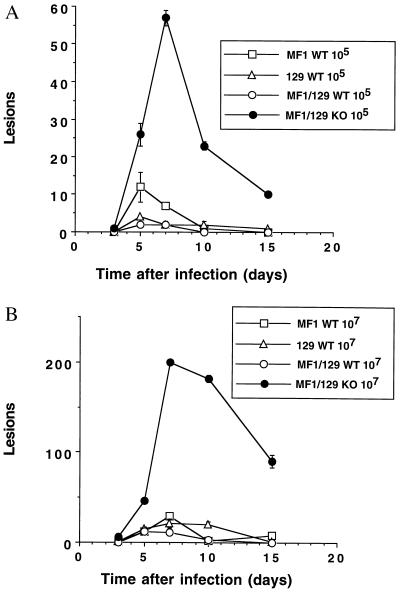
Lesions in hearts of infected mice. Wild-type mice (MF1, 129, and MF1/129 hybrid F2) and NOS2 null mice (MF1/129 KO) were infected with (A) 105 or (B) 107 pfu of CVB3. Hearts were harvested from noninfected animals or from infected mice. Tissue sections were stained with hematoxylin and eosin, and the number of lesions was counted. The difference between the NOS2 null mice and all controls is P < 0.001 (n = 3 sections from each of 3 mice ± SD).
References
Publication types
MeSH terms
Substances
Grants and funding
LinkOut - more resources
Full Text Sources
Molecular Biology Databases
