. 1998 Mar 3;95(5):2574-9.
doi: 10.1073/pnas.95.5.2574.

A substrate of the centisome 63 type III protein secretion system of Salmonella typhimurium is encoded by a cryptic bacteriophage

Affiliations

A substrate of the centisome 63 type III protein secretion system of Salmonella typhimurium is encoded by a cryptic bacteriophage

W D Hardt et al. Proc Natl Acad Sci U S A. .

Abstract

Salmonella enterica has evolved a type III protein secretion system that allows these enteropathogens to translocate effector molecules directly into the host cell cytoplasm. These effectors mediate a variety of responses, including cytoskeletal rearrangements, cytokine production, and in certain cells, the induction of apoptosis. We report here the characterization of a substrate of this secretion system in S. enterica serovar typhimurium (Salmonella typhimurium) that is homologous to the SopE protein of Salmonella dublin implicated in bacterial entry into cultured epithelial cells. The sopE locus is located within a cluster of genes that encode tail and tail fiber proteins of a cryptic P2-like prophage, outside of the centisome 63 pathogenicity island that encodes the invasion-associated type III secretion system. Southern hybridization analysis revealed that sopE is present in only a subset of S. enterica serovars and that the flanking bacteriophage genes are also highly polymorphic. Encoding effector proteins that are delivered through type III secretion systems in highly mobile genetic elements may allow pathogens to adapt rapidly by facilitating the assembly of an appropriate set of effector proteins required for successful replication in a new environment.


Figures
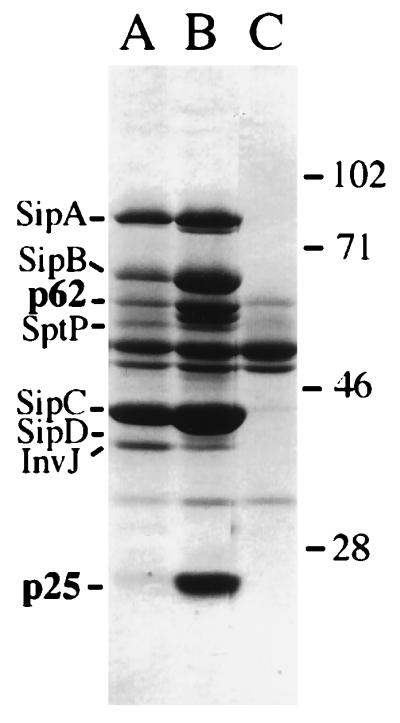
Figure 1
Figure 1
Type III secreted proteins of S. typhimurium. Culture supernatant proteins of wild-type S. typhimurium (lane A) and the isogenic sipD (lane B) and invG (lane C) strains were separated on an SDS/10% polyacrylamide gel and stained with Coomassie blue.
Figure 2
Figure 2
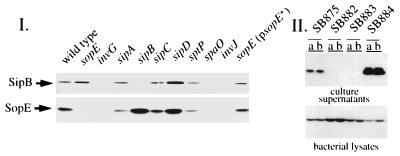
Western blot analysis of SopE secretion. (I) Effect of targets and components of the centisome 63 type III secretion system on SopE secretion. Proteins from culture supernatants of the wild-type S. typhimurium SL1344 and the isogenic strains with nonpolar mutations in sopE (SB757), invG (SB161), sipA (SB225), sipB (SB169), sipC (SB220), sipD (SB221), sptP (SB237), spaO (SB302), or invJ (SB303), as well as from SB757 complemented with pSB1130 (which carries sopE) were resolved on an SDS/12% polyacrylamide gel, transferred to a nitrocellulose membrane, and sequentially probed with antibodies directed against SopE and SipB. Reprobing for the intracellular marker protein 6-phosphogluconate dehydrogenase verified that the observed pattern of supernatant proteins was not due to bacterial lysis (data not shown). (II) Secretion of epitope-tagged SopE. Culture supernatant proteins and whole-cell lysates (duplicate independent samples, a and b) from a wild-type S. typhimurium strain expressing, under the control of its native promoter, a chromosomally encoded, M45-epitope-tagged SopE (SB875), and its isogenic derivatives carrying mutations in invG (SB882), invC (SB883), or sipD (SB884), were separated on an SDS/12% polyacrylamide gel, transferred to nitrocellulose, and probed with a mouse monoclonal antibody directed to the epitope tag.
Figure 3
Figure 3
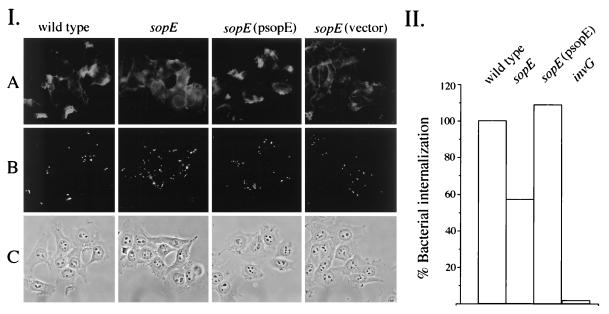
Effect of a null mutation in sopE on the interaction of S. typhimurium with Henle-407 cells. (I) Cultured Henle-407 cells were infected with S. typhimurium for 15 min, fixed, and stained with rhodamine-labeled phalloidin to visualize the actin cytoskeleton (A) and with a fluorescein isothiocyanate (FITC)-labeled antibody directed to S. typhimurium to visualize bacteria (B). (C) Phase-contrast images of the same cells. (Micrographs obtained with a ×40 objective.) (II) Internalization of the S. typhimurium sopE mutant into Henle-407 cells. Bacterial internalization levels, measured by microscopy as indicated in the text, were standardized to wild-type S. typhimurium. At a minimum, 300 cells were scored for each strain. The standard deviation of these experiments was less than 10%. The strains were as follows: wild type, SL1344; sopE, SB757; sopE (psopE), SB757 (pSB1130); invG, SB161.
Figure 4
Figure 4
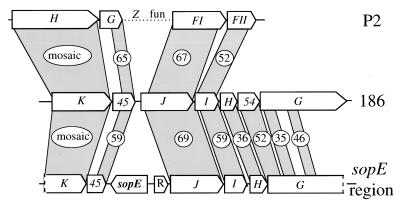
Comparison of the genetic organization of the S. typhimurium sopE chromosomal region with that of P2-like phages. Numbers in circles denote the percent identity between the indicated protein sequences.
Figure 5
Figure 5
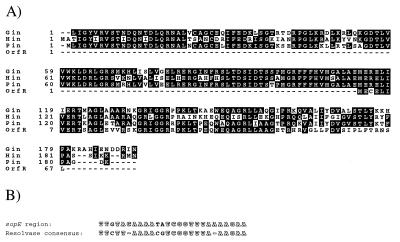
(A) Sequence alignment of S. typhimurium OrfR and site-specific recombinases. (B) Sequence alignment of a putative binding site for site-specific recombinases located 1,293 nt downstream of sopE, with the consensus binding sequence for this protein family (46).
Figure 6
Figure 6
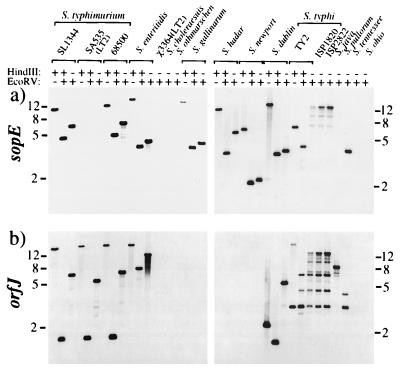
Southern hybridization analyses of the sopE and orfJ regions of Salmonella spp. Total cell DNA from various S. enterica serovars, digested with HindIII, EcoRV, or both, was probed with a 0.7-kb HindIII/XmnI fragment comprising the 3′ portion of orfJ and the 5′ portion of orfI. Blots were subsequently stripped and reprobed with a DNA fragment corresponding to the coding region of sopE.

References

    1. Ochman H, Soncini F C, Solomon F, Groisman E A. Proc Natl Acad Sc USA. 1996;93:7800–7804. - PMC - PubMed
    1. Shea J E, Hensel M, Gleeson C, Holden D W. Proc Natl Acad Sci USA. 1996;93:2593–2597. - PMC - PubMed
    1. Galán J E. Mol Microbiol. 1996;20:263–271. - PubMed
    1. Galán J E, Bliska J B. Annu Rev Cell Dev Biol. 1996;12:219–253. - PubMed
    1. Wood M W, Rosqvist R, Mullan P B, Edwards M H, Galyov E E. Mol Microbiol. 1996;22:327–338. - PubMed

Publication types

MeSH terms

Associated data

LinkOut - more resources