. 1998 Feb;274(2):R517-23.
doi: 10.1152/ajpregu.1998.274.2.R517.

Prejunctional M1 facilitory and M2 inhibitory muscarinic receptors mediate rat bladder contractility

Affiliations

Prejunctional M1 facilitory and M2 inhibitory muscarinic receptors mediate rat bladder contractility

A S Braverman et al. Am J Physiol. 1998 Feb.

Abstract

Subtype-selective muscarinic antagonists effects on carbachol-induced and electric field-stimulated contractility of rat bladder were compared in vitro. Schild plot analysis of cumulative carbachol dose-response curves in the presence of antagonists was consistent with M3-mediated bladder contractions. However, nerve-evoked contractions were inhibited 15% at 30 Hz (P < 0.01) by 10 nM pirenzepine (M1-selective antagonist), whereas 10 nM methoctramine (M2-selective antagonist) increased these contractions by 17% at 30 Hz (P < 0.01). Identical doses had no effect on carbachol-induced contractions, indicating prejunctional M1 facilitory and M2 inhibitory receptors. m1 Receptors could not be identified by subtype-selective antibodies, nor could the m1 transcript be identified by Northern hybridization. However, m1, m2, m3, and m4 transcripts were identified in rat bladder using the reverse transcriptase-polymerase chain reaction, providing support for the existence of the m1 subtype. In conclusion, strong evidence is provided for the existence of prejunctional M1 facilitory and M2 inhibitory and postjunctional M3 receptors modulating contractility in the rat urinary bladder.


Figures
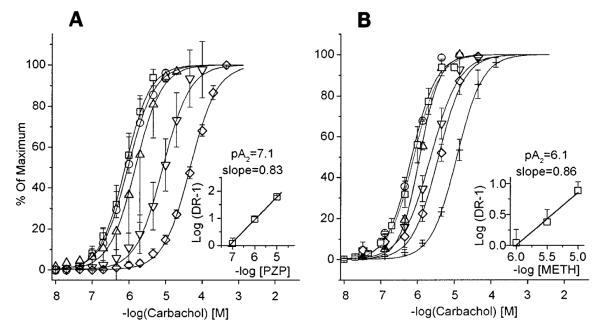
Fig. 1
Fig. 1
Carbachol dose-response displace-ment curves and Schild plots (insets) for pirenzepine (PZP, A) and methoctramine (Meth, B) effect on rat bladder strips in vitro. Data are expressed as percent of each individual strip’s maximal carbachol response. PZP: control (□), n = 16, maximum (max) = 4.8 ± 0.4 g; 10 nM (○), n = 4, max = 4.5 ± 1.4 g; 100 nM (△), n = 7, max = 4.2 ± 0.8 g; 1 μM (▽), n = 8, max = 4.0 ± 0.9 g; 10 μM (◇), n = 4, max = 4.3 ± 0.6 g. Meth: control (□), n = 16, max = 4.2 ± 0.8 g; 10 nM (○), n = 14, max = 4.3 ± 0.5 g; 100 nM (△), n = 6, max = 3.8 ± 0.4 g; 1 μM (▽) n = 5, max = 4.1 ± 1.0 g; 3 μM (◇), n = 3, max = 4.8 ± 1.2 g; 10 μM (+), n = 5, max = 3.0 ± 0.3 g. Slopes of Schild plots for both PZP and Meth are not significantly different from 1.0.
Fig. 2
Fig. 2
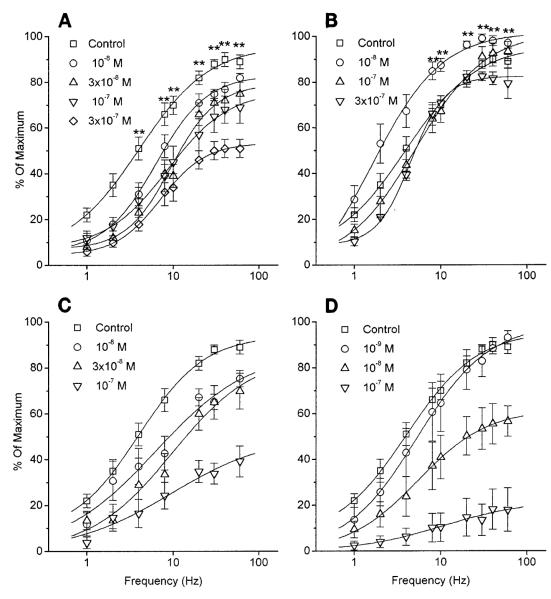
Muscarinic antagonists effect on electrically stimulated contraction of rat bladder strips in vitro. Average contractile response to electrical stimulation of 8 V, 1–60 Hz, 1-ms pulse duration, in presence of muscarinic antagonists. Data are expressed as percent of predrug maximum response for each strip. Pooled controls: (□) n = 12, max = 4.2 ± 0.7 g. PZP (A): 10 nM (○), n = 6, max = 5.7 ± 1.0 g; 30 nM (△), n = 9, max = 4.2 ± 0.4 g; 100 nM (▽), n = 3, max = 3.8 ± 0.9 g; 300 nM (◇), n = 3, max = 4.9 ± 1.0 g. Meth (B): 10 nM (○) n = 6, max = 4.0 ± 1.0 g; 100 nM (△), n = 7, max = 4.3 ± 0.7 g; 300 nM (▽), n = 3, max = 4.7 ± 0.7 g. ** Significant difference from control (P < 0.01). p-Fluoro hexahydrosilodifenidol (p-F-HHSiD, C): 10 nM (○), n = 6, max = 1.8 ± 0.5 g; 30 nM (△), n = 6, max = 2.7 ± 0.4 g; 100 nM (▽), n = 5, max = 2.0 ± 0.9 g. All p-F-HHSiD data points are significantly different from control (P < 0.01). 4-Diphenlacetoxy-N-methylpiperidine methiodide (4-DAMP, D): 1 nM (○), n = 2, max = 5.6 ± 1.6 g; 10 nM (△), n = 2, max = 6.6 ± 2.0 g; 100 nM (▽), n = 3, max = 4.2 ± 0.7 g. All 4-DAMP data points except 1 nM are significantly different from control (P < 0.01).
Fig. 3
Fig. 3
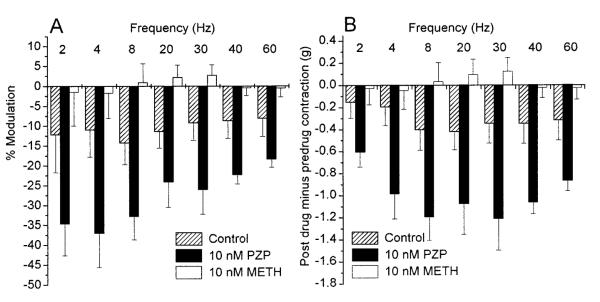
Effect of frequency on M2 inhibition or M1 facilitation of rat urinary bladder contractility. A: average percent modulation of rat urinary bladder strip contractility to electrical stimulation of 8 V, 2-60 Hz, 1-ms pulse duration, produced by 10 nM PZP and 10 nM Meth, and, for time controls, run simultaneously without antagonist. Data are expressed as average percent modulation ± SE. %Modulation = 100 × (postdrug contraction in grams – predrug contraction in grams)/predrug contraction in grams for each frequency. B: actual difference in grams ± SE of postdrug contractions minus predrug base-line contractions for time control, 10 nM PZP, and 10 nM Meth.
Fig. 4
Fig. 4
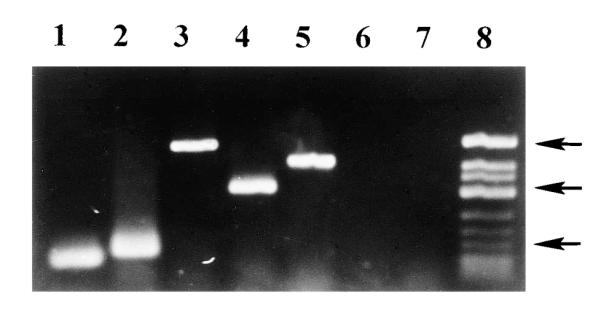
Ethidium bromide-stained agarose gel of reverse transcriptase-polymerase chain reaction (RT-PCR) products for the m1-m5 muscarinic receptors. Primers specific for muscarinic receptor subtypes were used to amplify DNA products, with the use of PCR, from a cDNA library prepared from rat urinary bladder RNA. Lane 1, m1-a primers, 123-base pair (bp) product; lane 2, m1-b primers, 175-bp product; lane 3, m2 primers, 686-bp product; lane 4, m3 primers, 433-bp product; lane 5, m4 primers, 587-bp product; lane 6, m5 primers, no product; lane 7, no RT control with m1-a primers, no product; lane 8, molecular weight marker. Top arrow, 725 bp; middle arrow, 417 bp; bottom arrow, 200 bp.

References

    1. Alberts P. Classification of the presynaptic muscarinic receptor subtype that regulates 3H-acetylcholine secretion in the guinea pig urinary bladder in vitro. J. Pharmacol. Exp. Ther. 1995;274:458–568. - PubMed
    1. Bonner TI, Buckley NJ, Young AC, Brann MR. Identification of a family of muscarinic acetylcholine receptor genes. Science. 1987;237:527–532. - PubMed
    1. Caulfield MP. Muscarinic receptors-characterization, coupling and function. Pharmacol. Ther. 1993;58:319–379. - PubMed
    1. Choppin A, Eglen RM, Hedge SS. Muscarinic M2 receptors modulate relaxant responses to isoproterenol in rat urinary bladder (Abstract) Life Sci. 1997;60:1193.
    1. Daniel EE, Gaspar V, Berzin I, Kwan C-Y. Characterization of α2-adrenoceptors and other adrenoceptors in mem-branes isolated from dog mesenteric nerve axons. J. Pharmacol. Exp. Ther. 1995;275:978–986. - PubMed

Publication types

MeSH terms

LinkOut - more resources