. 1998 Mar;9(3):611-21.
doi: 10.1091/mbc.9.3.611.

Regulation of telomere length by checkpoint genes in Schizosaccharomyces pombe

Affiliations
Free PMC article

Regulation of telomere length by checkpoint genes in Schizosaccharomyces pombe

M Dahlen et al. Mol Biol Cell. 1998 Mar.
Free PMC article

Abstract

We have studied telomere length in Schizosaccharomyces pombe strains carrying mutations affecting cell cycle checkpoints, DNA repair, and regulation of the Cdc2 protein kinase. Telomere shortening was found in rad1, rad3, rad17, and rad26 mutants. Telomere lengths in previously characterized rad1 mutants paralleled the replication checkpoint proficiency of those mutants. In contrast, rad9, chk1, hus1, and cds1 mutants had intact telomeres. No difference in telomere length was seen in mutants affected in the regulation of Cdc2, whereas some of the DNA repair mutants examined had slightly longer telomeres than did the wild type. Overexpression of the rad1(+) gene caused telomeres to elongate slightly. The kinetics of telomere shortening was monitored by following telomere length after disruption of the rad1(+) gene; the rate was approximately 1 nucleotide per generation. Wild-type telomere length could be restored by reintroduction of the wild-type rad1(+) gene. Expression of the Saccharomyces cerevisiae RCK1 protein kinase gene, which suppresses the radiation and hydroxyurea sensitivity of Sz. pombe checkpoint mutants, was able to attenuate telomere shortening in rad1 mutant cells and to increase telomere length in a wild-type background. The functional effects of telomere shortening in rad1 mutants were assayed by measuring loss of a linear and a circular minichromosome. A minor increase in loss rate was seen with the linear minichromosome, and an even smaller difference compared with wild-type was detected with the circular plasmid.


Figures
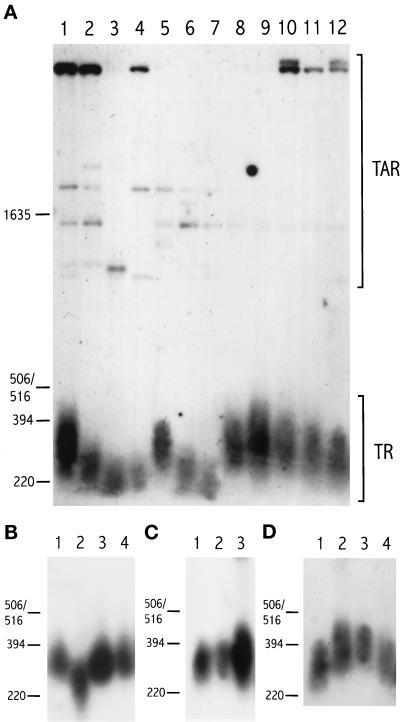
Figure 1
Figure 1
Southern blot analysis of telomere length in different mutant and wild-type Sz. pombe strains. Cells were grown for ∼100 generations before harvest. Genomic DNA was restricted with ApaI and separated on 1.2% agarose gels. DNA was blotted to filters and probed with the 1.9-kb ApaI fragment of pEN42 (Nimmo et al., 1994). Positions of DNA size markers and their sizes in base pairs are given on the left. (A) Lane 1, strain 972h (wild type); lane 2, h rad1-1 ura4; lane 3, rad3-136 ura4 leu1; lane 4, NRC2341 (hrad3-136); lane 5, rad9-192 ade6 ura4; lane 6, GK3 (rad17); lane 7, h rad26::ura4+ leu1-32 ade6-704; lane 8, h chk1::ura4+ leu1-32 ade6-704; lane 9, PR 87.97 (cdc2-1w); lane 10, cdc2-3w ura4 leu1 his3; lane 11, PGYQ686 (wee1::ura4+); lane 12, cdc25OP (adh:cdc25+). Brackets indicate the position of internal TAR and of the heterogeneous telomeric restriction fragment (TR). (B) Lane 1, 972h; lane 2, h rad26::ura4+; lane 3, hus1::LEU2; lane 4, cds1::ura4+. (C) Lane 1, 972h; lane 2, NRC3242 (rad8-190); lane 3, NRC3239 (rad5). (The amount of DNA loaded in lane 3 is greater than in the other two lanes.) (D) Lane 1, 972h; lane 2, NRC3241 (rad13); lane 3, NRC3240 (rad16); lane 4, rad21-45 ura4 leu1.
Figure 2
Figure 2
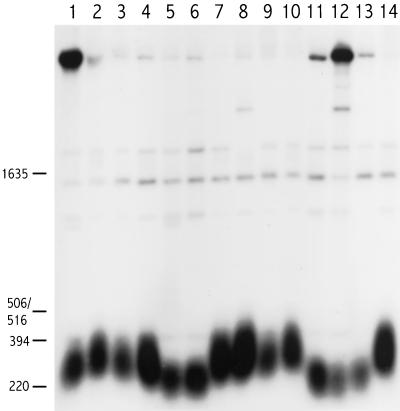
Telomere lengths in different rad1 mutants. Cells were grown for ∼100 generations, and DNA was analyzed as described in the legend to Figure 1. Lane 1, 972h; lane 2, h ura4-D18 leu1-32 his3; lane 3, KLP20 (rad1-S1); lane 4, KLP23 (rad1-S2); lane 5, GK21 (rad1-S3); lane 6, GK22 (rad1-S4); lane 7, GK23 (rad1-S5); lane 8, GK24 (rad1-S6); lane 9, PS56 (rad1-S56); lane 10, h+ ura4-D18 leu1-32 his3; lane 11, PS36 (rad1::ura4+); lane 12, PS32r (rad1::ura4+); lane 13, GK20 (rad1::ura4+); lane 14, h+ ura4-D18 leu1-32 his3.
Figure 3
Figure 3
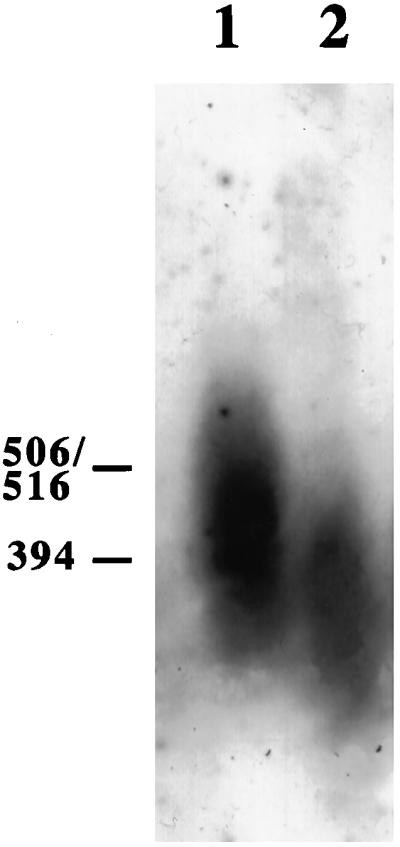
Telomere length after overexpression of rad1+. Cells were grown for 100 generations and Southern blot analysis was as detailed in the legend to Figure 1. Lane 1, SPT2 (wild-type strain h+ ura4-D18 leu1-32 his3 transformed with pGSR3 carrying rad1+ cDNA under control of the nmt1 promoter); lane 2, h+ ura4-D18 leu1-32 his3.
Figure 4
Figure 4
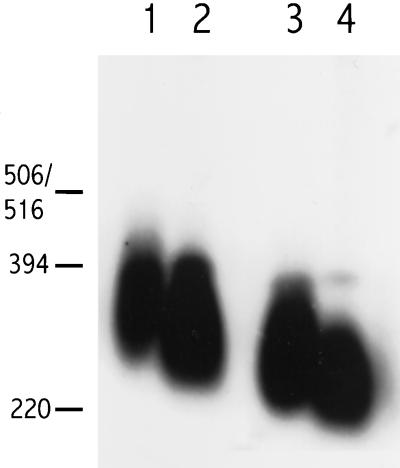
Expression of the S. cerevisiae protein kinase-encoding gene RCK1 from the regulatable nmt1 promoter in a chromosomally integrated construct causes telomere elongation in Sz. pombe. Southern blot analysis as detailed in the legend to Figure 1. Lane 1, AD1 (972h-derived strain expressing RCK1); lane 2, 972h; lane 3, AD2 (strain expressing RCK1; derived from PS36); lane 4, PS36 (rad1::ura4+).
Figure 5
Figure 5
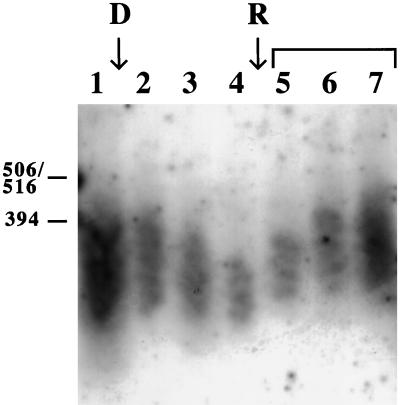
Time course of telomere shortening after disruption of the rad1+ gene and of restoration of wild-type telomeres after reintroduction of wild-type rad1+. Wild-type strain h+ ura4-D18 leu1-32 his3 was transformed with pr1u4 and DNA was isolated at various times thereafter. D, point where the rad1+ gene was disrupted; R, point where the rad1+ gene was reintroduced. Brackets above lanes indicate where the rad1+ gene was expressed from a multicopy plasmid (pIRT2R1). Southern blot as described in the legend to Figure 1. Lane 1, DNA was isolated before disruption (0 h); lane 2, 30 generations postdisruption (transformant colony expanded to 5 × 10⁸ cells); lane 3, 60 generations; lane 4, 100 generations postdisruption. The disruptant strain was then transformed with plasmid pIRT2R1 containing the wild-type rad1+ gene. Lane 5, 30 generations after reintroduction of rad1+; lane 6, 50 generations; lane 7, 100 generations.
Figure 6
Figure 6
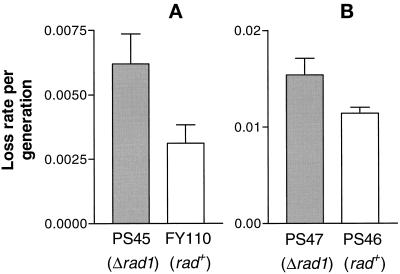
Frequency of minichromosome loss in wild-type and Δrad1 strains. The genomic rad1+ gene was disrupted in a strain carrying the minichromosome, and the resultant strain and its wild-type parent were grown for ∼100 generations. The frequency of chromosome loss per generation was estimated directly from the fraction of half-sectored colonies plus one-half the fraction of colonies with one-quarter section red and three-quarters white. Each value given is the average of at least three readings and represents counting of at least 5000 colonies. Error bars, ± 1 SE of the mean. (A) Linear minichromosome Ch16; (B) circular minichromosome CM3112.

References

    1. Al-Khodairy F, Carr AM. DNA repair mutants defining G2 checkpoint pathways in Schizosaccharomyces pombe. EMBO J. 1992;11:1343–1350. - PMC - PubMed
    1. Al-Khodairy F, Fotou E, Sheldrick KS, Griffiths DJF, Lehmann AR, Carr AM. Identification and characterization of new elements involved in checkpoint and feedback controls in fission yeast. Mol Biol Cell. 1994;5:147–160. - PMC - PubMed
    1. Allshire R, Nimmo ER, Ekwall K, Javerzat JP, Cranston G. Mutations derepressing silent centromeric domains in fission yeast disrupt chromosome segregation. Genes Dev. 1995;9:218–233. - PubMed
    1. Birkenbihl RP, Subramani S. Cloning and characterization of rad21, an essential gene of Schizosaccharomyces pombe involved in DNA double-strand-break repair. Nucleic Acids Res. 1992;20:6605–6611. - PMC - PubMed
    1. Boulton SJ, Jackson SP. Identification of a Saccharomyces cerevisiae Ku80 homologue: roles in DNA double strand break rejoining and in telomeric maintenance. Nucleic Acids Res. 1996;24:4639–4648. - PMC - PubMed

Publication types

MeSH terms