. 1998 Mar;66(3):987-93.
doi: 10.1128/IAI.66.3.987-993.1998.

Phase variation of hemoglobin utilization in Neisseria gonorrhoeae

Affiliations

Phase variation of hemoglobin utilization in Neisseria gonorrhoeae

C J Chen et al. Infect Immun. 1998 Mar.

Abstract

Most Neisseria gonorrhoeae isolates are unable to use human hemoglobin as the sole source of iron for growth (Hgb-), but a minor population is able to do so (Hgb+). This minor population grows luxuriously on hemoglobin, expresses two outer membrane proteins of 42 kDa (HpuA) and 89 kDa (HpuB), and binds hemoglobin under iron-stressed conditions. In addition to the previously reported HpuB, we identified and characterized HpuA, which is encoded by the gene hpuA, located immediately upstream of hpuB. Expression of both proteins was found to be controlled at the translational level by frameshift mutations in a run of guanine residues within the hpuA sequence encoding the mature HpuA protein. The "on-phase" hemoglobin-utilizing variants contained 10 G's, while the "off-phase" variants contained 9 G's. Insertional hpuB mutants of FA19 Hgb+ and FA1090 Hgb+ no longer expressed HpuB but still produced HpuA. A polar insertional mutation of the upstream hpuA gene in FA1090 Hgb+ eliminated production of both HpuA and HpuB, whereas a nonpolar insertional mutant expressed HpuB only. Insertional mutagenesis of either hpuA or hpuB or both substantially decreased the hemoglobin binding ability of the FA1090 Hgb+ variant and prevented growth on hemoglobin plates. Therefore, both HpuA and HpuB were required for the utilization of hemoglobin for growth.


Figures
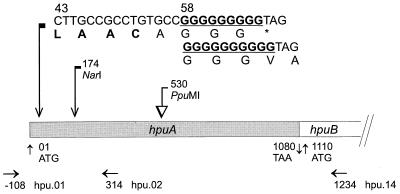
FIG. 1
FIG. 1
Descriptive map of FA1090 hpuA. Numbers indicate positions of first nucleotides. The open reading frames (ORFs) for hpuA and hpuB start at nucleotide positions 01 and 1,110, respectively. Beginning from position 43 is a consensus coding sequence for a type-II signal peptidase cleavage site, LAAC. A run of multiple guanine residues was located in hpuA, starting from position 58. The asterisk indicates a stop codon. A 1,130-bp fragment was isolated between the NarI site in hpuA and an XbaI site in the vector for mutagenesis. The PpuMI site was the insertion site for making various mutants. The primer pair, hpu.01 and hpu.14, was used in PCRs for the cloning of hpuA. The other primer pair, hpu.01 and hpu.02, was used to generate PCR products for enumerating guanine residues in the poly(G) tract.
FIG. 2
FIG. 2
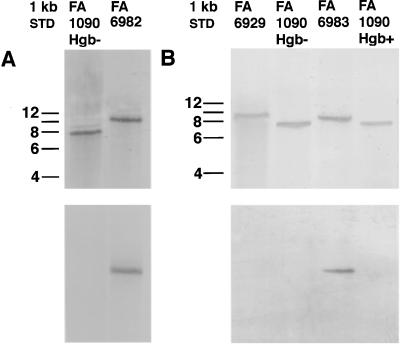
Southern blot analysis of hpuA and hpuB insertional mutants. Chromosomal DNAs from FA1090 parent and mutant strains were digested with ClaI and transferred bidirectionally to prepare two blots per gel. Hgb was the non-hemoglobin-utilizing variant, while Hgb+ was the hemoglobin-utilizing variant and the recipient for insertional mutation. (A) Blots of DNA fragments from FA6982, a polar insertional hpuA mutant, were probed with an hpuB fragment (upper panel) and an Ω fragment (lower panel). (B) Blots of DNA fragments from FA6929, an hpuB mutant, and FA6983, a nonpolar hpuA mutant, were probed with an hpuB fragment (upper panel) and an aphA-3 fragment (lower panel).
FIG. 3
FIG. 3
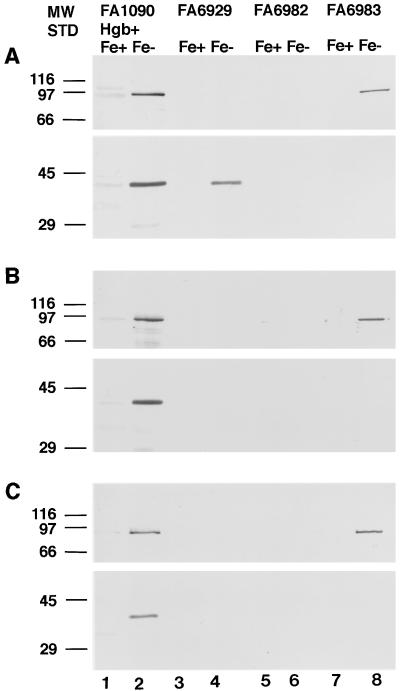
Detection of HpuA and HpuB among the total membrane proteins (A), the outer membrane proteins (B), and the hemoglobin-binding proteins (C) prepared from the hpuA and/or hpuB mutants of FA1090 Hgb+ grown under iron-replete (Fe+) or iron-stressed (Fe) conditions. FA6929 is an hpuB insertional mutant, and FA6982 and FA6983 are polar and nonpolar hpuA insertional mutants, respectively. Western blots of total membrane proteins, outer membrane proteins, and hemoglobin-binding affinity-purified proteins were cut into two panels each, one probed with affinity-purified anti-HpuB serum (upper panels) and the other probed with affinity-purified anti-HpuA serum (lower panels).
FIG. 4
FIG. 4
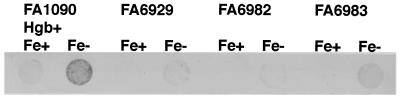
Dot blot assay showing binding of biotinylated human hemoglobin to iron-replete (Fe+) and iron-stressed (Fe) whole cells. FA1090 Hgb+ is the parent strain. FA6929 is an hpuB insertional mutant, and FA6982 and FA6983 are polar and nonpolar hpuA insertional mutants, respectively.
FIG. 5
FIG. 5
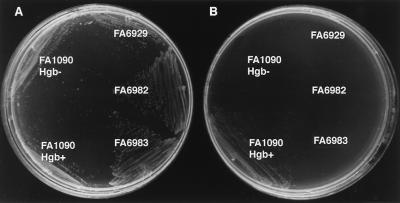
Growth phenotypes on GCB plate (A) and hemoglobin-Desferal plate (B). FA1090 Hgb is the non-hemoglobin-utilizing variant, and FA1090 Hgb+ is the hemoglobin-utilizing variant. FA6929 is an hpuB insertional mutant, and FA6982 and FA6983 are polar and nonpolar hpuA insertional mutants of FA1090 Hgb+, respectively.

References

    1. Anderson J E, Sparling P F, Cornelissen C N. Gonococcal transferrin-binding protein 2 facilitates but is not essential for transferrin utilization. J Bacteriol. 1994;176:3162–3170. - PMC - PubMed
    1. Apicella M A, Shero M, Jarvis G A, Griffiss J M, Mandrell R E, Schneider H. Phenotypic variation in epitope expression of the Neisseria gonorrhoeae lipooligosaccharide. Infect Immun. 1987;55:1755–1761. - PMC - PubMed
    1. Biswas, G., and P. F. Sparling. 1997. Personal communication.
    1. Biswas G D, Sparling P F. Characterization of lbpA, the structural gene for a lactoferrin receptor in Neisseria gonorrhoeae. Infect Immun. 1995;63:2958–2967. - PMC - PubMed
    1. Blanton K J, Biswas G D, Tsai J, Adams J, Dyer D W, Davis S M, Koch G G, Sen P K, Sparling P F. Genetic evidence that Neisseria gonorrhoeae produces specific receptors for transferrin and lactoferrin. J Bacteriol. 1990;172:5225–5235. - PMC - PubMed

Publication types

MeSH terms

LinkOut - more resources