. 1998 Mar;66(3):1000-7.
doi: 10.1128/IAI.66.3.1000-1007.1998.

The Pseudomonas aeruginosa flagellar cap protein, FliD, is responsible for mucin adhesion

Affiliations

The Pseudomonas aeruginosa flagellar cap protein, FliD, is responsible for mucin adhesion

S K Arora et al. Infect Immun. 1998 Mar.

Abstract

Mucin-specific adhesion of Pseudomonas aeruginosa plays an important role in the initial colonization of this organism in the airways of cystic fibrosis patients. We report here that the flagellar cap protein, FliD, participates in this adhesion process. A polar chromosomal insertional mutation in the P. aeruginosa fliD gene made this organism nonadhesive to mucin in an in vitro mucin adhesion assay. The adhesive phenotype was restored by providing the fliD gene alone on a multicopy plasmid, suggesting involvement of this gene in mucin adhesion of P. aeruginosa. Further supporting this observation, the in vitro competition experiments demonstrated that purified FliD protein inhibited the mucin adhesion of nonpiliated P. aeruginosa PAK-NP, while the same concentrations of PilA and FlaG proteins of P. aeruginosa were ineffective in this function. The regulation of the fliD gene was studied and was found to be unique in that the transcription of the fliD gene was independent of the flagellar sigma factor sigma28. Consistent with this finding, no sigma28 binding sequence could be identified in the fliD promoter region. The results of the beta-galactosidase assays suggest that the fliD gene in P. aeruginosa is regulated by the newly described transcriptional regulator FleQ and the alternate sigma factor sigma54 (RpoN).


Figures
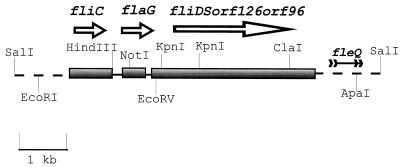
FIG. 1
FIG. 1
Map of the fliDSorf126orf96 region showing the gene arrangement in P. aeruginosa. The map is drawn approximately to scale. The shaded rectangles show the coding regions. The arrows beside the shaded rectangles indicate the direction of transcription. The EcoRV site used for insertional inactivation of the fliD gene is shown.
FIG. 2
FIG. 2
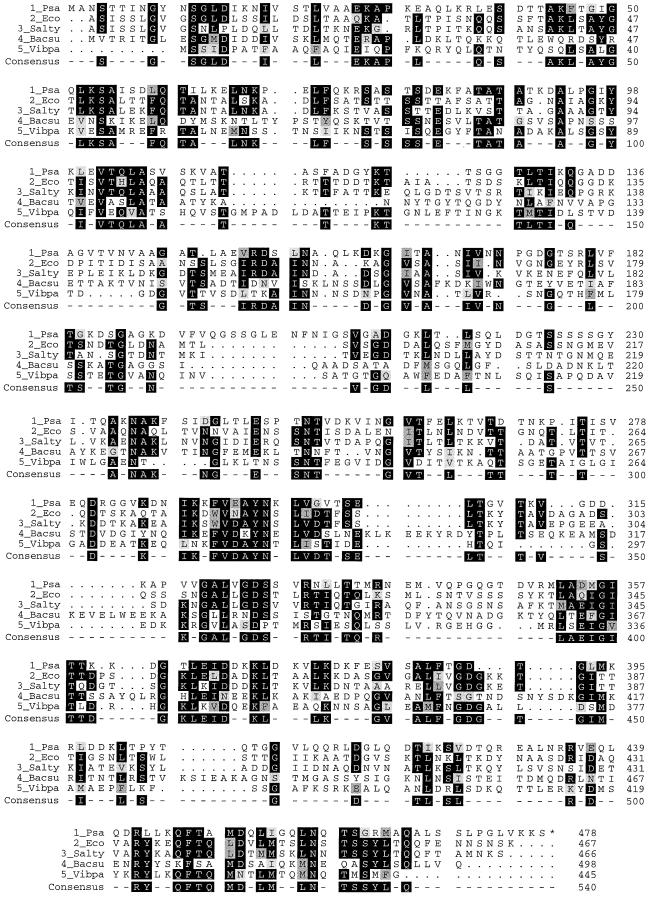
Computer-generated alignment (Prettybox program [Richard Westerman, Purdue University]) of FliD of P. aeruginosa with homologous FliD proteins of other organisms. Dark shading shows identity of amino acids, while the two shades of gray show degrees of similarity (based on the GCG Comparison Table [Genetics Computer Group, University of Wisconsin, Madison]). Psa, P. aeruginosa; Eco, E. coli; Salty, S. typhimurium; Bacsu, B. subtilis; Vibpa, V. parahaemolyticus.
FIG. 3
FIG. 3
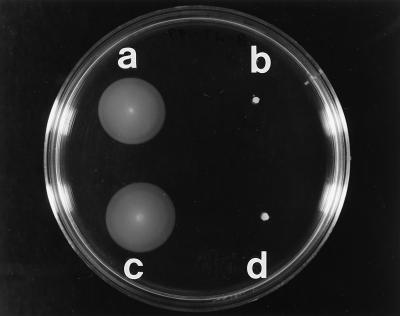
Soft L agar (0.3%) plate showing the motility phenotype of different P. aeruginosa strains. (a) pilA mutant PAK-NP. (b) pilA fliD mutant PAK-NPD. (c) PAK-NPD containing pPZ375D. (d) PAK-NPD containing the multicopy vector pPZ375.
FIG. 4
FIG. 4
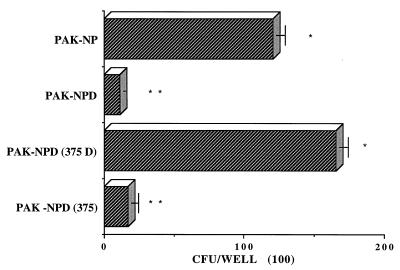
Adhesion of pilA and fliD mutants of P. aeruginosa PAK to mucin. PAK-NP, pilA mutant of PAK; PAK-NPD, pilA fliD mutant of PAK; PAK-NPD (375D), PAK-NPD complemented with the complete fliD gene on a multicopy plasmid vector, pPZ375; PAK-NPD (375), PAK-NPD with the vector pPZ375. Differences shown by asterisks are significant (∗ versus ∗∗, P < 0.001) by Student’s t test.
FIG. 5
FIG. 5
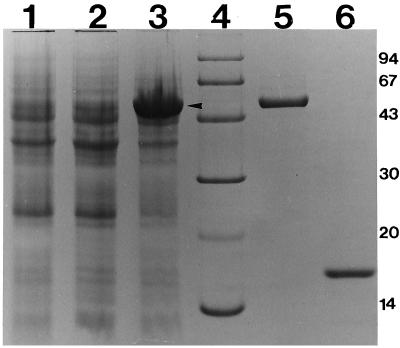
Overexpression and purification of FliD. FliD was overexpressed in E. coli host BL21 with the expression vector pET15B (Novagen, Inc.). Lanes: 1, BL21(pET15B) vector control induced with 2 mM IPTG for 4 h at 37°C; 2, BL21(pET15BD) vector with FliD insert uninduced; 3, BL21(pET15BD) vector with FliD insert induced with 2 mM IPTG for 4 h at 37°C; 4, Pharmacia low-molecular-mass (kilodaltons) markers; 5, approximately 400 ng of purified His-FliD protein; 6, approximately 400 ng of purified His-FlaG protein.
FIG. 6
FIG. 6
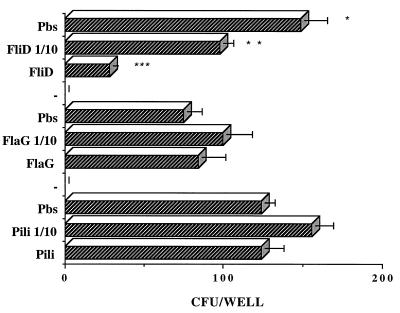
Effect of FliD protein on P. aeruginosa binding to mucin. The mucin adhesion of P. aeruginosa PAK-NP in PBS (Pbs) is compared to mucin adhesion in the presence of different amounts of P. aeruginosa proteins. Two control P. aeruginosa proteins, FlaG and PilA, were used at the same molar concentrations as FliD to test for any nonspecific effects of a protein. Differences shown by asterisks are significant (∗ versus ∗∗, P < 0.01; ∗ versus ∗∗∗, P < 0.001) by Student’s t test.
FIG. 7
FIG. 7
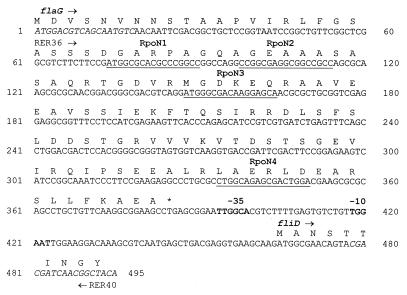
Promoter region of fliDSorf126orf96 operon. The promoter region of fliDSorf126orf96 used for β-galactosidase assays included the complete coding sequence of the flaG gene and extended into the coding region of fliD. The primers used for the β-galactosidase experiments, RER36 and RER40, are shown. In the upstream sequence, the four putative RpoN binding sites (YTGGYAYR-N3-YYTGCW) are underlined and the −10 and −35 elements of the ς70 binding site (TTGACA-N17-TATAAT) are in boldface.

References

    1. Altschul S F, Gish W, Miller W, Myers E W, Lipman D J. Basic alignment search tool. J Mol Biol. 1990;215:403–410. - PubMed
    1. Arora S K, Ritchings B W, Almira E C, Lory S, Ramphal R. Cloning and characterization of Pseudomonas aeruginosa fliF, necessary for flagellar assembly and bacterial adherence to mucin. Infect Immun. 1996;64:2130–2136. - PMC - PubMed
    1. Arora S K, Ritchings B W, Almira E C, Lory S, Ramphal R. A transcriptional activator, FleQ, regulates mucin adhesion and flagellar gene expression in Pseudomonas aeruginosa in a cascade manner. J Bacteriol. 1997;179:5574–5581. - PMC - PubMed
    1. Birnboim H C, Doly J. A rapid alkaline extraction procedure for screening recombinant plasmid DNA. Nucleic Acids Res. 1979;7:1513–1523. - PMC - PubMed
    1. Brun Y V, Shapiro L. A temporally controlled sigma-factor is required for polar morphogenesis and normal cell division in Caulobacter. Genes Dev. 1992;6:2395–2408. - PubMed

Publication types

Associated data

LinkOut - more resources