. 1998 Mar;66(3):1113-20.
doi: 10.1128/IAI.66.3.1113-1120.1998.

Identification of virulence-associated characteristics in clinical isolates of Yersinia enterocolitica lacking classical virulence markers

Affiliations

Identification of virulence-associated characteristics in clinical isolates of Yersinia enterocolitica lacking classical virulence markers

T Grant et al. Infect Immun. 1998 Mar.

Abstract

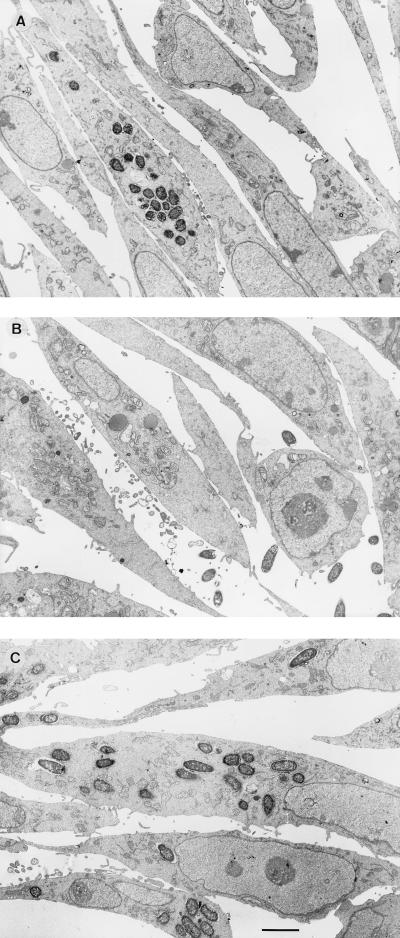
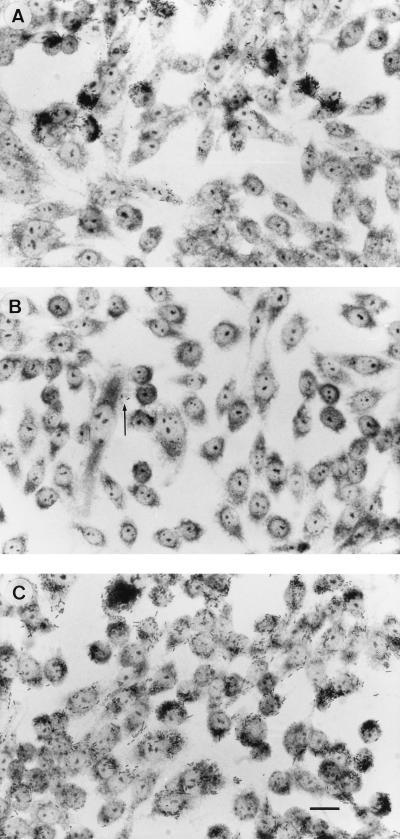
Yersinia enterocolitica is an important enteric pathogen which has well-defined virulence determinants that allow the bacteria to become established in their hosts and overcome host defenses. A number of strains obtained from patients with diarrhea, however, lack these genes. Accordingly, the mechanisms by which they cause disease are uncertain. Most of these isolates belong to biotype 1A. Strains of this biotype are also frequently isolated from a variety of nonclinical sources, such as food, soil, water, and healthy animals, and there is evidence that some of these strains are avirulent. In this study we investigated 111 strains of Y. enterocolitica biotype 1A, 79 from symptomatic humans and 32 from nonclinical sources, for virulence-associated characteristics. DNA hybridization studies showed that none of the strains carried sequences homologous with pYV, the approximately 70-kb Yersinia virulence plasmid. Some strains hybridized with DNA probes for one of the following chromosomal virulence-associated genes: ail (7.2%), myfA (11.7%), ystA (0.9%), and ystB (85%). In addition, 33 strains (29.7%) produced an enterotoxin that was reactive in infant mice. However, the frequencies of these virulence-associated properties in clinical and nonclinical isolates were similar. Clinical isolates invaded HEp-2 cells and Chinese hamster ovary cells to a significantly greater extent than nonclinical strains (P < or = 0.002). In addition, clinical strains colonized the intestinal tracts of perorally inoculated mice for significantly longer periods than nonclinical isolates (P < or = 0.01). Light and electron microscopic examination of tissue culture cells incubated with invasive yersiniae revealed that the bacteria invaded selected cells in large numbers but spared others, suggesting that biotype-1A strains of Y. enterocolitica may invade cells by a novel mechanism. These results indicate that some clinical isolates of Y. enterocolitica which lack classical virulence markers may be able to cause disease via virulence mechanisms which differ from those previously characterized in enteropathogenic Yersinia species.


Figures
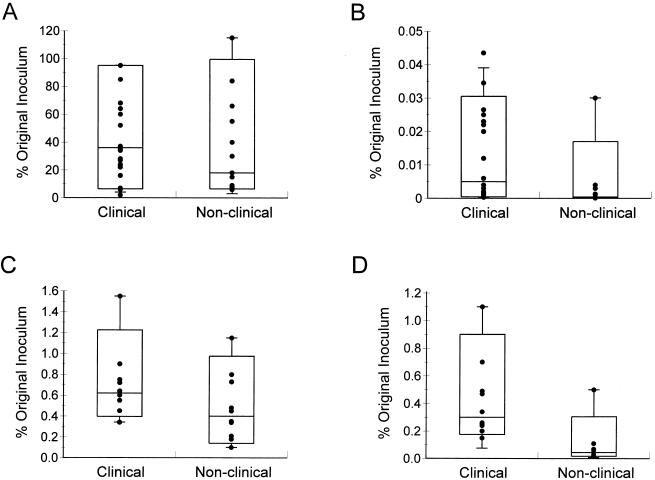
FIG. 1
FIG. 1
Abilities of clinical and nonclinical strains of Y. enterocolitica biotype 1A to adhere to (A) and invade (B) HEp-2 cells and to adhere to (C) and invade (D) CHO cells. Approximately 107 CFU was incubated with epithelial cells for 3 h before nonadherent bacteria were removed by three washes. To determine the number of adhesive bacteria, some epithelial cells were lysed and the cell-associated bacteria were enumerated. To determine the number of intracellular bacteria, other epithelial cells were incubated in fresh tissue culture medium containing 100 μg of gentamicin/ml for 90 min before epithelial cells were lysed and bacteria were enumerated. Data are expressed as percentages of the original inoculum and are means from at least two separate experiments using duplicate wells. In the box-and-whisker plots, the horizontal line within the box is the median value, the limits of the box are the 10th and 90th percentiles, and the whiskers are the 5th and 95th percentiles. The difference in adhesion between the two groups of isolates is not significant (P = 0.3 for HEp-2 cells and P = 0.14 for CHO cells by the Mann-Whitney test). The difference in invasion between the two groups of isolates is significant (P = 0.002 for HEp-2 cells and P < 0.001 for CHO cells).
FIG. 2
FIG. 2
TEM of CHO cells incubated for 3 h with representative strains of Y. enterocolitica: 937 (biotype 1A, invasive) (A), AM5 (biotype 1A, noninvasive) (B), and W22703c (biotype 2, invasive) (C). Findings similar to those illustrated in panels A and B were observed with eight other strains of Y. enterocolitica biotype 1A, five invasive and three noninvasive. Bar = 1 μm.
FIG. 3
FIG. 3
CHO cells incubated for 3 h with representative strains of Y. enterocolitica: 937 (biotype 1A, invasive) (A), AM5 (biotype 1A, noninvasive) (B), and W22703c (biotype 2, invasive) (C). Large numbers of strain 937 are associated with groups of five or more CHO cells, whereas only a few bacteria (arrows) of strain AM5 are associated with these cells. Strain W22703c demonstrates a more even pattern of association with the CHO cells. Findings similar to those illustrated in panels A and B were observed with eight other strains of Y. enterocolitica biotype 1A, five invasive and three noninvasive. Giemsa stain was used. Bar = 5 μm.
FIG. 4
FIG. 4
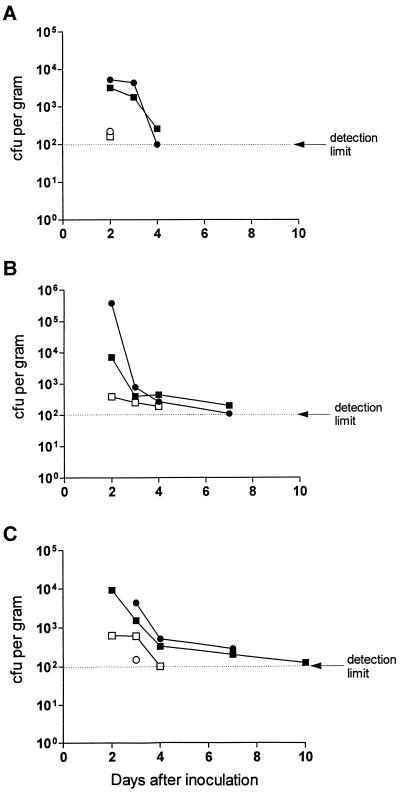
Colonization of BALB/c mice by strains of Y. enterocolitica. Mice were inoculated by gavage with one of four strains of biotype-1A Y. enterocolitica, namely, clinical isolate 61525 (•) or 937 (▪) or nonclinical isolate IP2222 (○) or AM5 (□). Each point represents the mean CFU obtained from the ilea (A), ceca (B), or colons (C) of three mice at the times indicated after inoculation. The duration of colonization by clinical isolates in all three sites was significantly longer than that for the nonclinical strains (P ≤ 0.01).

References

    1. Ausubel F M, Brent R, Kingston R E, Moore D D, Seidman J G, Smith J A. Current protocols in molecular biology. New York, N.Y: John Wiley & Sons, Inc.; 1991.
    1. Barrow G I, Feltham R K A. Cowan and Steel’s manual for the identification of medical bacteria. 3rd ed. Cambridge, United Kingdom: Cambridge University Press; 1993.
    1. Bissett M L, Powers C, Abbott S L, Janda J M. Epidemiologic investigations of Yersinia enterocolitica and related species: sources, frequency, and serogroup distribution. J Clin Microbiol. 1990;28:910–912. - PMC - PubMed
    1. Bliska J B, Copass M C, Falkow S. The Yersinia pseudotuberculosis adhesin YadA mediates intimate bacterial attachment to and entry into HEp-2 cells. Infect Immun. 1993;61:3914–3921. - PMC - PubMed
    1. Bottone E J. Yersinia enterocolitica: the charisma continues. Clin Microbiol Rev. 1997;10:257–276. - PMC - PubMed

Publication types

LinkOut - more resources