. 1998 Mar;66(3):1208-15.
doi: 10.1128/IAI.66.3.1208-1215.1998.

Defective nitric oxide effector functions lead to extreme susceptibility of Trypanosoma cruzi-infected mice deficient in gamma interferon receptor or inducible nitric oxide synthase

Affiliations

Defective nitric oxide effector functions lead to extreme susceptibility of Trypanosoma cruzi-infected mice deficient in gamma interferon receptor or inducible nitric oxide synthase

C Hölscher et al. Infect Immun. 1998 Mar.

Abstract

Trypanosoma cruzi, the causative agent of Chagas' disease, induces an innate and adaptive host immune response during the acute phase of infection. These responses were analyzed by comparing mouse lines deficient for the gamma interferon (IFN-gamma) receptor (IFN-gammaR(-/-)) or deficient for inducible nitric oxide synthase (iNOS(-/-)). Both lines were highly susceptible, with similar and dramatically increased parasite burdens and severe histopathology and were incapable of surviving even very low doses, exhibiting similar mortality kinetics. This pathophysiological correlation has a common cause, since both mutant mouse strains were unable to respond to infection by producing nitric oxide (NO) with the consequence that mutant macrophages had impaired trypanocidal activities. These in vivo and subsequent in vitro studies further demonstrated that an IFN-gamma-dependent pathway of iNOS induction is crucial for efficient NO production and mandatory for resisting acute infection with T. cruzi. Despite this defect, both mutant mouse strains had a rather normal proinflammatory cytokine response (interleukin-12 [IL-12], IFN-gamma, IL-6), with the exception of an impaired tumor necrosis factor alpha and IL-1alpha response in IFN-gammaR(-/-) mice, demonstrating that only the latter two cytokines are dependent on IFN-gamma activation. Moreover, polarization of T cells in type 1 and type 2 T-helper (Th1/Th2) and cytotoxic T (Tc1/Tc2) cells as well as T. cruzi-specific antibody responses were normal in IFN-gammaR(-/-) mice, demonstrating that IFN-gamma is not necessary for the promotion of T-cell differentiation and T. cruzi-specific antibody responses.


Figures
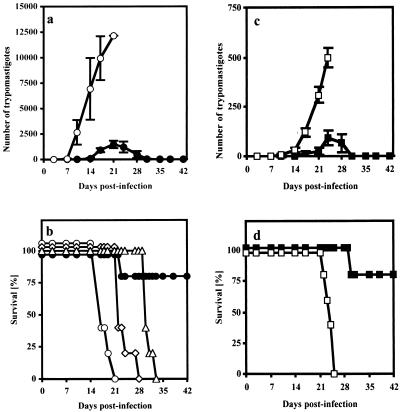
FIG. 1
FIG. 1
Parasitemia and survival of mutant mice infected with T. cruzi. IFN-γR−/− (open symbols) and wild-type (closed symbols) mice were each infected with 100 blood trypomastigotes, and the subsequent parasitemia (trypomastigotes per microliter) (a) was observed as described in Materials and Methods. Mice were each infected with 100 (○, •), 50 (◊), or 15 (▵) blood trypomastigotes, and survival (b) was monitored. iNOS−/− (open symbols) and wild-type (closed symbols) mice were each infected with 15 blood trypomastigotes, and parasitemia (trypomastigotes per microliter) (c) and survival (d) were monitored. Results are expressed as the means ± standard deviations (error bars) of five mice/group.
FIG. 2
FIG. 2
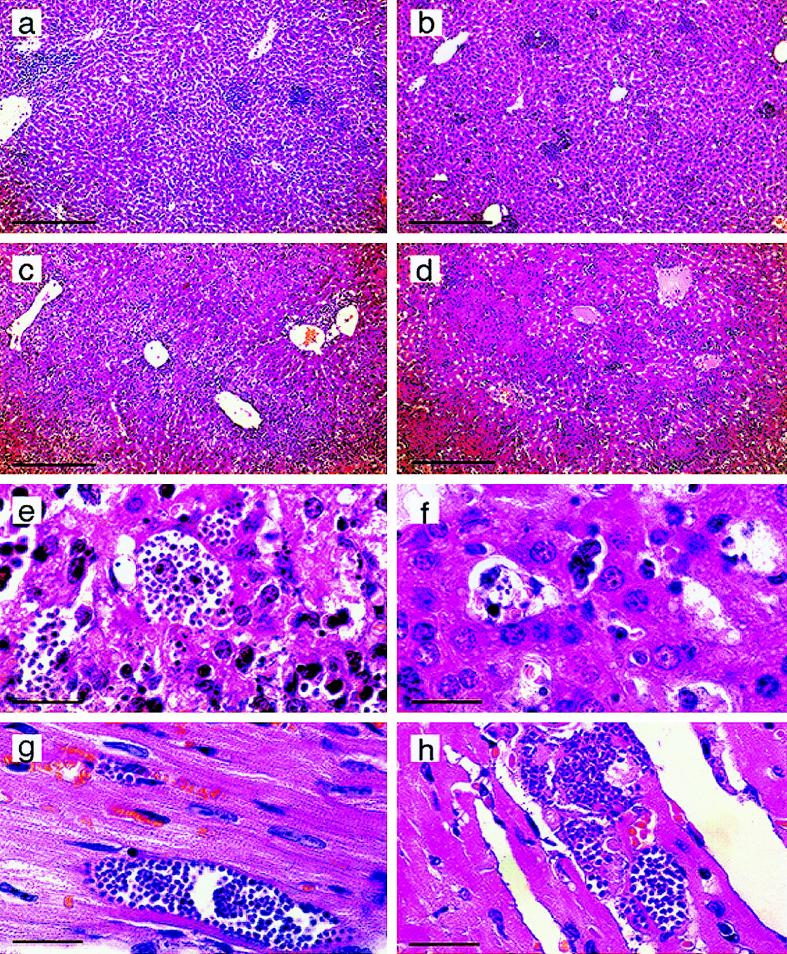
Histopathology of heart and liver tissues from T. cruzi-infected IFN-γR−/− and iNOS−/− mice. IFN-γR−/− and control mice were each infected with 100 trypomastigotes, iNOS−/− and control mice were each infected with 50 trypomastigotes, and hematoxylin-eosin-stained sections were prepared at 17 days postinfection. Liver tissue from IFN-γR+/+ (a) and iNOS+/+ (b) control mice showed comparable multiple small foci of mononuclear cell infiltration with minimal tissue damage. In contrast, liver tissue from IFN-γR−/− (c and e) and iNOS−/− (d and f) mice showed severe destruction (>60%) of the liver parenchyma with confluent necrosis. Mononuclear cell infiltration was comparable in both groups of deficient mice, but parasite numbers and amastigote nest sizes in the liver were greater in IFN-γR−/− mice (e) than in iNOS−/− mice (f). IFN-γR−/− (g) and iNOS−/− (h) heart sections showed many amastigote nests but poor inflammatory cell infiltrates. Shown are representative sections from five individual analyzed mice/group. Bar = 0.03 mm.
FIG. 3
FIG. 3
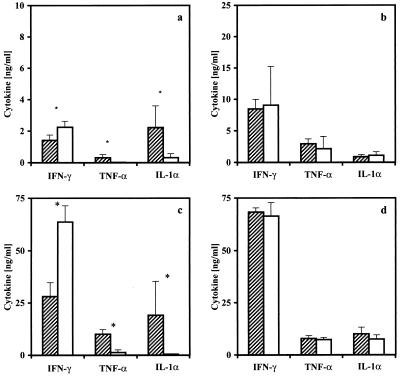
Levels of IFN-γ, TNF-α, and IL-1α in plasma. Groups of five IFN-γR−/− (a and c) or iNOS−/− (b and d) mice (open bars) and their wild-type controls (hatched bars) were each infected with 1,000 or 500 blood trypomastigotes, and the cytokine content of the plasma was determined 7 (a and b) and 10 (c and d) days postinfection as described in Materials and Methods. Asterisks indicate statistically significant differences (P < 0.05) from values of wild-type controls as calculated by Student’s t test. Error bars, standard deviations.
FIG. 4
FIG. 4
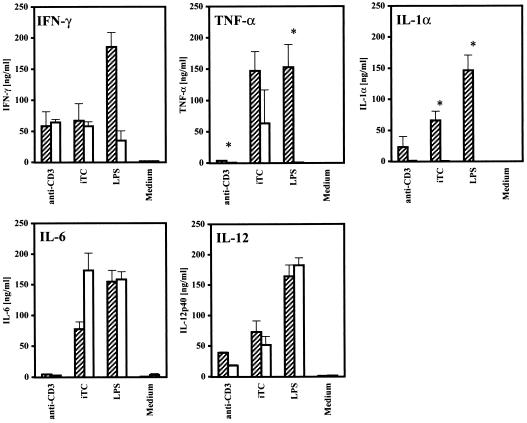
Cytokine synthesis from restimulated IFN-γR−/− spleen cells. Mice were each infected with 1,000 blood trypomastigotes of the Tulahuen strain of T. cruzi. At day 10, spleen cells of wild-type (hatched bars) and IFN-γR−/− (open bars) mice were isolated and cultured for 48 h in the presence of either anti-CD3, iTC, LPS, or medium alone, and the cytokine levels of the cell culture supernatants were determined as described in Materials and Methods. For the experiment whose results are shown, the pooled cells of five mice per group were used. Results are expressed as the means + standard deviations (error bars) of triplicate wells. Asterisks indicate statistically significant differences (P < 0.05) from values of wild-type controls as calculated by Student’s t test and are shown only for cases in which statistically significant differences were found in two independent experiments.
FIG. 5
FIG. 5
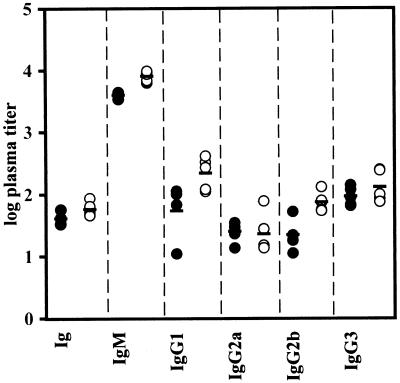
Immunoglobulin isotype distribution in plasma of IFN-γR−/− mice each infected with 100 blood trypomastigotes of the Tulahuen strain of T. cruzi. Blood was collected from wild-type (closed symbols) and IFN-γR−/− (open symbols) mice at day 17 postinfection. Ig isotypes of trypomastigote-specific antibodies in plasma were determined by an antigen-specific enzyme-linked immunosorbent assay as described in Materials and Methods. Antibody titers of individual mice are shown. Horizontal bars indicate mean values of five mice/group. Comparable results were obtained in another independent experiment.
FIG. 6
FIG. 6
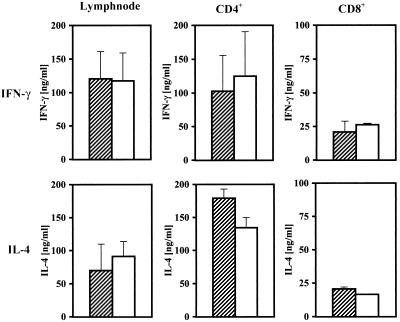
IFN-γ and IL-4 synthesis of CD4+ and CD8+ cells from IFN-γR−/− mice each infected with 1,000 blood trypomastigotes. At day 14 postinfection, lymph node cells and sorted CD4+ and CD8+ cells of wild-type (hatched bars) and IFN-γR−/− (open bars) mice were cultured for 48 h in the presence of immobilized anti-CD3 and the cytokine secretion in the supernatants was determined as described in Materials and Methods. In the experiment shown, pooled cells of five mice per group were used. Results are expressed as the means + standard deviations (error bars) of triplicate wells. Comparable results were obtained in another independent experiment.
FIG. 7
FIG. 7
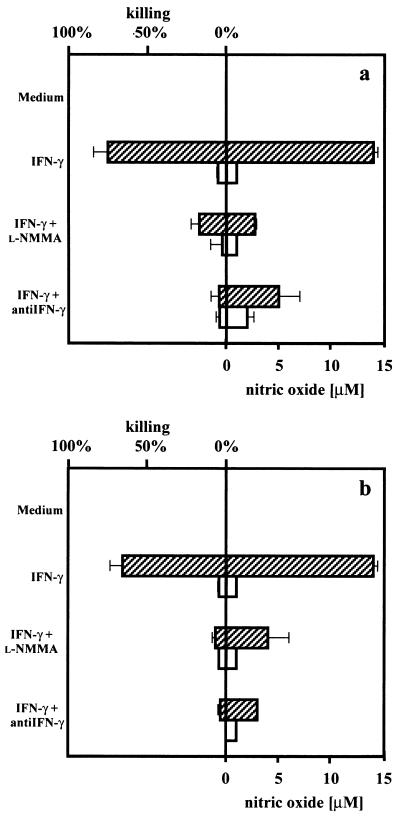
Trypanocidal activity and NO production of IFN-γR−/− (a) and iNOS−/− (b) mouse-derived BMMφ after in vitro infection with T. cruzi. BMMφ were isolated from femora of naive wild-type (hatched bars) or naive mutant (open bars) mice, infected with T. cruzi trypomastigotes, and incubated with medium alone, IFN-γ (100 U/ml), IFN-γ (100 U/ml) plus l-NMMA (500 μM), or IFN-γ (100 U/ml) plus anti-IFN-γ (500 ng/ml) as described in Materials and Methods. Two days later, the NO content of the supernatants and the percentage of T. cruzi-infected cells (250 scored cells/well) were determined in relation to those for infected BMMφ incubated with medium alone. Comparable results were obtained in another independent experiment. Error bars, standard deviations.

References

    1. Abrahamsohn I A, Coffman R L. Trypanosoma cruzi—IL-10, TNF, IFN-gamma, and IL-12 regulate innate and acquired-immunity to infection. Exp Parasitol. 1996;84:231–244. - PubMed
    1. Aliberti J C, Cardoso M A, Martins G A, Gazzinelli R T, Vieira L Q, Silva J S. Interleukin-12 mediates resistance to Trypanosoma cruzi in mice and is produced by murine macrophages in response to live trypomastigotes. Infect Immun. 1996;64:1961–1967. - PMC - PubMed
    1. Barrera L F, Kramnik I, Skamene E, Radzioch D. Nitrite production by macrophages derived from BCG-resistant and -susceptible congenic mouse strains in response to IFN-gamma and infection with BCG. Immunology. 1994;82:457–464. - PMC - PubMed
    1. Beckman J S. The double-edged role of nitric oxide in brain function and superoxide-mediated injury. J Dev Physiol. 1991;15:53–59. - PubMed
    1. Biron C A, Gazzinelli R T. Effects of IL-12 on immune responses to microbial infections: a key mediator in regulating disease outcome. Curr Opin Immunol. 1995;7:485–496. - PubMed

MeSH terms