


Intracellular calcium and Na+-Ca2+ exchange current in isolated toad pacemaker cells
- PMID: 9490832
- PMCID: PMC2230862
- DOI: 10.1111/j.1469-7793.1998.153br.x
Intracellular calcium and Na+-Ca2+ exchange current in isolated toad pacemaker cells
Abstract
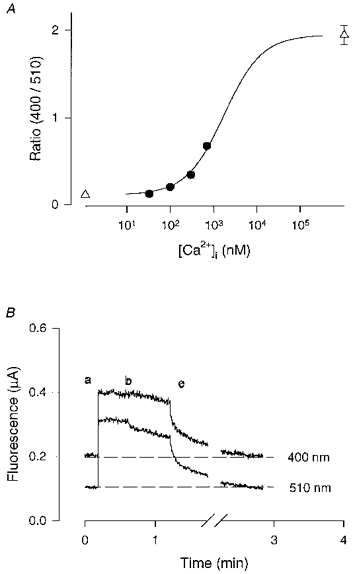
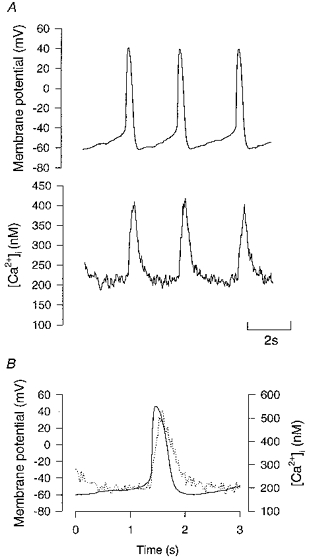
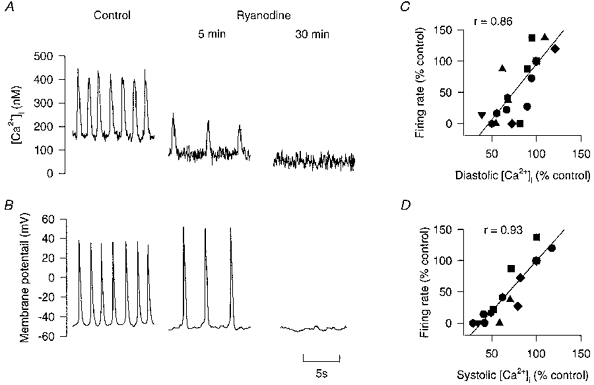
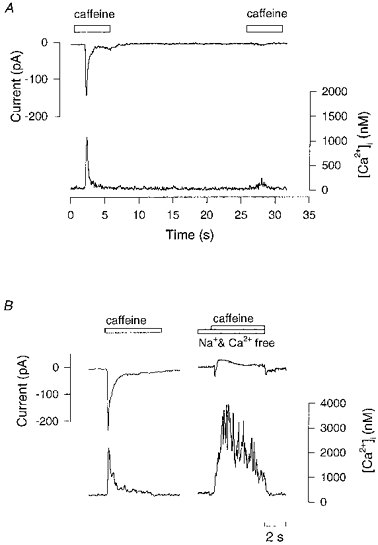
1. Single pacemaker cells were isolated from the sinus venosus of cane toad (Bufo marinus) in order to study the mechanisms involved in the spontaneous firing rate of action potentials. Intracellular calcium concentration ([Ca2+]i) was measured with indo-1 to determine whether [Ca2+]i influenced firing rate. A rapid transient rise of [Ca2+]i was recorded together with each spontaneous action potential. [Ca2+]i at the peak of systole was 655 +/- 64 nM and the minimum at the end of diastole was 195 +/- 15 nM. 2. Reduction of extracellular Ca2+ concentration from 2 to 0.5 mM caused a reduction in both systolic and diastolic [Ca2+]i and the spontaneous firing rate also gradually declined. 3. Application of the acetoxymethyl (AM) ester of BAPTA (10 microM), in order to increase intracellular calcium buffering, caused a decline in systolic and diastolic [Ca2+]i. The firing rate declined progressively until the cells stopped firing after 10-15 min. At the time that firing ceased, the diastolic [Ca2+]i had declined by 141 +/- 38 nM. 4. In the presence of ryanodine (2 microM), which interferes with Ca2+ release from the sarcoplasmic reticulum, the systolic and diastolic [Ca2+]i both declined and the firing rate decreased until the cells stopped firing. At quiescence diastolic [Ca2+]i had declined by 93 +/- 20 nM. 5. Exposure of the cells to Na+-free solution caused a rise in [Ca2+]i which exceeded the systolic level after 4.8 +/- 0.3 s. This rise is consistent with Ca2+ entry on a Na+-Ca2+ exchanger. 6. Rapid application of caffeine (10-20 mM) to cells clamped at -60 mV caused a rapid increase in [Ca2+]i which then spontaneously declined. An inward current with a similar time course to that of [Ca2+]i was also generated. Application of Ni2+ (5 mM) or 2,4-dichlorobenzamil (25 microM) reduced the amplitude of the inward current produced by caffeine by 96 +/- 1 % and 74 +/- 10 %, respectively. In a Na+-free solution the caffeine-induced current was reduced by 93 +/- 7 %. 7. Under a variety of circumstances the diastolic [Ca2+]i showed a close association with pacemaker firing rate. The existence of a Na+-Ca2+ exchanger and its estimated contribution to inward current during the pacemaker potential suggest that the Na+-Ca2+ exchange current makes a contribution to pacemaker activity.
Figures




References
-
- Anderson K, Lai FA, Liu QY, Rousseau E, Erickson HP, Meissner G. Structural and functional characterization of the purified cardiac ryanodine receptor-Ca2+ release channel complex. Journal of Biological Chemistry. 1989;264:1329–1335. - PubMed
-
- Barry PH, Lynch JW. Liquid junction potentials and small cell effects in patch-clamp analysis. Journal of Membrane Biology. 1991;121:101–117. - PubMed
Publication types
MeSH terms
Substances
LinkOut - more resources
Full Text Sources
Research Materials
Miscellaneous
