. 1998 Feb 15;507 ( Pt 1)(Pt 1):163-74.
doi: 10.1111/j.1469-7793.1998.163bu.x.

Nitric oxide lowers the calcium sensitivity of tension in the rat tail artery

Affiliations

Nitric oxide lowers the calcium sensitivity of tension in the rat tail artery

N N Tran et al. J Physiol. .

Abstract

1. Controversy exists as to whether a fall in the intracellular Ca2+ concentration ([Ca2+]i) is a requisite element of the vasodilatory response to nitric oxide (NO). 2. We studied the effect of NO on the coupling between [Ca2+]i and vasoconstriction in arterial segments loaded with the [Ca2+]i-sensitive, intracellular dye fura-2. As data interpretation is equivocal when fura-2 is loaded into both endothelial and smooth muscle cells, we compared results from in vitro experiments on segments of the rat tail artery in which fura-2 and noradrenaline were applied on the luminal or adventitial side, and endothelium was removed 'physically' (rubbing or air) or 'functionally' (Nomega-nitro-L-arginine methyl ester). The use of air perfusion to remove endothelium is of considerable benefit since it allows paired observations in a single tissue. 3. Fura-2 loaded into endothelial cells but endothelial 'contamination' of the smooth muscle cell [Ca2+]i signal was minimal. 4. Endogenous NO decreased vasoconstrictor responses to noradrenaline but had no effect on [Ca2+]i. 5. Nitroglycerine decreased vasoconstrictor responses in a concentration-dependent fashion but had no effect on [Ca2+]i. 6. In conclusion, NO causes vasodilatation via a mechanism which is downstream of [Ca2+]i mobilization.


Figures
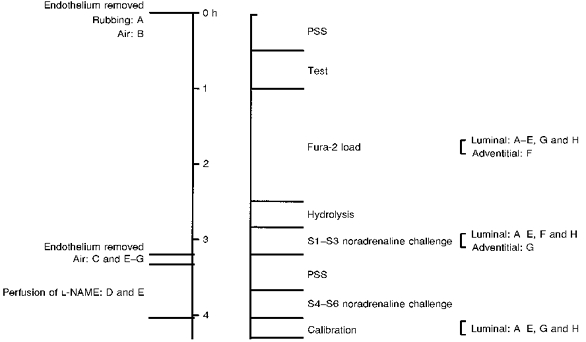
Figure 1
Figure 1. Specific experimental protocols
Protocol A, endothelium denuded by rubbing at the beginning. Protocol B, endothelium denuded by air at the beginning. Protocol C, endothelium denuded by air in the middle. Protocol D, L-NAME perfusion. Protocol E, L-NAME perfusion plus endothelium denuded by air. Protocol F, fura-2 adventitial loading. Protocol G, noradrenaline adventitial challenge. Protocol H, time control (with endothelium). n= 6 per protocol.
Figure 2
Figure 2
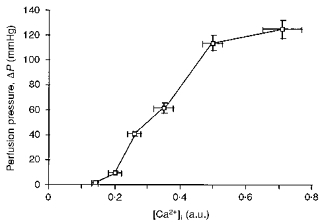
Relationship between [Ca2+]i and vasoconstriction produced by noradrenaline (0.1-30 μM, 2 min at each concentration); n= 6.
Figure 3
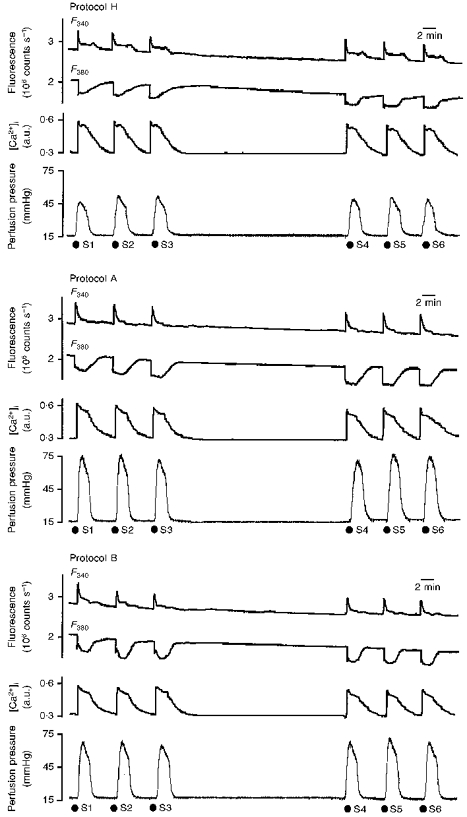
Figure 3. F340 and F380, [Ca2+]i and vasoconstriction following noradrenaline (S1-S6) in protocols H (top), A (middle) and B (bottom)
Each panel shows original recordings of changes in fluorescence (excitation wavelengths, 340 nm (F340) and 380 nm (F380)) of the intracellular [Ca2+]i-sensitive dye fura-2 (upper records), calculated [Ca2+]i (middle records), and perfusion pressure at constant flow rate (bottom records) following intraluminal perfusion of noradrenaline (S1-S6, 3 μM, 2 min).
Figure 4
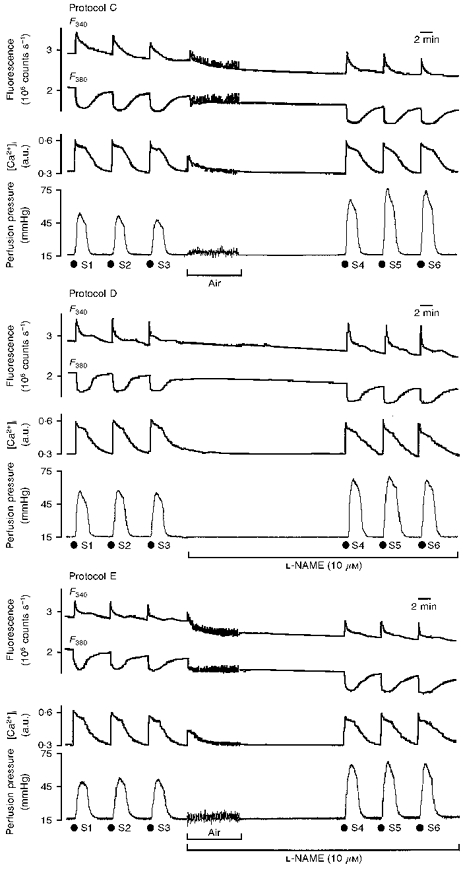
Figure 4. F340 and F380, [Ca2+]i and vasoconstriction following S1-S6 noradrenaline challenges in protocols C (top), D (middle) and E (bottom)
Original recordings (see Fig. 3) showing the effect of intraluminal perfusion of noradrenaline (3 μM, 2 min) on [Ca2+]i mobilization and perfusion pressure before (S1-S3) and after (S4-S6) intraluminal perfusion of air or L-NAME (10 μM). During air perfusion there was a marked increase in the variability of the baseline fluorescence and perfusion pressure signals.
Figure 5
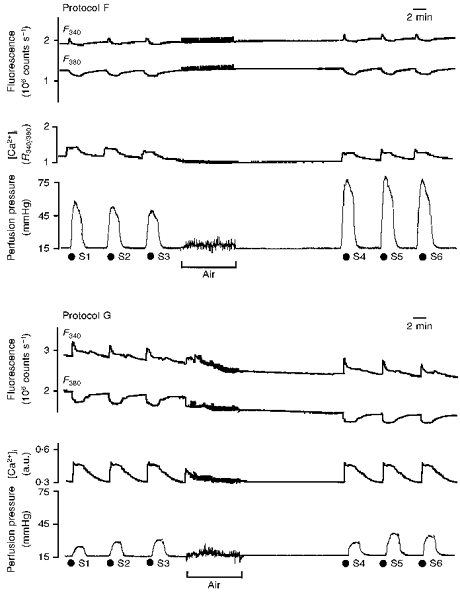
Figure 5. F340 and F380, R340/380 or [Ca2+]i, and vasoconstriction following S1-S6 noradrenaline challenges in protocols F (top) and G (bottom)
Original recordings (see Fig. 3) showing the effect of noradrenaline (3 μM, 2 min) on [Ca2+]i mobilization (R340/380 (top panel) or a.u. (bottom panel)) and perfusion pressure before (S1-S3) and after (S4-S6) intraluminal perfusion of air. [Ca2+]i signals in protocol F are represented as R340/380 as calibration values were low (see Discussion).
Figure 6
Figure 6. F340 and F380, [Ca2+]i and vasoconstriction in arteries pre-contracted by noradrenaline and exposed to nitroglycerine
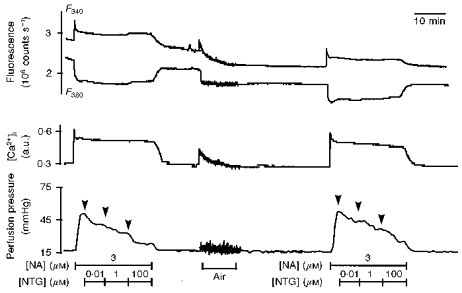
Original recordings (see Fig. 3) showing the effect of intraluminal perfusion of noradrenaline (NA; 3 μM, 21 min) and of nitroglycerine (NTG; 0.01, 1 and 100 μM; 7 min) on [Ca2+]i mobilization and perfusion pressure before and after intraluminal perfusion of air.
Figure 7
Figure 7
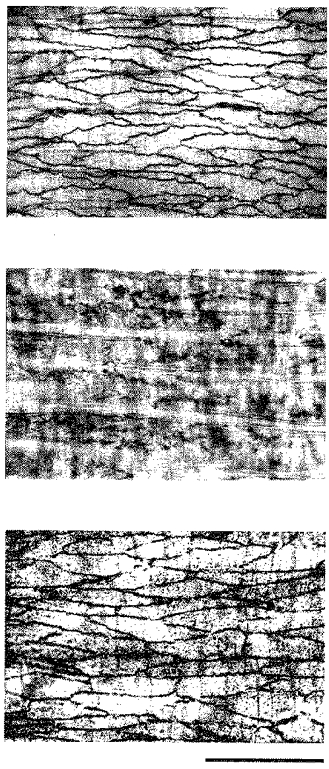
Silver nitrate en face staining of representative arterial segments from protocols H (top), C (middle) and D (bottom). Scale bar, 25 μm.

References

    1. Abe S, Kanaide H, Nakamura M. Front-surface fluorometry with fura-2 and effects of nitroglycerin on cytosolic calcium concentrations and on tension in the coronary artery of the pig. British Journal of Pharmacology. 1990;101:545–552. - PMC - PubMed
    1. Atkinson J, Fouda AK, Sonnay M. Vasoconstriction of the perfused rat caudal artery is independent of longitudinal tension and flow rate. British Journal of Pharmacology. 1986;88:437. abstract P.
    1. Atkinson J, Tatchum-Talom R, Capdeville-Atkinson C. Reduction of endothelial function with age in the mesenteric arterial bed of normotensive rat. British Journal of Pharmacology. 1994;111:1184–1188. - PMC - PubMed
    1. Blatter LA, Wier WG. Nitric oxide decreases [Ca2+]i in vascular smooth muscle by inhibition of the calcium current. Cell Calcium. 1994;15:122–131. - PubMed
    1. Boutinet S, Giummelly P, Atkinson J, Capdeville-Atkinson C. Simultaneous measurement of intracellular calcium levels and the damping capacity in the rat common carotid artery with a new in vitro pulsatile system. British Journal of Pharmacology. 1994;112:584. abstract P.

Publication types

MeSH terms

LinkOut - more resources