


Early detection of visual field progression in glaucoma: a comparison of PROGRESSOR and STATPAC 2
- PMID: 9497460
- PMCID: PMC1722087
- DOI: 10.1136/bjo.81.12.1037
Early detection of visual field progression in glaucoma: a comparison of PROGRESSOR and STATPAC 2
Abstract
Aim: To compare the performance of PROGRESSOR (pointwise linear regression) and STATPAC 2 (comparison with baseline values) in detecting early deterioration in the visual fields of glaucoma patients.
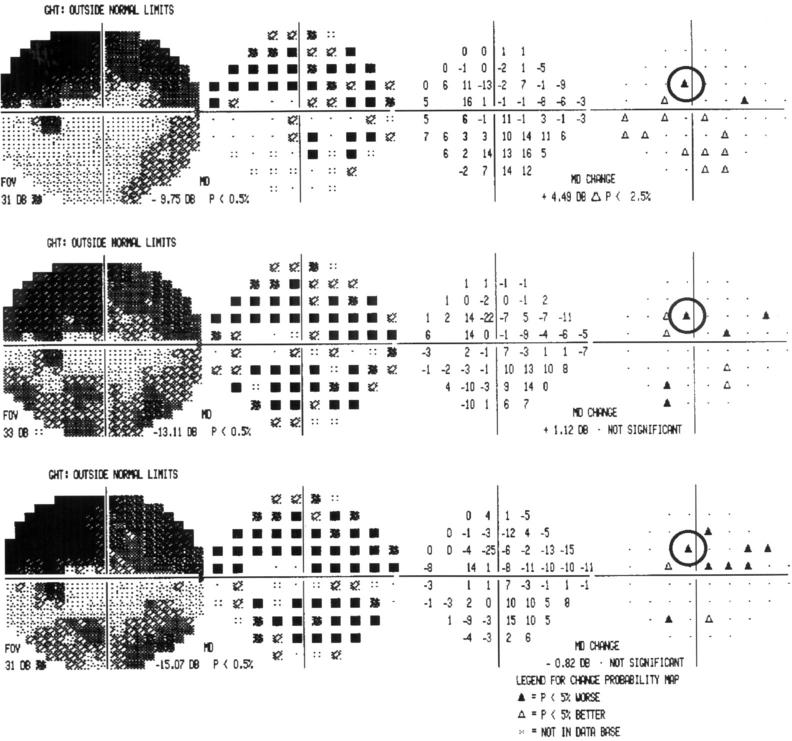
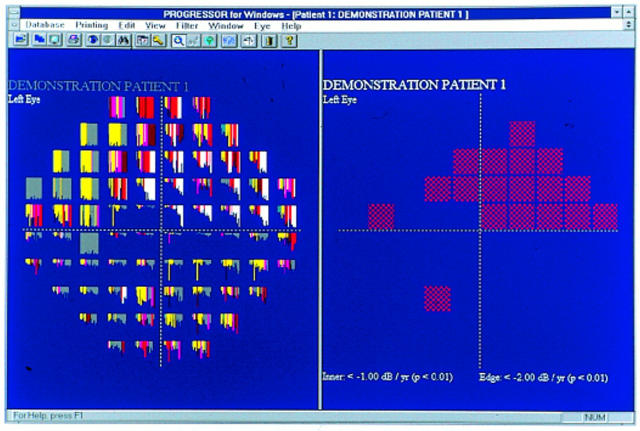
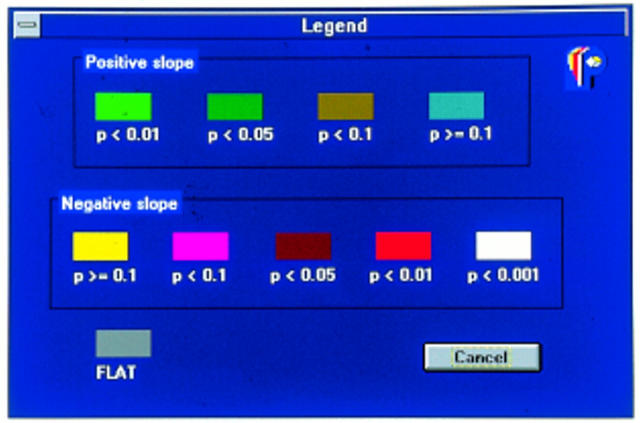
Methods: Visual field series from 19 untreated normal tension glaucoma eyes which were deteriorating on clinical grounds were analysed by PROGRESSOR and STATPAC 2. Progression criteria for PROGRESSOR were (1) inner points: slope < -1 dB/year, p < 0.05 and (2) edge points: slope < -2 dB/year, p < 0.05. Criteria for STATPAC 2 were p < 0.05 change probability for any point on three consecutive fields. Detection time was defined as the time interval between the initial field and the first field in which at least one progressing point was identified. Detection times produced by the two techniques were compared.
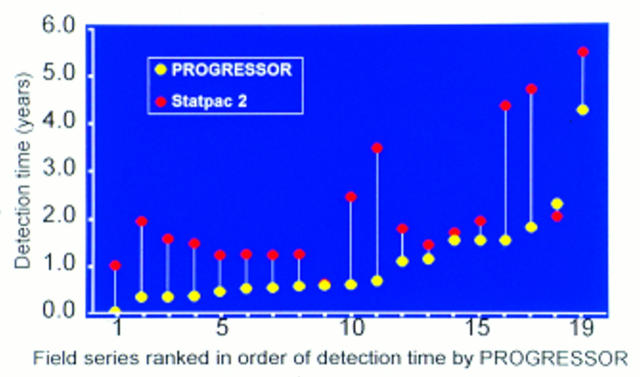
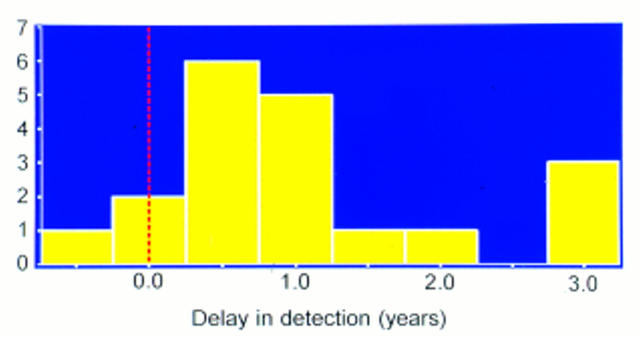
Results: PROGRESSOR and STATPAC 2 agreed on progression in all 19 eyes. Mean detection time for PROGRESSOR was 1.077 (SD 0.985) years and for STATPAC 2 was 2.161 (1.357) years. PROGRESSOR detected progression sooner than STATPAC 2 in 18 eyes (p < 0.01), Wilcoxon matched pairs signed rank test). PROGRESSOR detected progression earlier by a mean of 1.085 (0.936) years.
Conclusions: PROGRESSOR consistently detected progression earlier than STATPAC 2. The PROGRESSOR software is a useful tool for the early detection of visual field deterioration in glaucoma.
Figures
Comment in
-
Colour for time; charting the fourth dimension.Br J Ophthalmol. 1997 Dec;81(12):1026. doi: 10.1136/bjo.81.12.1026. Br J Ophthalmol. 1997. PMID: 9497456 Free PMC article. No abstract available.
-
Visual field progression in glaucoma.Br J Ophthalmol. 1998 Sep;82(9):1097-8. doi: 10.1136/bjo.82.9.1096d. Br J Ophthalmol. 1998. PMID: 9893615 Free PMC article. No abstract available.
References
Publication types
MeSH terms
LinkOut - more resources
Full Text Sources
Other Literature Sources
Medical
Miscellaneous
