


doi: 10.1128/JVI.72.3.2010-2021.1998.
The genome sequence of herpes simplex virus type 2
Affiliations
- PMID: 9499055
- PMCID: PMC109494
- DOI: 10.1128/JVI.72.3.2010-2021.1998
Item in Clipboard
The genome sequence of herpes simplex virus type 2
J Virol.
1998 Mar.
Abstract
The genomic DNA sequence of herpes simplex virus type 2 (HSV-2) strain HG52 was determined as 154,746 bp with a G+C content of 70.4%. A total of 74 genes encoding distinct proteins was identified; three of these were each present in two copies, within major repeat elements of the genome. The HSV-2 gene set corresponds closely with that of HSV-1, and the HSV-2 sequence prompted several local revisions to the published HSV-1 sequence (D. J. McGeoch, M. A. Dalrymple, A. J. Davison, A. Dolan, M. C. Frame, D. McNab, L. J. Perry, J. E. Scott, and P. Taylor, J. Gen. Virol. 69:1531-1574, 1988). No compelling evidence for the existence of any additional protein-coding genes in HSV-2 was identified.
Figures
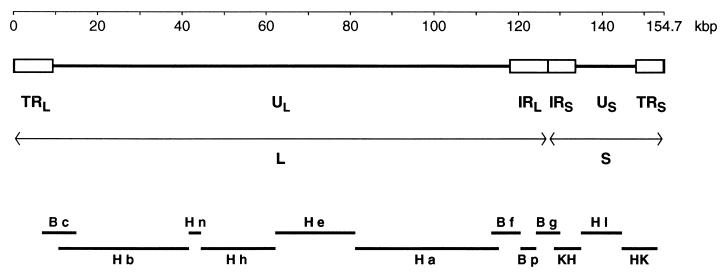
Overall organization of the genome of HSV-2. The linear double-stranded DNA is represented, with the scale at the top. The unique portions of the genome (UL and US) are shown as heavy solid lines, and the major repeat elements (TRL, IRL, IRS, and TRS) are shown as open boxes. For each pair of repeats the two copies are in opposing orientations. As indicated, TRL, UL, and IRL are regarded as comprising the L region, and IRS, US, and TRS are regarded as comprising the S region. Plasmid-cloned fragments used for sequence determination are indicated at the bottom: BamHI and HindIII fragments are indicated by B and H, respectively, followed by individual fragment designations in lowercase; KH and HK indicate KpnI/HindIII fragments as described in the text.
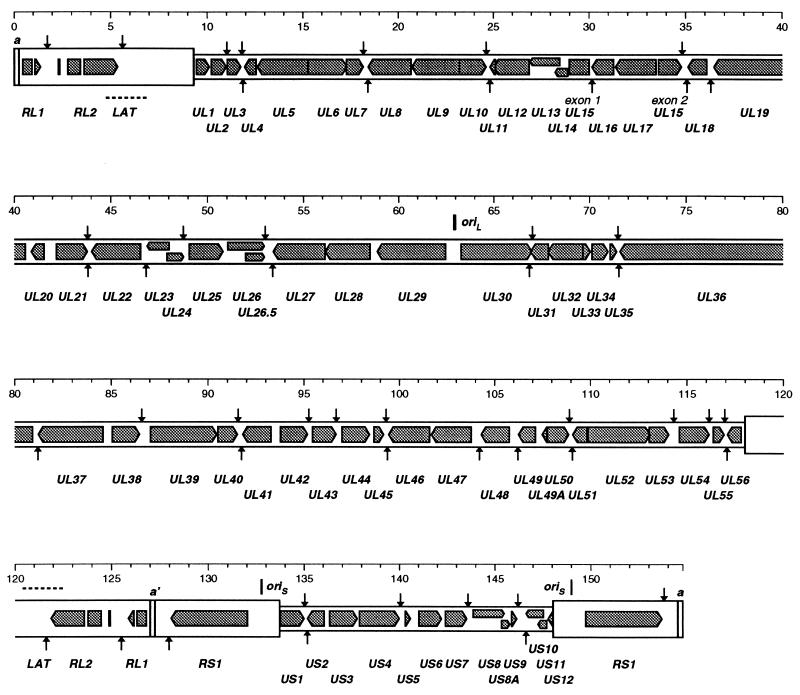
Layout of genes and other elements in the genome of HSV-2. The genome is shown expanded from the representation in Fig. 1, with unique regions as narrow open boxes and major repeats as wider boxes, on four successive lines; sequence numbering (in kilobases) is indicated above each section. Positions of the terminal repeat (a) sequences and the internal inverted copy (a′) are marked. Protein-coding regions and orientations for recognized genes as listed in Table 3 are shown as grey-filled arrow shapes (non-3′ exons are shown as box shapes). Locations of proposed transcript polyadenylation signals (AATAAA and variants thereof) are marked by small arrows (for rightward transcripts these are above the genome, and for leftward transcripts they are below). The positions of origins of replication are marked.
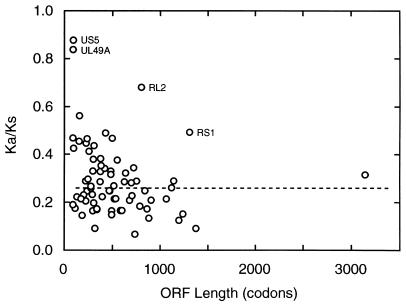
Plot of Ka/Ks ratio versus length of coding region for each aligned pair of HSV-1 and HSV-2 genes. The ratio of nonsynonymous to synonymous divergences (Ka/Ks; see Table 3) for pairs of HSV-1 and HSV-2 coding sequences (excluding UL26.5 and US4) is plotted against the corresponding ORF length (average of HSV-1 and HSV-2 lengths). The median value for Ka/Ks is indicated with a dashed line. Plotted points for four outliers with high Ka/Ks values are annotated with gene names.
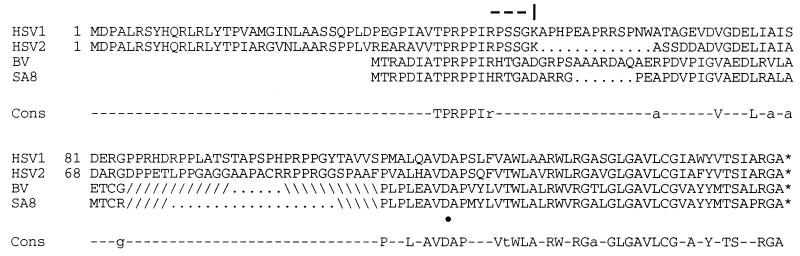
US8A amino acid sequences for HSV-1, HSV-2, and two simian alphaherpesviruses. Proposed amino acid sequences for US8A in HSV-1 and HSV-2 are aligned together with sequences of counterparts for herpesvirus B (BV) and simian agent 8 (SA8) as interpreted from the DNA sequence data of references and , respectively. In the consensus (Cons) line, completely conserved residues are indicated in uppercase and residues conserved in three of the sequences are indicated in lowercase. The position corresponding to the end of the US8 ORF in the DNA sequences (−1 frame relative to US8A) is marked (– – – |). In BV and SA8 a region of uncertainty representing the limits for a proposed shift of reading frame in the reported DNA sequence is shown as bounded by //// and \\\\, with inserted gapping characters indicated by dots. The position corresponding to a presumptive frameshift in SA8 only is marked by •. The location corresponding to the identically placed end of the ORF in all four sequences is marked ∗.
References
-
- Bankier A T, Barrell B G. Sequencing single-stranded DNA using the chain-termination method. In: Howe C J, Ward E S, editors. Nucleic acids sequencing: a practical approach. Oxford, United Kingdom: IRL Press; 1989. pp. 37–78.
Publication types
MeSH terms
Substances
Associated data
- Actions
LinkOut - more resources
Full Text Sources
Other Literature Sources
