. 1998 Mar;116(3):935-46.
doi: 10.1104/pp.116.3.935.

An embryo-defective mutant of arabidopsis disrupted in the final step of biotin synthesis

An embryo-defective mutant of arabidopsis disrupted in the final step of biotin synthesis

DA Patton et al. Plant Physiol. 1998 Mar.

Abstract

Auxotrophic mutants have played an important role in the genetic dissection of biosynthetic pathways in microorganisms. Equivalent mutants have been more difficult to identify in plants. The bio1 auxotroph of Arabidopsis thaliana was shown previously to be defective in the synthesis of the biotin precursor 7, 8-diaminopelargonic acid. A second biotin auxotroph of A. thaliana has now been identified. Arrested embryos from this bio2 mutant are defective in the final step of biotin synthesis, the conversion of dethiobiotin to biotin. This enzymatic reaction, catalyzed by the bioB product (biotin synthase) in Escherichia coli, has been studied extensively in plants and bacteria because it involves the unusual addition of sulfur to form a thiophene ring. Three lines of evidence indicate that bio2 is defective in biotin synthase production: mutant embryos are rescued by biotin but not dethiobiotin, the mutant allele maps to the same chromosomal location as the cloned biotin synthase gene, and gel-blot hybridizations and polymerase chain reaction amplifications revealed that homozygous mutant plants contain a deletion spanning the entire BIO2-coding region. Here we describe how the isolation and characterization of this null allele have provided valuable insights into biotin synthesis, auxotrophy, and gene redundancy in plants.


Figures
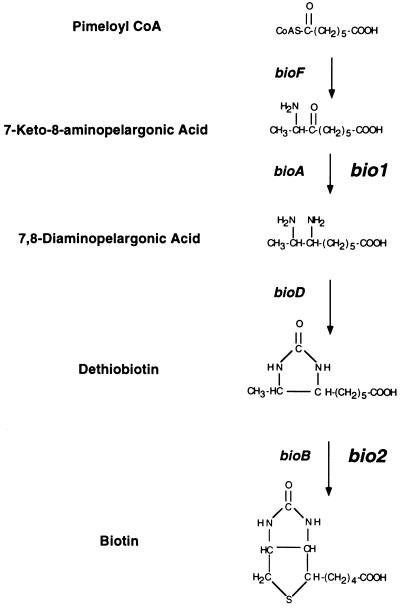
Figure 1
Figure 1
Biotin biosynthetic pathway in plants and microorganisms. Letters correspond to cloned bio genes of E. coli. Numbers correspond to mutant bio genes of Arabidopsis. The immediate precursor of pimeloyl CoA appears to be pimelic acid in many but not all organisms.
Figure 2
Figure 2
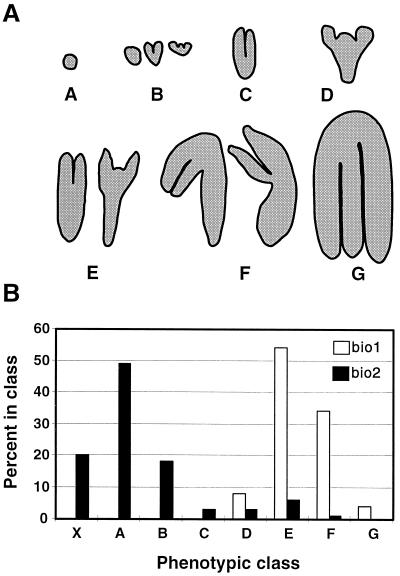
Terminal phenotypes of bio1 and bio2 embryos obtained from heterozygous siliques. A, Examples of phenotypic classes observed. Embryos ranged from the globular (A) to cotyledon (E–G) stages. B, Distribution of phenotypic classes (A–G) in random samples of 125 arrested embryos from each mutant. Class X embryos were too small to be visible under a dissecting microscope. Note the different distribution of embryo phenotypes found in bio1 and bio2 mutant seeds.
Figure 3
Figure 3
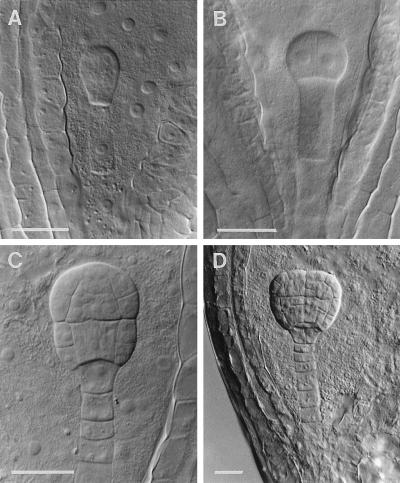
Early defects in development of bio2 seeds revealed after treatment with Hoyer's solution and examination with Nomarski optics. A and C, Immature mutant seeds. Note unusual elongation of apical cell (A) and embryo proper (C) in mutant seeds. B and D, Wild-type seeds at the proembryo (B) and late-globular (D) stages. Scale bars = 20 μm.
Figure 4
Figure 4
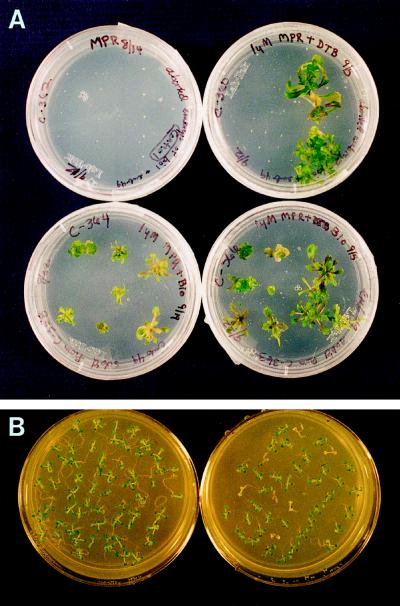
Response of immature mutant embryos (A) and mature rescued seeds (B) in culture. A, Arrested embryos were removed from immature siliques of heterozygous plants, plated on basal and enriched media, and observed after several weeks in culture. The top row of plates contained bio2 embryos on the left half of each plate and bio1 embryos on the right half. The left plate is a basal medium; the right plate contains 1 μm dethiobiotin. The bottom row of plates contains plants derived from bio2 embryos rescued on 1 μm biotin. Note that bio2 embryos were rescued only in the presence of biotin. B, Mature seeds from heterozygous (bio2/BIO2) plants grown in pots watered with biotin were plated on basal medium (right) and 1 μm biotin (left). Each plate received seeds from a single silique. Segregating mutant seedlings appeared pale in the absence of biotin (right) but normal in the presence of biotin (left).
Figure 5
Figure 5
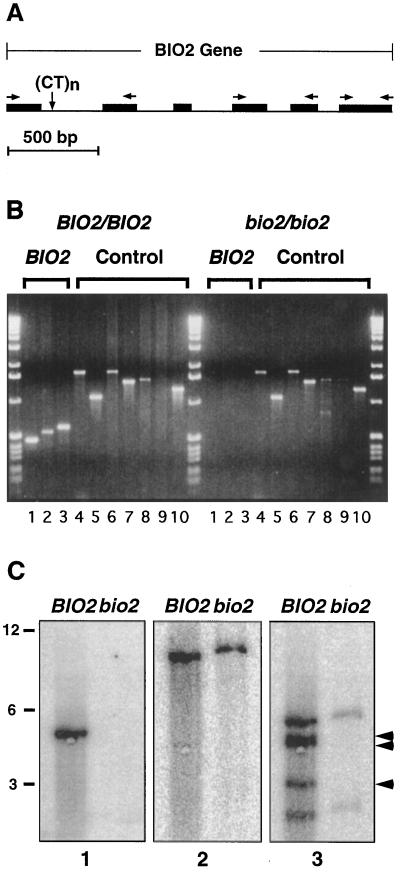
Molecular characterization of the bio2 locus. A, Structure of the wild-type (BIO2) gene. Thin lines represent introns; thick bars correspond to exons. Horizontal arrows note the locations of primers used to confirm the presence of a deletion in mutant plants. The vertical arrow denotes a region within the first intron that contains a “CT” repeat detectable as an SSLP between Landsberg erecta and Columbia ecotypes. B, Analysis of PCR products generated using template DNA from wild-type (BIO2/BIO2) and mutant (bio2/bio2) plants. “BIO2” lanes contain PCR products generated using primers spanning the BIO2 locus. Locations of these primer pairs are designated with arrows in A. “Control” lanes contain products generated using primers specific for seven different single-copy genes in Arabidopsis. Lanes with identical numbers used the same primer pairs. Reference lanes contain a 1-kb ladder. Note that DNA isolated from mutant plants yielded PCR products in all cases tested except with BIO2 primers. C, Gel blot of genomic DNA isolated from wild-type (BIO2) and mutant (bio2) plants and digested with EcoRI. The same blot was probed sequentially with the full-length BIO2 cDNA (1); a random single-copy gene used as a positive control (2); and a λ clone containing the BIO2 gene located within a 22-kb insert (3). There was no hybridization between the BIO2 cDNA probe and DNA isolated from mutant plants. Three bands marked with arrows (13 kb total) are missing from the blot of bio2 DNA probed with the λ BIO2 genomic clone.

References

    1. Alban C, Baldet P, Axiotis S, Douce R. Purification and characterization of 3-methylcrotonyl-coenzyme A carboxylase from higher plant mitochondria. Plant Physiol. 1993;102:957–965. - PMC - PubMed
    1. Alexeev D, Bury SM, Boys CWG, Turner MA, Sawyer L, Ramsey AJ, Baxter HC, Baxter RL. Sequence and crystallization of Escherichia coli dethiobiotin synthetase, the penultimate enzyme of biotin biosynthesis. J Mol Biol. 1994;235:774–776. - PubMed
    1. Ashburner M. Drosophila: A Laboratory Handbook. Cold Spring Harbor, NY: Cold Spring Harbor Laboratory Press; 1989.
    1. Ausubel FM, Brent R, Kingston RE, Moore DD, Seidman JG, Smith JA, Struhl K. Current Protocols in Molecular Biology. New York: John Wiley & Sons; 1987.
    1. Baldet P, Alban C, Axiotis S, Douce R. Localization of free and bound biotin in cells from green pea leaves. Arch Biochem Biophys. 1993a;303:67–73. - PubMed

LinkOut - more resources