. 1998 Mar;116(3):1063-72.
doi: 10.1104/pp.116.3.1063.

The role of iron-deficiency stress responses in stimulating heavy-metal transport in plants

The role of iron-deficiency stress responses in stimulating heavy-metal transport in plants

CK Cohen et al. Plant Physiol. 1998 Mar.

Abstract

Plant accumulation of Fe and other metals can be enhanced under Fe deficiency. We investigated the influence of Fe status on heavy-metal and divalent-cation uptake in roots of pea (Pisum sativum L. cv Sparkle) seedlings using Cd2+ uptake as a model system. Radiotracer techniques were used to quantify unidirectional 109Cd influx into roots of Fe-deficient and Fe-sufficient pea seedlings. The concentration-dependent kinetics for 109Cd influx were graphically complex and nonsaturating but could be resolved into a linear component and a saturable component exhibiting Michaelis-Menten kinetics. We demonstrated that the linear component was apoplastically bound Cd2+ remaining in the root cell wall after desorption, whereas the saturable component was transporter-mediated Cd2+ influx across the root-cell plasma membrane. The Cd2+ transport system in roots of both Fe-deficient and Fe-sufficient seedlings exhibited similar Michaelis constant values, 1.5 and 0.6 m, respectively, for saturable Cd2+ influx, whereas the maximum initial velocity for Cd2+ uptake in Fe-deficient seedlings was nearly 7-fold higher than that in Fe-grown seedlings. Investigations into the mechanistic basis for this response demonstrated that Fe-deficiency-induced stimulation of the plasma membrane H+-ATPase did not play a role in the enhanced Cd2+ uptake. Expression studies with the Fe2+ transporter cloned from Arabidopsis, IRT1, indicated that Fe deficiency induced the expression of this transporter, which might facilitate the transport of heavy-metal divalent cations such as Cd2+ and Zn2+, in addition to Fe2+.


Figures
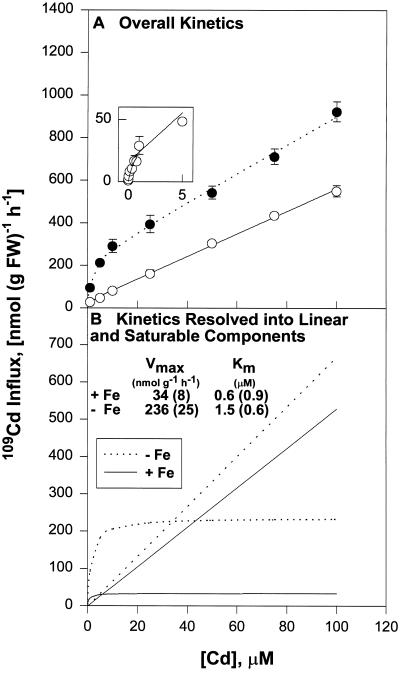
Figure 1
Figure 1
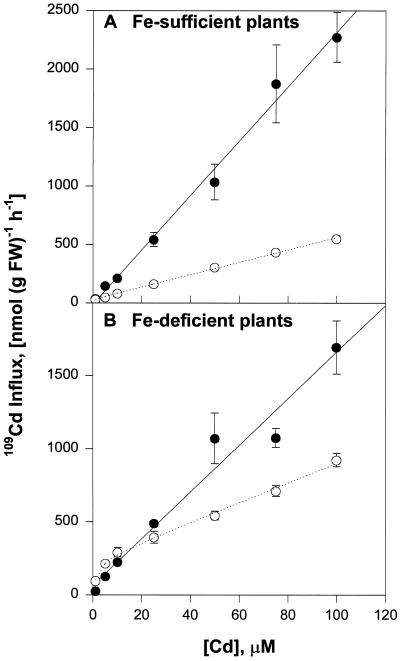
A, Concentration-dependent kinetics of root 109Cd influx in ± Fe-grown pea seedlings. After a 30-min recovery from excision in pretreatment solution, root segments were exposed to radiolabeled uptake solutions for 20 min and then desorbed for 15 min. The inset depicts the concentration-dependent kinetics of Cd influx over the 0- to 5-μm concentration range in the +Fe-grown pea seedlings. Values are means expressed as nmol Cd2+ (g fresh weight [FW])−1 h−1 (for +Fe [○], n = 3–6; for −Fe [•], n = 4–6). Error bars represent se. B, The plots in A were mathematically dissected into their linear and hyperbolic components to estimate the kinetic parameters.
Figure 2
Figure 2
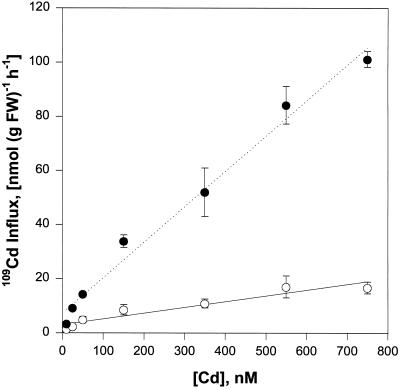
Concentration-dependent kinetics of root 109Cd influx in ± Fe-grown pea seedlings (0–0.75 μm range). After a 30-min recovery from excision in pretreatment solution, root segments were placed in radiolabeled uptake solutions for 20 min and then desorbed for 15 min. Values are means expressed as nmol Cd2+ (g fresh weight [FW])−1 h−1 (for +Fe [○], n = 6–9; for −Fe [•], n = 2–3). Error bars represent se.
Figure 3
Figure 3
Concentration-dependent kinetics of 109Cd influx in intact and methanol:chloroform-treated roots from +Fe-grown pea seedlings (A) and −Fe-grown pea seedlings (B). Excised roots were treated for 3 d in 2:1 (v/v) methanol:chloroform to remove protoplast material and rinsed for 1 d in H2O. Root segments were then placed in radiolabeled uptake solutions for 20 min and subsequently desorbed for 15 min. Values are means expressed as nmol Cd2+ (g fresh weight [FW])−1 h−1. For +Fe: intact roots (○), n = 3 to 6 and cell wall only (•), n = 2 to 3; for −Fe: intact roots (○) and cell wall only (•), n = 4 to 6. Error bars represent se.
Figure 4
Figure 4
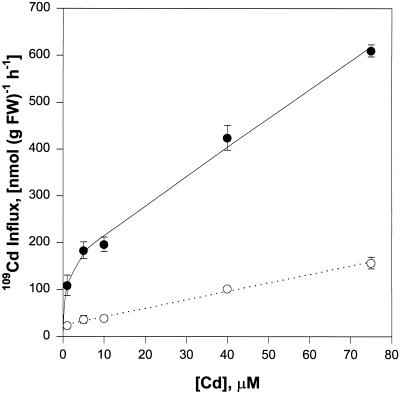
Concentration-dependent kinetics of 109Cd influx into roots of −Fe-grown pea seedlings treated with LaCl3, a Ca2+-channel blocker. After excision, root segments were pretreated for 30 min in 0.2 mm LaCl3, and then placed in radiolabeled uptake solution containing 0.2 mm LaCl3 for 20 min, and subsequently desorbed for 15 min. Values are means expressed as nmol Cd2+ (g fresh weight [FW])−1 h−1 (n = 4). •, Control roots; ○, +La3+. Error bars represent se.
Figure 5
Figure 5
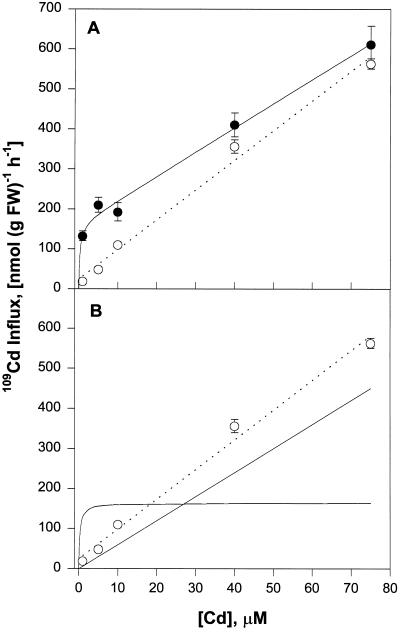
A, Concentration-dependent kinetics of 109Cd influx in −Fe-grown pea seedling roots treated with the protonophore and metabolic inhibitor CCCP. After excision, root segments were pretreated for 30 min in 20 μm CCCP, then placed in radiolabeled uptake solution containing CCCP for 20 min, and subsequently desorbed for 15 min. •, −CCCP; ○, +CCCP. B, The concentration-dependent kinetics of root 109Cd influx for CCCP-treated pea seedlings. The Cd2+-uptake kinetics for −CCCP-treated seedlings (solid lines) were dissected into linear and hyperbolic components. ○, +CCCP. Values are means expressed as nmol Cd2+ (g fresh weight [FW])−1 h−1 (n = 4). Error bars represent se.
Figure 6
Figure 6
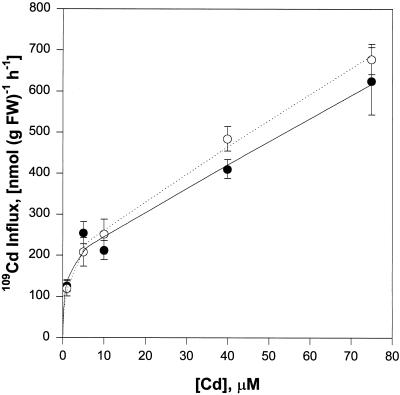
Concentration-dependent kinetics of root 109Cd influx in −Fe-grown pea seedlings in buffered (10 mm Mes-Tris, pH 6.0) and unbuffered uptake solution. After excision, root segments were pretreated for 30 min in buffered (10 mm; ○) or unbuffered (0 mm; •) solutions, placed in fresh buffered or unbuffered radiolabeled uptake solution for 20 min, and subsequently desorbed for 15 min. Values are means expressed as nmol Cd2+ (g fresh weight [FW])−1 h−1 (n = 4). Error bars represent se.
Figure 7
Figure 7
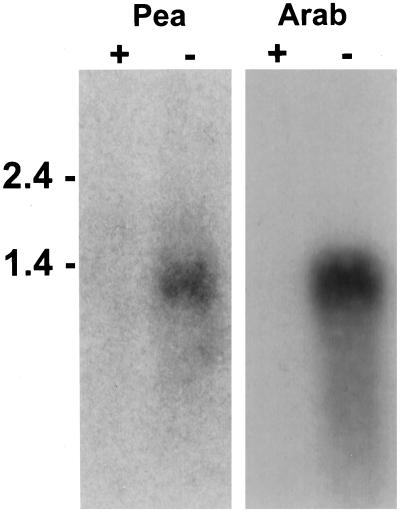
Regulation of IRT1 mRNA levels by Fe availability in Arabidopsis and pea seedlings. Polyadenylated RNA from ± Fe-grown roots of Arabidopsis (1.2 μg) and pea (1.9 μg) was probed with the Arabidopsis IRT1 genomic clone. RNA was prepared from 21-d-old Arabidopsis plants grown for 5 d without Fe or 13-d-old pea plants grown for 4 d without Fe.

References

    1. Ambler JE, Brown JC, Gauch HG. Sites of iron reduction in soybean plants. Agron J. 1971;63:95–97.
    1. Askwith C, Eide D, Van Ho A, Bernard PS, Li L, Davis-Kaplan S, Sipe DM, Kaplan J. The FET3 gene of S. cerevisiae encodes a multicopper oxidase required for ferrous iron uptake. Cell. 1994;76:403–410. - PubMed
    1. Bertl A, Slayman CL. Cation-selective channels in the vacuolar membrane of Saccharomyces: dependence on calcium, redox state, and voltage. Proc Natl Acad Sci USA. 1990;87:7824–7828. - PMC - PubMed
    1. Bienfait HF. Mechanisms in Fe-efficiency reactions of higher plants. J Plant Nutr. 1988;11:605–629.
    1. Bienfait HF, Bino RJ, van der Bliek AM, Duivenvoorden JF, Fontain JM. Characterization of ferric reducing activity in roots of Fe-deficient Phaseolus vulgaris. Physiol Plant. 1983;59:196–202.

LinkOut - more resources