


doi: 10.1073/pnas.95.6.2885.
Inhibition of FtsZ polymerization by SulA, an inhibitor of septation in Escherichia coli
Affiliations
- PMID: 9501185
- PMCID: PMC19664
- DOI: 10.1073/pnas.95.6.2885
Item in Clipboard
Inhibition of FtsZ polymerization by SulA, an inhibitor of septation in Escherichia coli
Proc Natl Acad Sci U S A.
.
Abstract
The bacterial cell division protein FtsZ assembles into the cytokinetic Z ring that directs cytokinesis in prokaryotes. In Escherichia coli the formation of the Z ring is prevented by induction of the cell division inhibitor SulA (SfiA), a component of the SOS response. Here we show that a MalE-SulA fusion that retains this inhibitory function in vivo inhibits the GTPase activity and polymerization of FtsZ in vitro. MalE-SulA10, which does not block Z ring formation in vivo, is unable to inhibit the GTPase activity and polymerization in vitro. Furthermore, FtsZ114, which is refractory to SulA in vivo, is not inhibited by MalE-SulA. These results indicate that SulA blocks Z ring formation by blocking FtsZ polymerization.
Figures
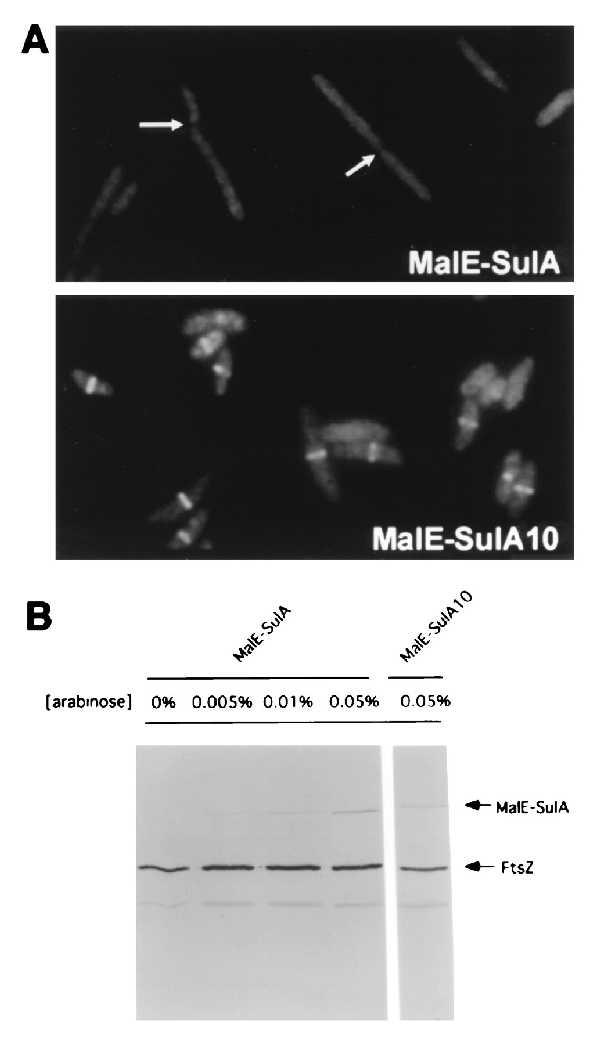
Cell morphology and Z ring formation after induction of MalE-SulA fusions. (A) Cultures of DH5α (pJC93) or (pJC94) were grown in L broth with glucose. Arabinose was added at 0.05% and incubation was continued for 1 hr. Samples were taken and cells were immunostained with antibodies to FtsZ. The arrows indicate cells that have constrictions but lack Z rings. (×1,000.) (B) The induction of the MalE-SulA fusions monitored by immunoblot analysis. Samples from the cultures in A as well as several additional cultures with less arabinose were taken for immunoblotting. The samples were separated by SDS/PAGE, transferred to nitrocellulose, and immunostained with antibodies against FtsZ and the MalE-SulA fusion. The bands corresponding to FtsZ and the MalE-SulA fusions are indicated.
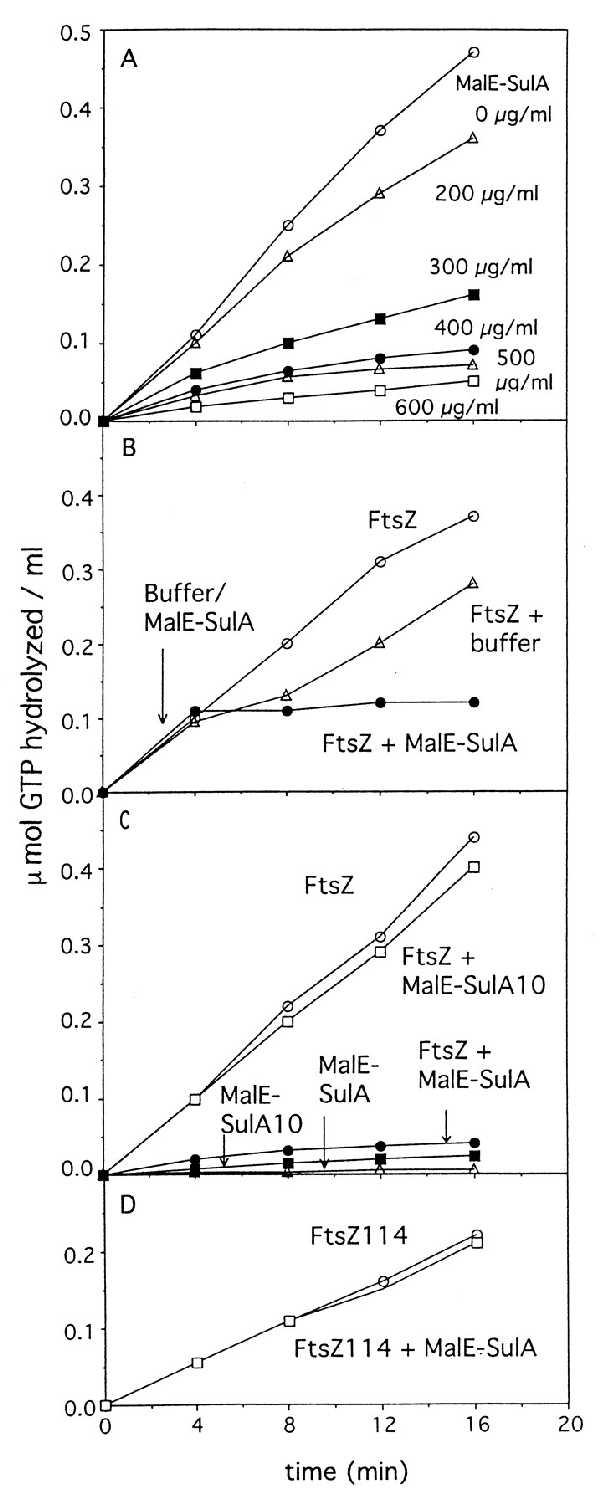
Effect of SulA on the GTPase activity of FtsZ. The GTPase activity was measured in the following buffer: 50 mM Mes–NaOH, pH 6.5/10 mM MgCl2/200 mM KCl. The reaction was initiated with the addition of GTP and incubation at 30°C. At various times samples were removed and GTP hydrolysis was measured by the amount of Pi released. (A) MalE-SulA inhibits the FtsZ GTPase activity. The FtsZ concentration in the reaction was 160 μg/ml and the amount of MalE-SulA is indicated. (B) MalE-SulA immediately inhibits the FtsZ GTPase activity. The GTPase reaction was initiated and divided into two parts; to one part the MalE-SulA fusion was added and to the other buffer was added at the indicated time. (C) MalE-SulA10 does not inhibit the GTPase activity of FtsZ. The MalE-SulA10 mutant protein was added at zero time to a concentration of 600 μg/ml. The FtsZ concentration was 160 μg/ml. (D) Effect of MalE-SulA fusion on the GTPase activity of FtsZ114. The GTPase reaction was carried out with 160 μg/ml FtsZ114 and 600 μg/ml the MalE-SulA fusion.
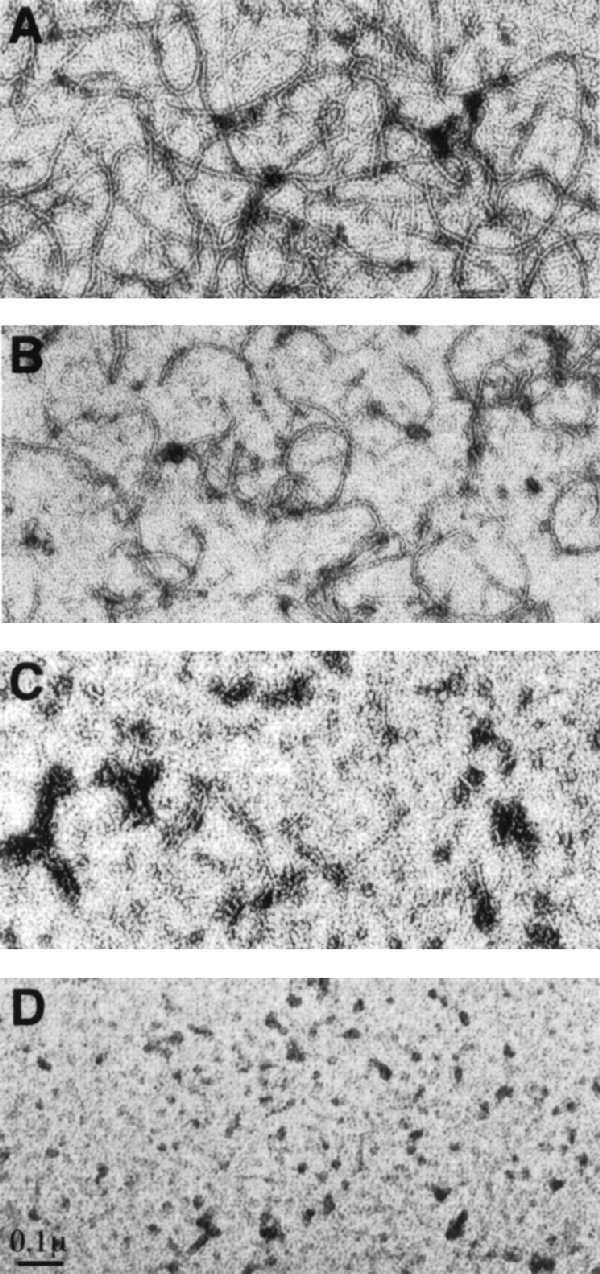
The MalE-SulA fusion inhibits polymerization of FtsZ. FtsZ at 160 μg/ml was diluted into polymerization buffer along with different concentrations of the MalE-SulA fusion. GTP was added to 1 mM and the samples were incubated at 30°C. At 10 min samples were taken and examined by negative-stain electron microscopy. The concentration of the MalE-SulA fusion was 0, 100, 200, and 300 μg/ml in A, B, C, and D, respectively.
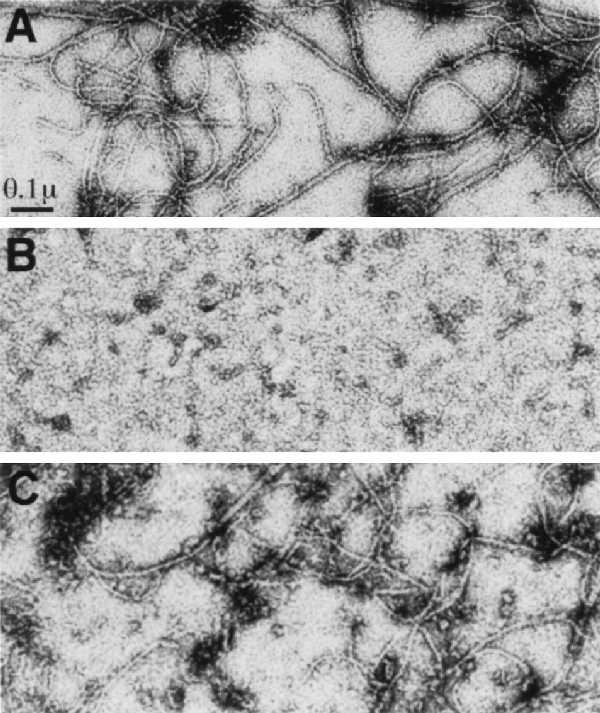
The MalE-SulA fusion promotes depolymerization of FtsZ polymers. The polymerization of FtsZ (160 μg/ml) was initiated in polymerizing buffer containing 50 mM KCl by the addition of 1 mM GTP and incubating at 30°C. Ten minutes later buffer (A), MalE-SulA at 200 μg/ml (B), or MalE-SulA10 at 200 μg/ml (C) was added. The additions resulted in less than a 10% dilution. After an additional 5-min incubation all samples were examined by negative-stain electron microscopy.
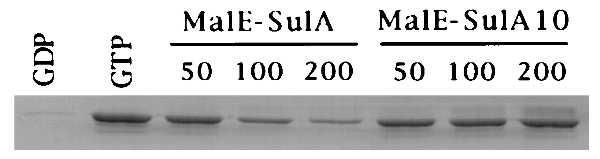
Comparison of the effects of MalE-SulA and MalE-SulA10 on FtsZ polymerization. The effects of MalE-SulA fusions were determined by a sedimentation assay. FtsZ was diluted to 160 μg/ml in polymerizing buffer containing 50 mM KCl in the presence of increasing concentrations of MalE-SulA or MalE-SulA10 as indicated. After the addition of 1 mM GTP, samples were centrifuged for 10 min at 80,000 rpm in a Beckman TL-100 centrifuge. The amount of FtsZ in the pellet was visualized by SDS/PAGE and Coomassie staining and quantitated with a Molecular Dynamics densitometer. With GTP 50% of the total FtsZ was recovered in the pellet as observed earlier (16). With the addition of MalE-SulA at 50, 100, and 200 μg/ml the FtsZ recovered was 39%, 20%, and 12%, respectively. With the addition of MalE-SulA10 at 50, 100, and 200 μg/ml the FtsZ recovered was 36%, 37%, and 42%, respectively. This slight reduction in FtsZ recovery observed with MalE-SulA10 was also observed with MalE alone, indicating it was a nonspecific effect.
References
Publication types
MeSH terms
Substances
Grants and funding
LinkOut - more resources
Full Text Sources
Other Literature Sources
Molecular Biology Databases
