


High affinity ligands from in vitro selection: complex targets
- PMID: 9501188
- PMCID: PMC19667
- DOI: 10.1073/pnas.95.6.2902
High affinity ligands from in vitro selection: complex targets
Abstract
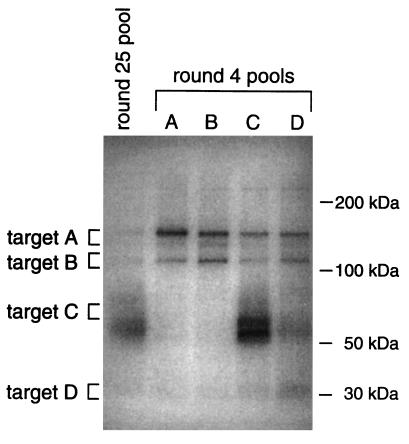
Human red blood cell membranes were used as a model system to determine if the systematic evolution of ligands by exponential enrichment (SELEX) methodology, an in vitro protocol for isolating high-affinity oligonucleotides that bind specifically to virtually any single protein, could be used with a complex mixture of potential targets. Ligands to multiple targets were generated simultaneously during the selection process, and the binding affinities of these ligands for their targets are comparable to those found in similar experiments against pure targets. A secondary selection scheme, deconvolution-SELEX, facilitates rapid isolation of the ligands to targets of special interest within the mixture. SELEX provides high-affinity compounds for multiple targets in a mixture and might allow a means for dissecting complex biological systems.
Figures
References
-
- Tuerk C, Gold L. Science. 1990;249:505–510. - PubMed
-
- Gold L, Polisky B, Uhlenbeck O, Yarus M. Annu Rev Biochem. 1995;64:763–797. - PubMed
-
- Fitzwater T, Polisky B. In: Methods in Enzymology. Abelson J, Simon M I, editors. San Diego: Academic; 1996. pp. 275–301. - PubMed
-
- Gold L. J Biol Chem. 1995;270:13581–13584. - PubMed
Publication types
MeSH terms
Substances
Grants and funding
LinkOut - more resources
Full Text Sources
Other Literature Sources
