. 1998 Mar 17;95(6):2902-7.
doi: 10.1073/pnas.95.6.2902.

High affinity ligands from in vitro selection: complex targets

Affiliations

High affinity ligands from in vitro selection: complex targets

K N Morris et al. Proc Natl Acad Sci U S A. .

Abstract

Human red blood cell membranes were used as a model system to determine if the systematic evolution of ligands by exponential enrichment (SELEX) methodology, an in vitro protocol for isolating high-affinity oligonucleotides that bind specifically to virtually any single protein, could be used with a complex mixture of potential targets. Ligands to multiple targets were generated simultaneously during the selection process, and the binding affinities of these ligands for their targets are comparable to those found in similar experiments against pure targets. A secondary selection scheme, deconvolution-SELEX, facilitates rapid isolation of the ligands to targets of special interest within the mixture. SELEX provides high-affinity compounds for multiple targets in a mixture and might allow a means for dissecting complex biological systems.


Figures
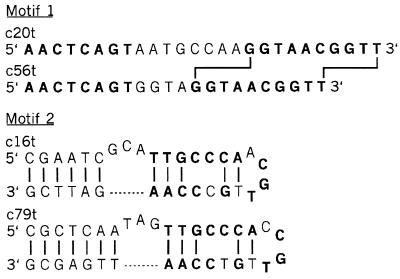
Figure 1
Figure 1
Deoxynucleotide sequences of the motif I and motif II truncates used in the binding and cross-linking experiments (see text). Invarient residues within each motif are shown in boldface type. The shift in the spacing of the 3′ conserved element between the motif I ligands is indicated by lines connecting the sequences. The proposed secondary structures of the motif II ligands are shown with base-pairing interactions denoted by lines connecting the nucleotides.
Figure 2
Figure 2
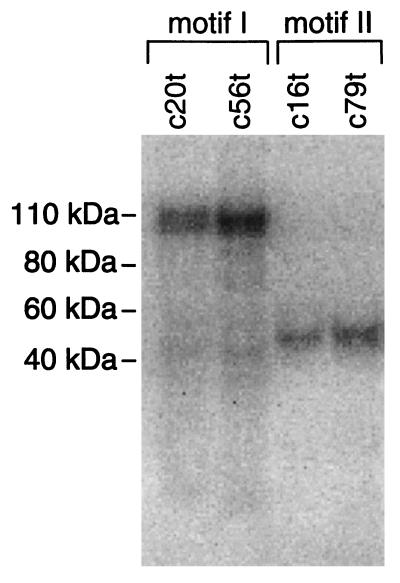
Autoradiograph of the SDS/PAGE analysis of the cross-linking products formed between the truncated ssDNA ligands indicated above each lane and their targets on the RBC membranes.
Figure 3
Figure 3
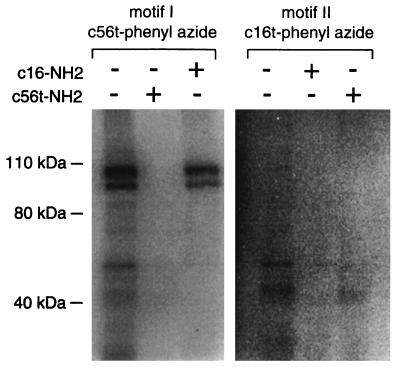
Autoradiograph of the SDS/PAGE analysis of the cross-linking products formed between c56t and c16t and their targets on the RBC membranes in the presence or absence of competitor ligand. The radioactive ligand present in each group of three lanes and the presence (+) or absence (−) of a thousandfold excess of nonradioactively labeled ligand is indicated above. The specific cross-linking products for each ligand is denoted by an arrow.
Figure 4
Figure 4
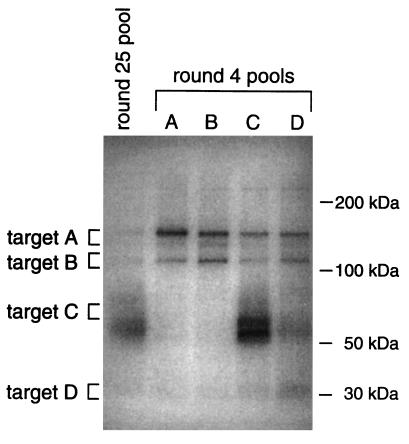
Autoradiograph of the SDS/PAGE analysis of the cross-linking product formed by the radioactively labeled round 25 starting pool and each of the round 4 deconvolution-SELEX pools (A–D) with the RBC membranes. The approximate region of the gel excised for each target is indicated by brackets.
Figure 5
Figure 5
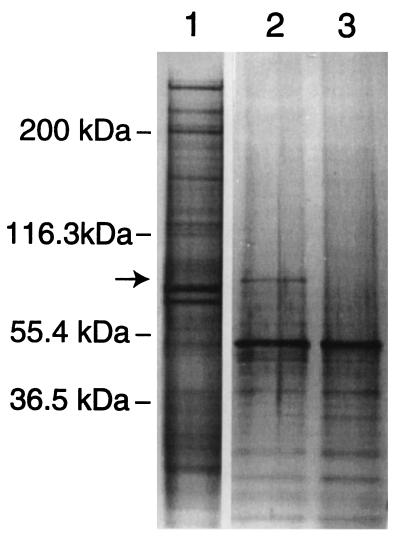
Silver-stained denaturing polyacrylamide gel used to analyze the ligand mediated target purification procedure. Lanes: 1, untreated RBC membranes; 2, purification with c56t; 3, purification minus c56t. The target band isolated in the reaction containing the c56t ligand is indicated by an arrow.

References

    1. Tuerk C, Gold L. Science. 1990;249:505–510. - PubMed
    1. Gold L, Polisky B, Uhlenbeck O, Yarus M. Annu Rev Biochem. 1995;64:763–797. - PubMed
    1. Fitzwater T, Polisky B. In: Methods in Enzymology. Abelson J, Simon M I, editors. San Diego: Academic; 1996. pp. 275–301. - PubMed
    1. Gold L. J Biol Chem. 1995;270:13581–13584. - PubMed
    1. Gold L, Brown D, He Y-Y, Shtatland T, Singer B S, Wu Y. Proc Natl Acad Sci USA. 1997;94:59–64. - PMC - PubMed

Publication types

MeSH terms

LinkOut - more resources