. 1998 Mar 17;95(6):3100-5.
doi: 10.1073/pnas.95.6.3100.

Increased platelet sensitivity to ADP in mice lacking platelet-type 12-lipoxygenase

Affiliations

Increased platelet sensitivity to ADP in mice lacking platelet-type 12-lipoxygenase

E N Johnson et al. Proc Natl Acad Sci U S A. .

Abstract

Arachidonic acid metabolism is one of several mechanisms culminating in the production of an agonist for platelet activation and recruitment. Although the proaggregatory role of thromboxane A2, a product of the aspirin-inhibitable cyclooxygenase, is well established, relatively little is known regarding the biological importance of arachidonic acid metabolism via the 12-lipoxygenase (P-12LO) pathway to 12-hydro(pero)xyeicosatetraenoic acid. We observed that platelets obtained from mice in which the P-12LO gene has been disrupted by gene targeting (P-12LO-/-) exhibit a selective hypersensitivity to ADP, manifested as a marked increase in slope and percent aggregation in ex vivo assays and increased mortality in an ADP-induced mouse model of thromboembolism. The hyperresponsiveness to ADP is independent of dense granule release, cyclooxygenase-derived eicosanoid synthesis, and protein kinase C activity. The addition of 12-hydroxyeicosatetraenoic acid to P-12LO-/- platelet-rich plasma rescues the hyperresponsive phenotype resulting in a diminished ADP-induced aggregation profile. The enhanced ADP sensitivity of P-12LO-/- mice appears to reveal a mechanism by which a product of the P-12LO pathway suppresses platelet activation by ADP.


Figures
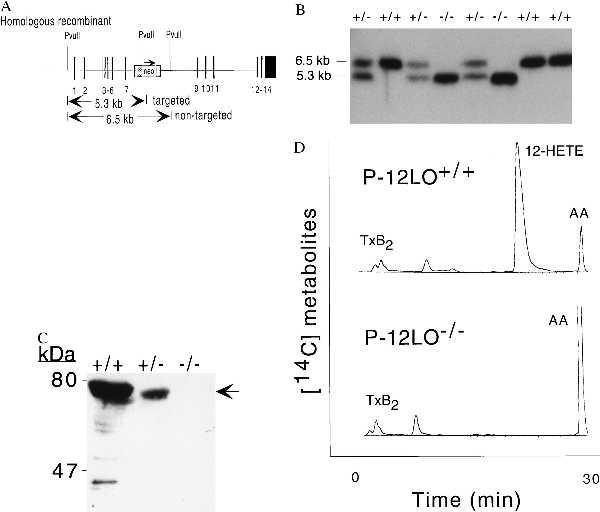
Figure 1
Figure 1
Disruption of the P-12LO gene in mice. (A) The predicted homologous recombinant in which exon 8 was deleted and replaced with a neomycin cassette. An additional PvuII restriction endonuclease site in the neomycin cassette was used to detect the presence of the mutant allele. (B) Southern blot in which mouse tail DNA was digested with PvuII; hybridization with labeled probe encoding exons 1–2 was used to detect the presence of only the mutant allele (5.3 kb; P-12LO−/−), only the wild-type allele (6.5 kb; P-12LO+/+), or both (P-12LO+/−) by autoradiography. (C) Western blot detection of P-12LO protein. Arrow shows the position of P-12LO immunoreactive protein. (D) HPLC chromatograms of products formed from incubation of platelets with [14C]arachidonic acid (0.3 μCi, 100 μM; 1 Ci = 37 GBq).
Figure 2
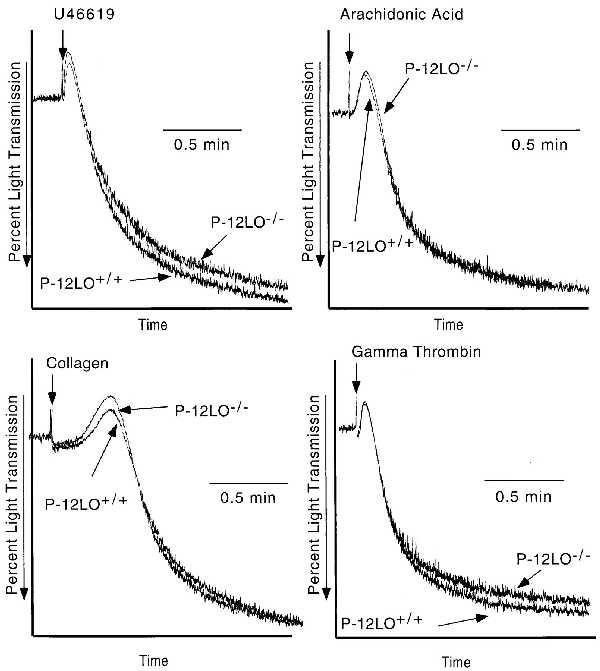
Figure 2
Thrombin, collagen, U46619, and arachidonic acid-induced aggregation responses are largely unaffected by disruption of the P-12LO gene. Agonist was added to PRP as indicated by the arrow. Extent of aggregation of P-12LO−/− mouse platelets was not significantly different from wild-type control mouse platelets stimulated with γ thrombin (10–100 nM), collagen (2–40 μg/ml), U46619 (0.5–20 μM), or arachidonic acid (20–100 μM) (n = 4 to 6).
Figure 3
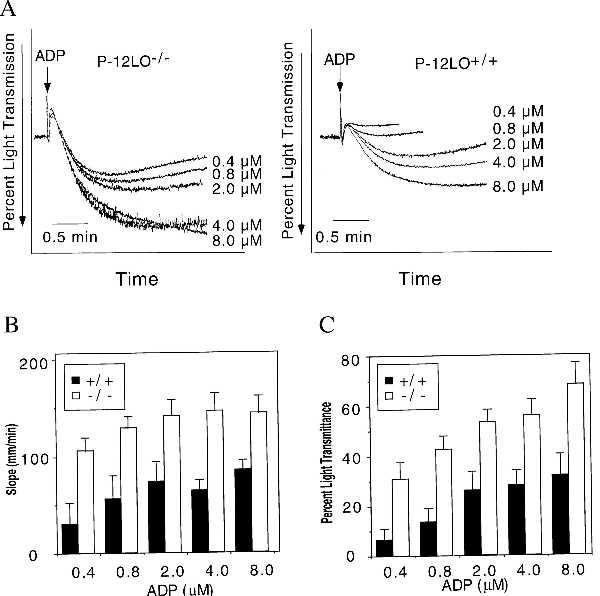
Figure 3
ADP-stimulated aggregation is uniquely altered in P-12LO−/− mice. (A) Aggregation profiles of P-12LO+/+ and P-12LO−/− platelets at the indicated doses of ADP. (B and C) Bar graphs depict the mean slope (B) and percent of platelet aggregation (C) of eight +/+ (solid bars) and eight −/− (open bars) mice. Error bars are the SEM. At each dose the difference is significant, as determined by Student’s t test (P < 0.05).
Figure 4
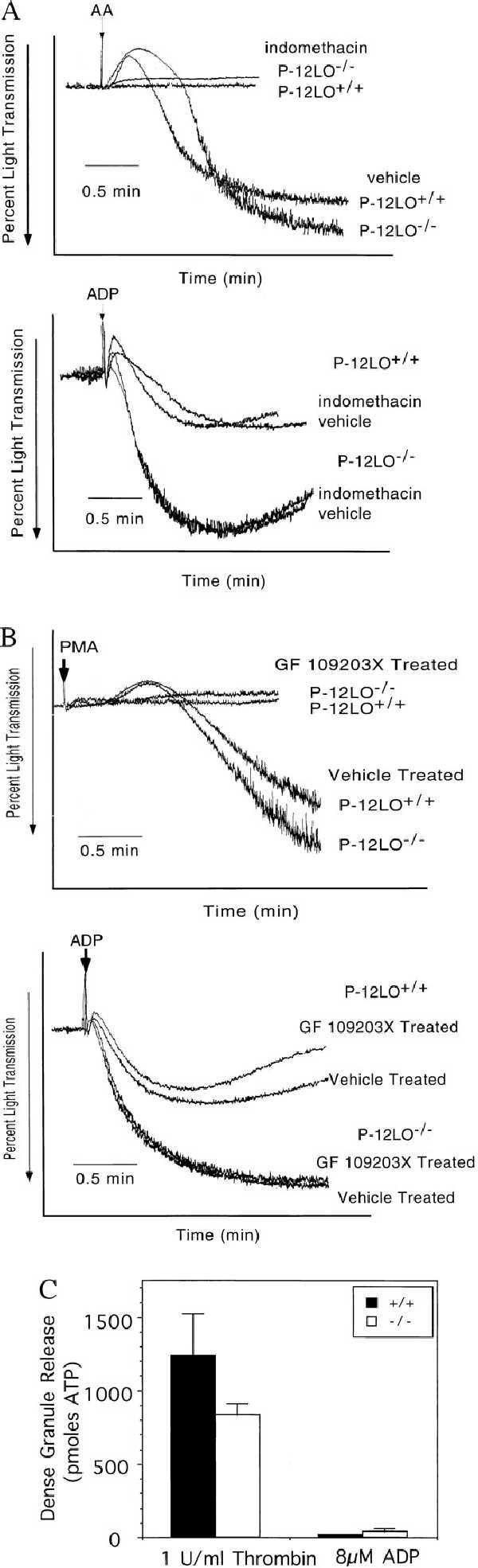
Figure 4
Analysis of second messenger systems in ADP-induced platelet aggregation. The lack of role of COX-1-derived thromboxane synthesis (A) and PKC (B) in ADP-stimulated aggregation of P-12LO+/+ and P-12LO−/− platelets (Lower). Platelets were incubated with either 1 μM indomethacin or 5 μM GF109203X before aggregation. Aggregation by arachidonic acid or phorbol 12-myristate 13-acetate was completely inhibited by incubation with indomethacin or GF109203X, respectively (Upper). Traces are representative of experiments performed with platelets from two mice. (C) Measurement of ATP release upon stimulation of P-12LO+/+ (solid bars) and −/− (open bars) platelets with thrombin (1 unit/ml) and 8 μM ADP (n = 3).
Figure 5
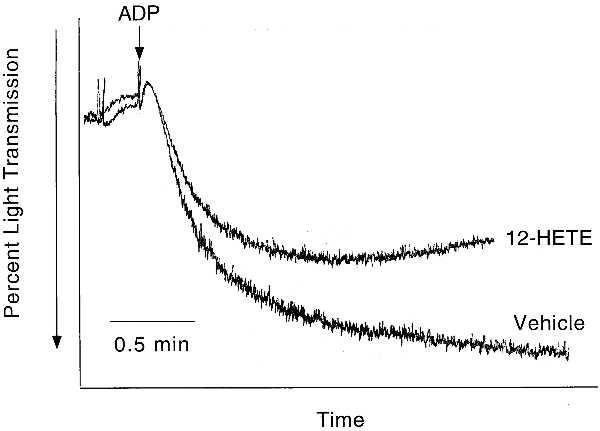
Figure 5
Hyperaggregation in ADP-stimulated P-12LO−/− platelets can be attenuated by adding back 12-HETE. PRP was prepared as described above. Immediately after the addition of 12-HETE (200 μM, final concentration) or vehicle (EtOH), ADP (8 μM, final concentration) was added to induce aggregation. The curve shown is a representative tracing of a decrease in percent aggregation from 82.5% to 63.1%. A Student’s t test of paired experiments yielded a two-tailed P value of 0.0032 (n = 12).
Figure 6
Figure 6
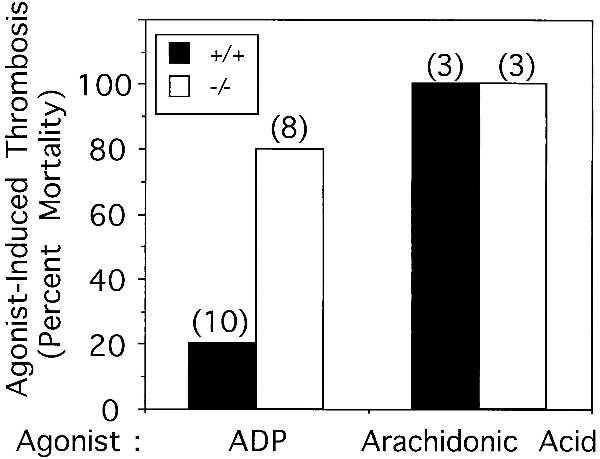
P-12LO−/− mice are more sensitive to thrombosis elicited by intravenous ADP injection. Female mice were injected with ADP at 0.035 mg/g (body weight) via the tail vein. The percent mortality of P-12LO+/+ (solid bars) and P-12LO−/− (open bars) mice is indicated. The number of mice is indicated in parentheses. (P < 0.05, as determined by Fisher’s exact test). Differences in mortality with arachidonic acid-induced thrombosis were not observed at 30 mg/kg (data not shown) and 100 mg/kg.

References

    1. Yamamoto S. Biochim Biophys Acta. 1992;1128:117–131. - PubMed
    1. Funk C D. Biochim Biophys Acta. 1996;1304:65–84. - PubMed
    1. Funk C D, Furci L, FitzGerald G A. Proc Natl Acad Sci USA. 1990;87:5638–5642. - PMC - PubMed
    1. Izumi T, Hoshiko S, Rådmark O, Samuelsson B. Proc Natl Acad Sci USA. 1990;87:7477–7481. - PMC - PubMed
    1. Samuelsson B, Goldyne M, Granström E, Hamberg M, Hammarström S, Malmsten C. Annu Rev Biochem. 1978;47:997–1029. - PubMed

Publication types

Substances