. 1998 Mar 17;95(6):3188-92.
doi: 10.1073/pnas.95.6.3188.

Loss of bombesin-induced feeding suppression in gastrin-releasing peptide receptor-deficient mice

Affiliations

Loss of bombesin-induced feeding suppression in gastrin-releasing peptide receptor-deficient mice

L L Hampton et al. Proc Natl Acad Sci U S A. .

Abstract

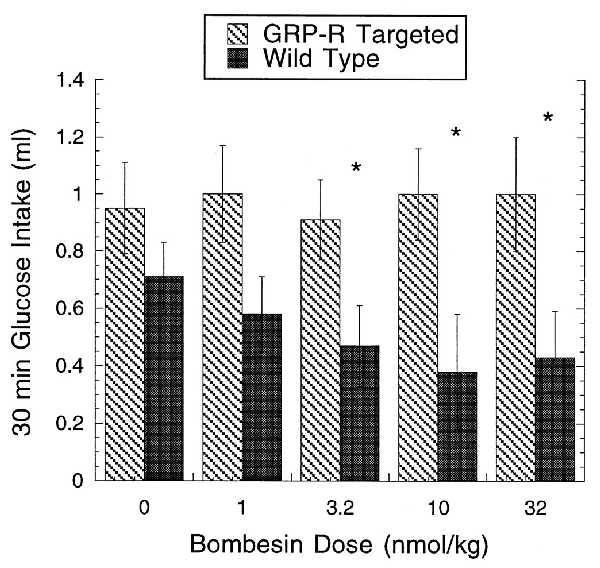
The gastrin-releasing peptide receptor (GRP-R) is one of three members of the mammalian bombesin subfamily of seven-transmembrane G protein-coupled receptors that mediate diverse biological responses including secretion, neuromodulation, chemotaxis, and growth. The X chromosome-linked GRP-R gene is expressed widely during embryonic development and predominantly in gastrointestinal, neuronal, and neuroendocrine systems in the adult. Surprisingly, gene-targeted mice lacking a functional GRP-R gene develop and reproduce normally and show no gross phenotypic abnormalities. However, peripheral administration of bombesin at dosages up to 32 nmol/kg to such mice had no effect on the suppression of glucose intake, whereas normal mice showed a dose-dependent suppression of glucose intake. These data suggest that selective agonists for the GRP-R may be useful in inducing satiety.


Figures
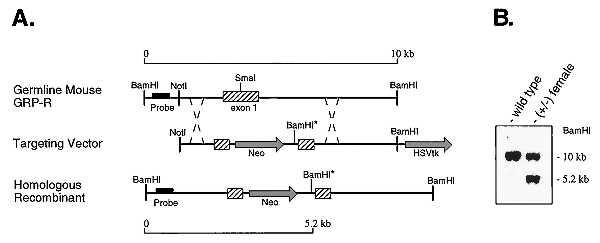
Figure 1
Figure 1
Targeted disruption of the mouse GRP-R gene. (A) Diagram of the GRP-R genomic structure, targeting vector construct, and gene structure after homologous recombination. Hatched boxes, GRP-R exon 1 sequence; shaded arrows, neo and HSVtk cassettes. The neo cassette is inserted into the SmaI site of the GRP-R exon 1 along with an additional BamHI site (noted by ∗). The location of a 5′ probe sequence is indicated by a solid bar. Homologous recombination after electroporation of ES cells with this construct yields a GRP-R mutant allele in which the 10-kb wild-type BamHI genomic fragment is replaced with a 5.2-kb BamHI fragment. (B) Southern blot of BamHI-digested genomic DNA from a wild-type (+/Y) male and a heterozygous (+/−) female. Hybridization was to a 32P-labeled 600-bp 5′ fragment designated as “probe” in A. The molecular sizes of the genomic DNA fragments hybridizing to the probe are indicated.
Figure 2
Figure 2
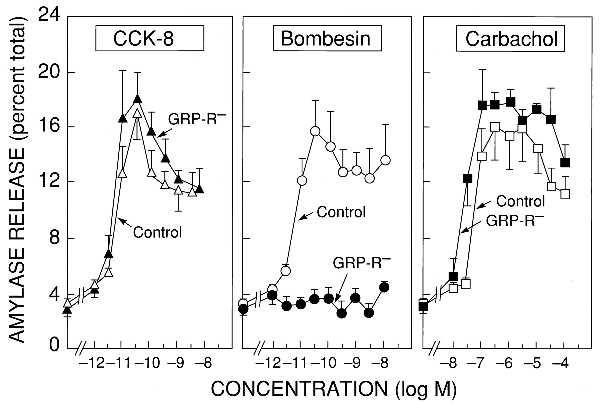
Amylase release in pancreatic acini. Abilities of CCK-8 (Left), BN (Center), and carbachol (Right) to stimulate amylase release from dispersed pancreatic acini prepared from GRP-R-targeted (−/Y) male mice (solid symbols) or control (+/Y) male littermates (open symbols). Dispersed acini were incubated with the indicated concentrations of secretagogues for 30 min at 37°C. Results are expressed as the percentage of total cellular amylase activity in the cells before the incubation that was released into the extracellular medium during the incubation and are the means ± SEM of three experiments performed in triplicate.
Figure 3
Figure 3
Effect of BN on glucose uptake. Thirty-minute glucose intake in GRP-R-targeted (−/Y) male mice and wild-type (+/Y) male littermates after intraperitoneal administration of BN at 0 (0.9% saline) or 1.0, 3.2, 10, and 32 nmol/kg. BN produced a significant suppression of glucose intake in wild-type mice at doses of 3.2, 10, and 32 nmol/kg but failed to suppress intake at any dose in GRP-R-targeted mice. ∗, Significantly different from 0.9% saline (P < 0.05).

References

    1. Anastasi A, Erspamer V, Bucci M. Experientia. 1971;27:166–167. - PubMed
    1. McDonald T J, Jornvall H, Nilsson M, Vagne M, Ghatei M, Bloom S R, Mutt V. Biochem Biophys Res Commun. 1979;90:227–233. - PubMed
    1. Minamino N, Kangawa K, Matuso H. Biochem Biophys Res Commun. 1983;114:541–548. - PubMed
    1. Lebacq-Verheyden A-M, Trepel J, Sausville E A, Battey J F. In: Handbook of Experimental Pharmacology. Sporn M, Roberts A, editors. Vol. 95. Berlin: Springer; 1990. pp. 71–124.
    1. Spindel E R. Trends Neurosci. 1986;9:130–133.