. 1998 Feb 12;8(4):235-8.
doi: 10.1016/s0960-9822(98)70089-2.

Fluctuations in cyclin E levels are required for multiple rounds of endocycle S phase in Drosophila

Affiliations

Fluctuations in cyclin E levels are required for multiple rounds of endocycle S phase in Drosophila

P J Follette et al. Curr Biol. .

Abstract

The precise cell-cycle alternation of S phase and mitosis is controlled by alternating competence of nuclei to respond to S-phase-inducing factors [1]. Nuclei acquire competence to replicate at the low point in cyclin-dependent kinase (Cdk) activities that follows mitotic destruction of cyclins. The elevation of Cdk activity late in G1 is thought to drive cells into S phase and to block replicated DNA from re-acquiring replication competence [2]. Whereas mitosis is normally required to eliminate the cyclins prior to another cycle of replication, experimental elimination of Cdk activity in G2 can restore competence to replicate [3-6]. Here, we examine the roles of Cdks in the endocycies of Drosophila [7]. In these cycles, rounds of discrete S phases without intervening mitoses result in polyteny. Cyclins A and B are lost in cells as they enter endocycles [8,9], and pulses of Cyclin E expression drive endocycle S phases [10-12]. To address whether oscillations of Cyclin E expression are required for endocycles, we expressed Cyclin E continuously in Drosophila salivary glands. Growth of the cells was severely inhibited, and a period of DNA replication was induced but further replication was inhibited. This replication inhibition could be overcome by the kinase inhibitor 6-dimethylaminopurine (6-DMAP), but not by expression of subunits of the transcription factor E2F. These results indicate that endocycle S phases require oscillations in Cdk activity, but, in contrast to oscillations in mitotic cells, these occur independently of mitosis.


Figures
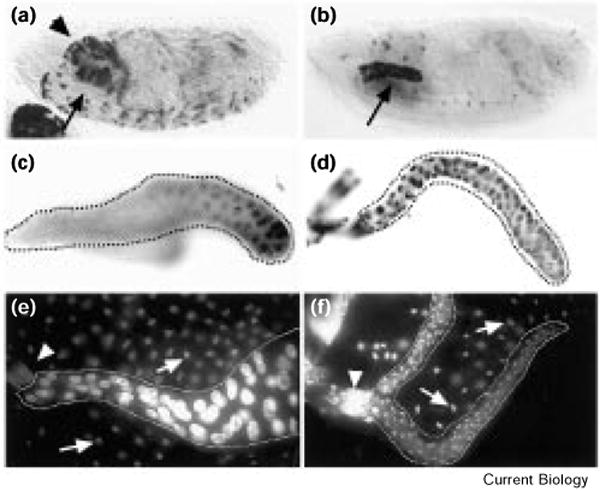
Figure 1
Figure 1
Continuous Cyclin E expression begins in embryonic salivary glands and continues throughout larval development. (a,b) Embryos and (c,d) salivary glands (outlined) of early third instar larvae were hybridized with a digoxigenin-labeled Cyclin E RNA probe that was visualized using alkaline-phosphatase-conjugated anti-digoxigenin antibodies. Cyclin E RNA accumulated in the salivary glands (arrows) of 43B-UAS–Cyclin E embryos (b) by stage 15, at which time wild-type (Sevelin) embryos (a) do not express Cyclin E in the salivary glands. The arrowhead in (a) indicates labeling in the brain, which is somewhat out of focus in (b). (c) A fraction of the cells of the larval salivary gland express Cyclin E RNA in the wild-type (yw67) salivary glands, whereas all of the cells of the 43B-UAS–Cyclin E glands (d) express Cyclin E. (e) Late third instar wild-type and (f) 43B-UAS–Cyclin E salivary glands (outlined by dotted lines) stained with 1 μg/ml Hoechst 33258. Whereas the salivary glands normally increase in size dramatically during the third instar, the salivary glands of the 43B-UAS–Cyclin E larvae remain small. Arrowheads indicate the ring of diploid cells forming the imaginal ring. Arrows indicate the nuclei of the fat body; cells of the fat body (which are not expressing Cyclin E continuously in these experiments) also endoreplicate but to a lesser extent than cells of the wild-type salivary gland. Note the relative size of the fat body nuclei compared to the wild-type and 43B-UAS–Cyclin E salivary gland nuclei.
Figure 2
Figure 2
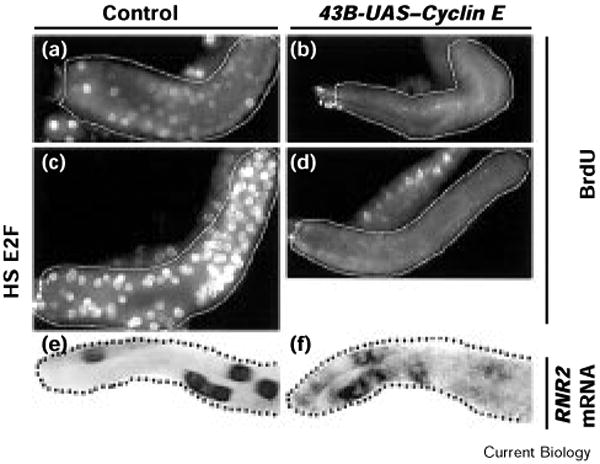
Continuous Cyclin E expression in Drosophila salivary glands causes a prolonged period of replication inhibition in larvae. (a,b) Early third instar larval salivary glands (outlined) were dissected and cultured with 1 mg/ml BrdU for 30 min. The incorporated nucleotide was detected by immunofluorescent staining. (a) Wild-type salivary glands showed BrdU incorporation in a subset of nuclei. Whereas little or no incorporation is seen in 43B-UAS–Cyclin E salivary glands (b), we did detect occasional small dots of BrdU incorporation and rare nuclei with more complete labeling (not evident in this figure). We suggest that these dots of BrdU incorporation result from the firing of isolated replication origins: if the replication block created by the UAS–Cyclin E and 43B transgenes is imperfect, then a failure of the block may result in the sporadic assembly of replication components at an origin followed by local replication. (c,d) Salivary glands (outlined) from early third instar larvae that carry heat-shock-inducible (HS) transgenes for E2F and DP were labeled by culturing dissected glands with BrdU for 30 min. (c) Induction of the subunits of E2F (E2F and DP) in a wild-type background causes an increase in BrdU incorporation but not in (d) the salivary glands of 43B-UAS–Cyclin E larvae that express Cyclin E continuously. Larvae were heat shocked at 37°C for 1 h, allowed to recover for 2 h, and dissected and labeled in Schneider's tissue culture medium with 1 mg/ml BrdU. (e,f) Early third instar salivary glands were hybridized with a digoxigenin-labeled probe for RNR2 RNA and the probe visualized immunohistochemically. RNR2 is a target of E2F, and provides an indication of E2F activity. In both (e) wild-type and (f) 43B-UAS–Cyclin E salivary glands, RNR2 is expressed in a subset of the cells of the gland.
Figure 3
Figure 3
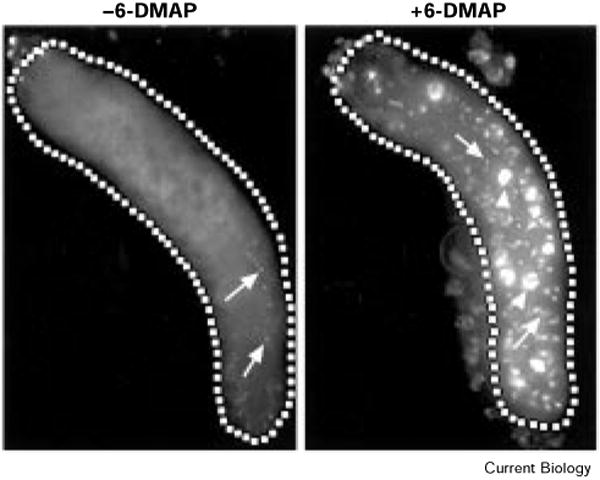
The kinase inhibitor 6-DMAP causes an additional period of BrdU incorporation in 43B-UAS–Cyclin E larval salivary glands. Salivary glands were dissected from second instar 43B-UAS–Cyclin E larvae and incubated for 30 min in tissue culture medium with or without 10 mM 6-DMAP. The glands were then washed six times for 5 min with medium free of 6-DMAP and labeled for 30 min in culture medium with BrdU. (a) Untreated glands show only some small dots of BrdU incorporation (arrows). (b) Treatment with 6-DMAP resulted in BrdU incorporation in both dots (arrows) and entire nuclei (arrowheads). BrdU was detected using rhodamine-conjugated secondary antibodies and the images captured using a CCD (charge-coupled device) camera.
Figure 4
Figure 4
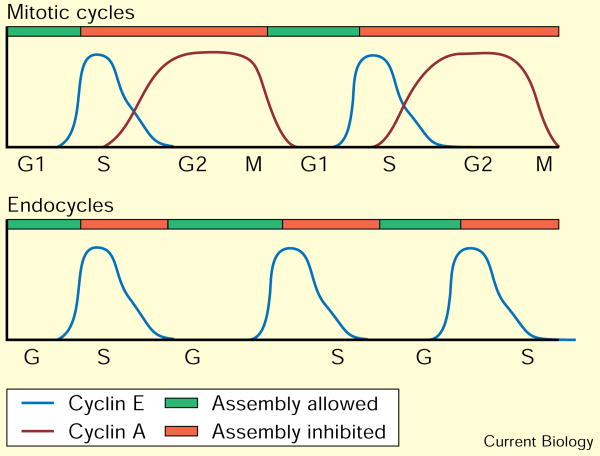
A model to explain the control of S phase in mitotic cycles and endocycles. We summarize here previous proposals [2,5,6,10,11,15] for the coordination of DNA replication with mitotic cycles and endocycles, with emphasis on the newly demonstrated ability of cyclin E to inhibit re-replication. In mitotic cells, the absence of Cdk activity allows the assembly of replication origins during the G1 phase. Because Cdks are required in order for assembled origins to fire, DNA replication does not begin until Cdk activity appears in late G1 phase, provoking entry into S phase. Once in S phase, re-assembly of fired origins is inhibited by Cdk activity, which is present until the G2 cyclins (specifically cyclin A) are degraded during mitosis. In endocycles, fluctuations in Cdk activity cause a similar cycle of origin assembly, origin firing, and prevention of reassembly, but here the ability to reassemble origins does not rely on passage through mitosis. Instead, the G2 cyclins are not expressed in these cells, and the prevention of reassembly is carried out by cyclin-E-associated kinase activity, which fluctuates independently of mitosis.

References

    1. Rao PN, Johnson RT. Mammalian cell fusion: studies on the regulation of DNA synthesis and mitosis. Nature. 1970;225:159–164. - PubMed
    1. Su TT, Follette PJ, O'Farrell PH. Qualifying for the license to replicate. Cell. 1995;81:825–828. - PMC - PubMed
    1. Broek D, Bartlett R, Crawford K, Nurse P. Involvement of p34cdc2 in establishing the dependency of S phase on mitosis. Nature. 1991;349:388–393. - PubMed
    1. Hayles J, Fisher D, Woollard A, Nurse P. Temporal order of S phase and mitosis in fission yeast is determined by the state of the p34cdc2-mitotic B cyclin complex. Cell. 1994;78:813–822. - PubMed
    1. Dahmann C, Diffley JF, Nasmyth KA. S-phase-promoting cyclin-dependent kinases prevent re-replication by inhibiting the transition of replication origins to a pre-replicative state. Curr Biol. 1995;5:1257–1269. - PubMed

Publication types

LinkOut - more resources