. 1998 Mar 15;507 ( Pt 3)(Pt 3):843-55.
doi: 10.1111/j.1469-7793.1998.843bs.x.

Activation of P2X receptors for adenosine triphosphate evokes cardiorespiratory reflexes in anaesthetized rats

Affiliations

Activation of P2X receptors for adenosine triphosphate evokes cardiorespiratory reflexes in anaesthetized rats

D S McQueen et al. J Physiol. .

Abstract

1. We tested the hypothesis that activation of P2X receptors associated with vagal afferent nerves can evoke a Bezold-Jarisch (B-J) depressor reflex in anaesthetized rats. 2. Injection of alphabeta-methylene ATP (alphabeta-MeATP; 0.6-600 nmol i.v.) evoked a dose-dependent B-J reflex comprising bradycardia, hypotension and apnoea in rats anaesthetized with pentobarbitone. Apnoea was commonly preceded by hyperventilation. Bilateral vagotomy significantly reduced the bradycardia and most of the apnoeic response without affecting hyperventilation, and unmasked a vasopressor response. Hypotension and apnoea were subject to desensitization, and ATP was about 100 times less potent than alphabeta-MeATP in evoking the B-J reflex. 3. ED50 values for responses to alphabeta-MeATP were: bradycardia 14.6 +/- 3.8 nmol; apnoea 47.1 +/- 8.5 nmol; hyperventilation 23.3 +/- 6.0 nmol, n = 14. The ED50 for apnoea was significantly greater than that for bradycardia or hyperventilation (P < 0.05). Atropine (2.8 micromol (kg body wt)-1 i.v.) antagonized the reflex bradycardia and hypotension. 4. The P2 antagonists suramin (14 micromol (kg body wt)-1 i.v.) and PPADS (17 micromol (kg body wt)-1 i.v.) antagonized the bradycardic and apnoeic components of the reflex response to alphabeta-MeATP, without reducing the vasopressor or hyperventilatory responses to the agonist. 5. Recordings from vagal afferents showed that pulmonary inflation receptors were activated by alphabeta-MeATP in 62 % of units recorded (ED50 22 +/- 5 nmol) and this was blocked by PPADS (17 micromol (kg body wt)-1 i.v.); unidentified vagal afferents were also activated. 6. alphabeta-MeATP activated carotid chemoreceptor afferents (ED50 23 +/- 9 nmol), an action that was unaffected by PPADS or suramin. 7. The results support the hypothesis that P2X receptor subtypes for ATP are associated with specific sensory nerves that form part of the homeostatic mechanism for cardiovascular and respiratory regulation and these receptors therefore have physiological, pathological and therapeutic significance.


Figures

Figure 1
Figure 1. Cardiorespiratory effects of αβ-MeATP
Cardiorespiratory effects of a dose of αβ-MeATP (100 nmol i.v. at continuous vertical line) in a rat anaesthetized with pentobarbitone. In each panel the upper trace from the computerized chart recorder is arterial BP, and the lower trace is respiratory airflow (inspiration downwards, arbitrary units (a.u.), mV). Heart rate was measured by counting individual beats in the BP trace. During the control state (A) bradycardia, transient hyperventilation, vasodepression and apnoea were obtained in response to the rapid injection of αβ-MeATP. After cutting both vagus nerves at mid-cervical level (B) the bradycardia, hypotension, and apnoea were abolished, leaving hyperventilation and a vasopressor response to the same dose of agonist. Cutting both carotid sinus nerves (C) abolished hyperventilation without reducing the vasopressor response. The delayed arrhythmia seen in C differed from the reflex bradycardia observed in A, and was associated with the substantial rise in systemic blood pressure; the arrhythmia may result from activation of C fibre sympathetic cardiac afferents innervating the left ventricle (see Hainsworth, 1991).
Figure 4
Figure 4. Summary of pooled ED50 data for brachycardia, apnoea and hyperventilation evoked by αβ-MeATP
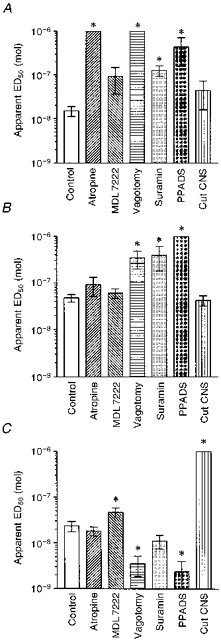
Mean apparent ED50 values ± s.e.m. for reflex changes evoked by i.v. αβ-MeATP before (Control, n = 14) and after various procedures in rats anaesthetized with pentobarbitone. A, bradycardia was significantly reduced by atropine (2.8 μmol (kg body wt)−1, n = 4), bilateral vagotomy (n = 3), suramin (14 μmol (kg body wt)−1, n = 3) and by PPADS (17 μmol (kg body wt)−1, n = 4), but unaffected by MDL 72222 (0.24 μmol (kg body wt)−1, n = 2) or cutting the sinus nerves (Cut CNS, n = 3). B, apnoea was unaffected by atropine (n = 4), MDL 72222 (n = 3), or cutting the carotid sinus nerves (n = 4), but was reduced after vagotomy (n = 5), suramin (n = 4) or PPADS (n = 4). C, hyperventilation was reduced by cutting the carotid sinus nerves (n = 4), and slightly but significantly by MDL 72222 (n = 4). The response was potentiated by vagotomy (n = 5) or PPADS (n = 4), and unaffected by atropine or suramin (both n = 4). *P < 0.05 versus control values (Mann-Whitney test).
Figure 2
Figure 2. Cardiovascular effects in an artifically ventilated pithed rat in which reflex effects were abolished
Effects of αβ-MeATP (60 nmol i.v. at vertical line) (A) and adenosine (375 nmol i.v.) in an artificially ventilated pithed rat (B) in which reflex effects were abolished. The P2X receptor agonist gave a vasopressor response with no bradycardia, whereas adenosine caused bradycardia and hypotension.
Figure 3
Figure 3. log dose-response curves showing the effects of αβ-MeATP
Results from individual experiments illustrating the effects of αβ-MeATP on heart rate (A), apnoea (B) and hyperventilation (C), before (^) and after (•) the purinoceptor antagonist PPADS (17 μmol (kg body wt)−1 i.v.) which reduced the bradycardia and apnoea components of agonist-induced responses, whereas the hyperventilation component was unaffected or even enhanced by PPADS. Apparent ED50 values were estimated from the log dose-response plots.
Figure 5
Figure 5. Activation of pulmonary vagal afferents by αβ-MeATP
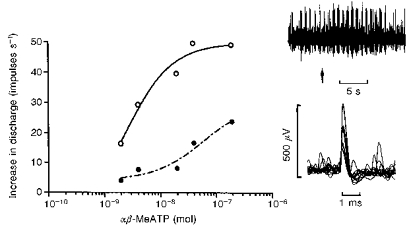
Multi-unit recording from vagal afferents which increased their discharge frequency without any rapid adaptation when the lungs were inflated, i.e. lung inflation receptors. Injection of the P2X agonist αβ-MeATP increased firing of the three units counted by the spike voltage discriminator (^, continuous line) and PPADS (17 μmol (kg body wt)−1 i.v.) antagonized the response (•, dashed line). The upper neurogram shows the neural discharge before and after a control i.v. injection of 2 nmol αβ-MeATP at arrow - note that bursts of activity occurred during inspiration. The lower inset shows a sample of superimposed action potentials (3) triggered by the injection of αβ-MeATP. The number of action potentials triggered during the 5 s period following onset of the response was plotted as the increase above basal values which averaged 14.1 ± 1.4 impulses s−1 before, and 16.3 ± 1.5 impulses s−1 after PPADS. The respiratory pump was set to a stroke volume of 3 ml with a frequency of 84 strokes min−1.
Figure 6
Figure 6. Activation of carotid body chemoreceptors by αβ-MeATP and ATP, and the effect of P2 purinoceptor antagonist PPADS
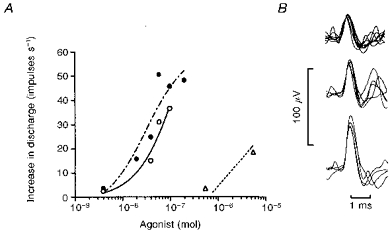
Multi-unit recording from carotid chemoreceptor afferent fibres in an artificially ventilated rat anaesthetized with pentobarbitone. A, all three afferents counted by the voltage discriminator were activated by αβ-MeATP (^, continuous line), and PPADS (17 μmol (kg body wt)−1 i.v.) did not antagonize the response (•, dashed line). Responses evoked by ATP (▵, dotted line) in the control state are also shown. B, three individual action potentials (successive triggered oscilloscope sweeps superimposed) sampled during their activation by αβ-MeATP. The increase in total discharge above pre-injection basal frequency was plotted in A, and basal discharge from these afferents during ventilation with room air averaged 9.3 impulses s−1 before and 9.9 impulses s−1 after PPADS.

References

    1. Bezold von A, Hirt L. Über die physiologischen Wirkungendes des essigsauren Veratrins. Untersuchungen Physiologisches Laboratorium Würzburg. 1867;1:75–156.
    1. Bo X, Zhang Y, Nassar M, Burnstock G, Schoepfer R. A P2X purinoceptor cDNA conferring a novel pharmacological profile. FEBS Letters. 1995;375:129–133. - PubMed
    1. Buell G, Collo G, Rassendren F. P2X receptors - an emerging channel family. European Journal of Neuroscience. 1996;8:2221–2228. - PubMed
    1. Burnstock G. Sympathetic purinergic transmission in small blood vessels. Trends in Pharmacological Science. 1988;9:116–117. - PubMed
    1. Collo G, North RA, Kawashima E, Merlot-pich E, Neidhart S, Suprenant A, Buell G. The cloning of P2X(5) and P2X(6) receptors and the distribution and properties of an extended family of ATP-gated ion channels. Journal of Neuroscience. 1996;16:2495–2507. - PMC - PubMed

MeSH terms

Substances

LinkOut - more resources