


doi: 10.1073/pnas.95.7.3455.
Transcriptional sequencing: A method for DNA sequencing using RNA polymerase
Affiliations
- PMID: 9520387
- PMCID: PMC19857
- DOI: 10.1073/pnas.95.7.3455
Item in Clipboard
Transcriptional sequencing: A method for DNA sequencing using RNA polymerase
Proc Natl Acad Sci U S A.
.
Abstract
We have developed a sequencing method based on the RNA polymerase chain termination reaction with rhodamine dye attached to 3'-deoxynucleoside triphosphate (3'-dNTP). This method enables us to conduct a rapid isothermal sequencing reaction in <30 min, to reduce the amount of template required, and to do PCR direct sequencing without the elimination of primers and 2'-dNTP, which disturbs the Sanger sequencing reaction. An accurate and longer read length was made possible by newly designed four-color dye-3'-dNTPs and mutated RNA polymerase with an improved incorporation rate of 3'-dNTP. This method should be useful for large-scale sequencing in genome projects and clinical diagnosis.
Figures
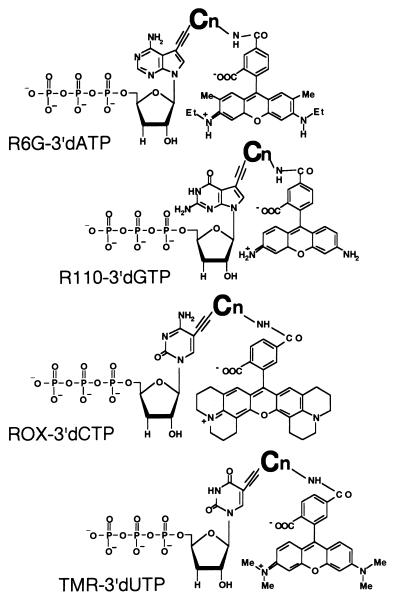
Structures of four rhodamine-labeled 3′-deoxynucleoside 5′-triphosphates. Cn indicates the number of CH2 in the linker arm between rhodamine dye and base of 3′dNTP.
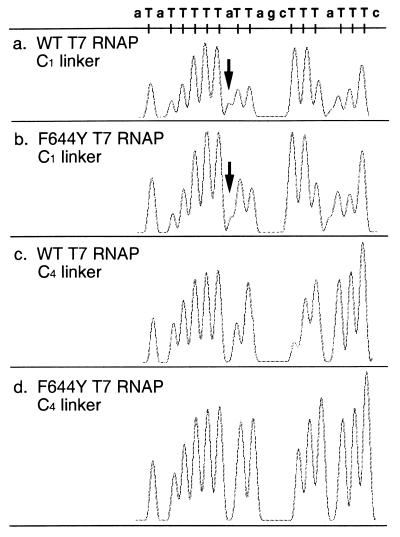
Effects of linker length and mutated T7 RNAP in the termination pattern with TMR-3′-dUTP. Sequencing reactions were performed with human thyroid-stimulating hormone β-subunit unpurified PCR products for the template. Wild-type or mutated F644Y T7 RNAP for enzyme, C1 or C4 linker arm for dye-3′dNTP were tested, respectively. PPase was added to all reactions. All peaks are shown on the same scale. (a) Combination of C1 linker and wt T7 RNAP. (b) Combination of C1 linker and mutant T7 RNAP. (c) Combination of C4 linker and wt T7 RNAP. (d) Combination of C4 linker and mutant T7 RNAP. Arrows indicate false peaks.
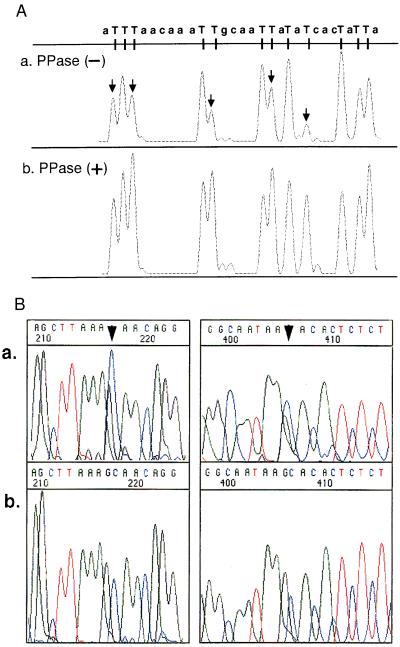
(A) Improvement of peak uniformity by use of PPase. Sequencing reactions were performed in the absence or presence of PPase. Minus or plus indicates the absence or presence of PPase. All peaks indicating termination patterns with TMR-3′-dUTP are shown on the same scale. The arrows indicate sites relatively sensitive to pyrophosphorolysis a. Peak degradations in sensitive sites were prevented by PPase b. (B) Elimination of peak compression by use of 7-deaza-GTP in place of GTP. The arrows indicate two compression sites in human TSH cDNA using GTP as the substrate a. Compressions in the corresponding sequence were eliminated by use of 7-deaza-GTP for the substrate b.
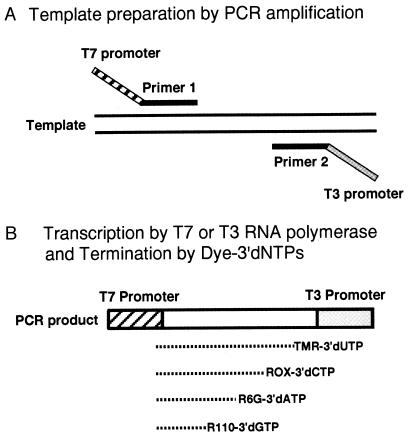
Schematic representation of direct sequencing by transcriptional sequencing. (A) Thin lines are double strand templates whereas thick lines are primers. The phage promoter sequence can be appended to one or both of the PCR primers and incorporated into the PCR product. Alternatively, because most cloning vectors contain two different opposite-oriented phage promoters flanking a multiple cloning site, an inserted DNA can be amplified by using flanking primers and transcribed directly. (B) The remaining primers and 2′-dNTPs need not be removed from PCR products prior to sequencing because the transcription reaction is independent of residual primers and dNTPs. RNA fragments are transcribed under a phage promoter from unpurified PCR reactant and terminated by four kinds of dye-3′dNTPs. Sequencing products are purified and subjected to electrophoresis on a DNA sequencer. This procedure simply requires the addition of one aliquot to the PCR product.
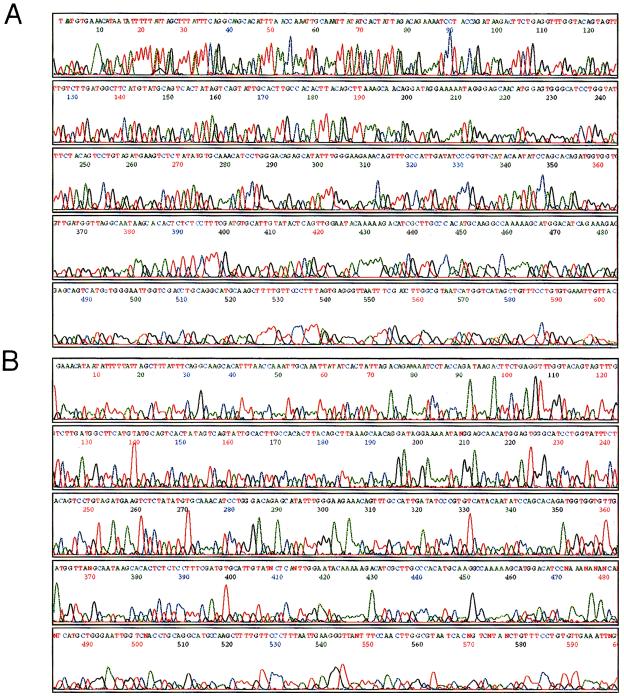
Comparison of transcriptional sequencing (A) with dye-terminator cycle sequencing (B) on the ABI 377 sequencer. 100 ng of human TSH cDNA (plasmid clone:pBS750) was sequenced with both methods as described in Materials and Methods.
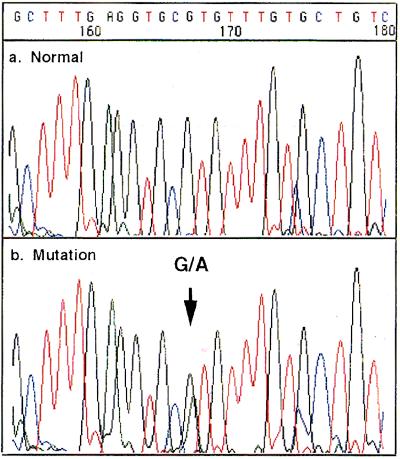
Detection of heterozygotes by direct transcriptional sequencing. The top electropherogram shows sequence of the p53 exon 8 PCR product by amplification of wt DNA. The lower electropherogram shows the heterozygous point mutation from 274R (CGT) to 274H (CAT) in human colon carcinoma cell line HT29.
References
-
- Huang X C, Quesada M A, Mathies R A. Anal Chem. 1992;64:2149–2154. - PubMed
Publication types
MeSH terms
Substances
LinkOut - more resources
Full Text Sources
Other Literature Sources
