. 1998 Mar 31;95(7):3483-8.
doi: 10.1073/pnas.95.7.3483.

The glutathione redox couple modulates zinc transfer from metallothionein to zinc-depleted sorbitol dehydrogenase

Affiliations

The glutathione redox couple modulates zinc transfer from metallothionein to zinc-depleted sorbitol dehydrogenase

L J Jiang et al. Proc Natl Acad Sci U S A. .

Abstract

The release and transfer of zinc from metallothionein (MT) to zinc-depleted sorbitol dehydrogenase (EC 1.1.1.14) in vitro has been used to explore the role of MT in cellular zinc distribution. A 1:1 molar ratio of MT to sorbitol dehydrogenase is required for full reactivation, indicating that only one of the seven zinc atoms of MT is transferred in this process. Reduced glutathione (GSH) and glutathione disulfide (GSSG) are critical modulators of both the rate of zinc transfer and the ultimate number of zinc atoms transferred. GSSG increases the rate of zinc transfer 3-fold, and its concentration is the major determinant for efficient zinc transfer. GSH has a dual function. In the absence of GSSG, it inhibits zinc transfer from MT, indicating that MT is in a latent state under the relatively high cellular concentrations of GSH. In addition, it primes MT for the reaction with GSSG by enhancing the rate of zinc transfer 10-fold and by increasing the number of zinc atoms transferred to four. 65Zn-labeling experiments confirm the release of one zinc from MT in the absence of glutathione and the more effective release of zinc in the presence of GSH and GSSG. In vivo, MT may keep the cellular concentrations of free zinc very low and, acting as a temporary cellular reservoir, release zinc in a process that is dynamically controlled by its interactions with both GSH and GSSG. These results suggest that a change of the redox state of the cell could serve as a driving force and signal for zinc distribution from MT.


Figures

Figure 1
Figure 1
Kinetics of the reconstitution of apo-SDH with free zinc (□) and MT-1 (▪). Free zinc (1.7 μM) or MT (0.24 μM) (molar ratio between zinc and apo-SDH of 1.0) was incubated with apo-SDH (1.7 μM) in 0.2 M Tris⋅HCl, pH 7.4. Aliquots (10 μl) were periodically withdrawn from this mixture and assayed for enzymatic activity. Reactivation is expressed as the activity of native SDH recovered.
Figure 2
Figure 2
Kinetics of the reconstitution of apo-SDH (1.7 μM) with 1.7 μM MT-1 (▪) and 11.9 μM carbonic anhydrase (□). Conditions were as described in the legend of Fig. 1.
Figure 3
Figure 3
Reconstitution of apo-SDH with free zinc (A) and MT-1 (B). Free zinc or MT-1 was incubated with apo-SDH (1.7 μM) under different ratios of zinc to apo-SDH monomers in 0.2 M Tris⋅HCl, pH 7.4, for 30 min (or 60 min for MT-1). Aliquots (10 μl) were withdrawn from this mixture and assayed for enzymatic activity.
Figure 4
Figure 4
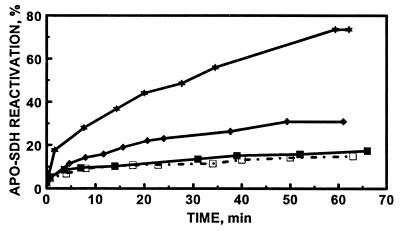
Kinetics of the reconstitution of apo-SDH with MT-1 in the presence of GSSG and/or GSH. MT (0.24 μM) (molar ratio between zinc and apo-SDH of 1.0) was incubated with apo-SDH (1.7 μM) in 0.2 M Tris⋅HCl, pH 7.4, in the presence of GSSG and/or GSH. ▪, In the absence of GSH and GSSG; ⧫, in the presence of 3 mM GSSG; ★, in the presence of 3 mM GSSG and 1.5 mM GSH; or □, in the presence of 10 μM GSH. Aliquots (10 μl) were periodically withdrawn from the mixtures and assayed for enzymatic activity.
Figure 5
Figure 5
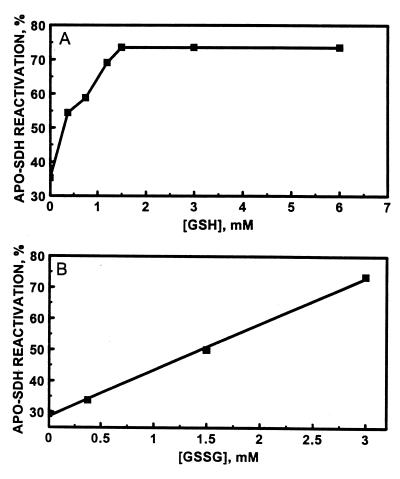
Dependence of the reactivation of apo-SDH on the concentration of GSH at a fixed concentration of 3 mM GSSG (A) and on the concentration of GSSG at a fixed concentration of 1.5 mM GSH (B). MT (0.24 μM) was incubated with apo-SDH (1.7 μM) in 0.2 M Tris⋅HCl, pH 7.4, for 60 min at the indicated concentrations of GSH and GSSG. Aliquots (10 μl) were then withdrawn from the mixtures and assayed for enzymatic activity.
Figure 6
Figure 6
Radiochromatograms of 65Zn-MT-2 with apo-SDH in the absence or presence of GSH and GSSG. MT-2 was incubated with apo-SDH (molar ratio between zinc and apo-SDH of 1.0) for 60 min and then the mixture was analyzed by radiochromatography. (A) In the absence of GSH and GSSG. (B) [GSH] = 1.5 mM, [GSSG] = 3 mM. For the determination of the number of zinc atoms transferred, the radiochromatograms were integrated from fractions 14–17. ▪, MT control; □, MT after the reaction with apo-SDH.
Figure 7
Figure 7
Inhibition of zinc transfer from MT-2 by GSH. MT (1.3 μM) was incubated with PAR (100 μM) in 0.2 M Tris⋅HCl, pH 7.4, in the presence of increasing amounts of GSH, and the reaction was followed by measuring the increase of absorbance at 500 nm of the zinc-PAR complex for 60 min. The number of zinc atoms released from MT was calculated on the basis of the formation of Zn(PAR)2500 = 61,500 M−1⋅cm−1). Inhibition is expressed as the decrease in the amount of zinc transferred. The dotted line is based on a simple model with one GSH binding site and a dissociation constant of 56 μM.

References

    1. Vallee B L. Experientia Suppl. 1979;34:19–40. - PubMed
    1. Vallee B L. Experientia Suppl. 1987;52:5–16. - PubMed
    1. Vallee B L, Maret W. In: Metallothionein III. Suzuki K T, Imura N, Kimura M, editors. Basel: Birkhäuser; 1993. pp. 1–27.
    1. Kägi J H R. In: Metallothionein III. Suzuki K T, Imura N, Kimura M, editors. Basel: Birkhäuser; 1993. pp. 29–55.
    1. Maret W, Larsen K S, Vallee B L. Proc Natl Acad Sci USA. 1997;94:2233–2237. - PMC - PubMed

Publication types

LinkOut - more resources