. 1998 Mar 31;95(7):3770-5.
doi: 10.1073/pnas.95.7.3770.

Unusual features of the Drosophila melanogaster telomere transposable element HeT-A are conserved in Drosophila yakuba telomere elements

Affiliations

Unusual features of the Drosophila melanogaster telomere transposable element HeT-A are conserved in Drosophila yakuba telomere elements

O N Danilevskaya et al. Proc Natl Acad Sci U S A. .

Abstract

HeT-A was the first transposable element shown to have a bona fide role in chromosome structure, maintenance of telomeres in Drosophila melanogaster. HeT-A has hallmarks of non-long-terminal-repeat (non-LTR) retrotransposable elements but also has several unique features. We have now isolated HeT-A elements from Drosophila yakuba, showing that the retrotransposon mechanism of telomere maintenance predates the separation of D. melanogaster and D. yakuba (5-15 million years ago). HeT-A elements from the two species show significant sequence divergence, yet unusual features seen in HeT-Amel are conserved in HeT-Ayak. In both species, HeT-A elements are found in head-to-tail tandem arrays in telomeric heterochromatin. In both species, nearly half of the HeT-A sequence is noncoding and shows a distinctive imperfect repeat pattern of A-rich segments. Neither element encodes reverse transcriptase. The HeT-Amel promoter appears to be intermediate between the promoters of non-LTR and of LTR retrotransposons. The HeT-Ayak promoter shows similar features. HeT-Amel has a frameshift within the coding region. HeT-Ayak does not require a frameshift but shows conservation of the polypeptide sequence of the frameshifted product of D. melanogaster.


Figures
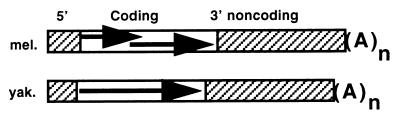
Figure 1
Figure 1
Diagrams of HeT-Amel and HeT-Ayak element, shown as the sense strand of their RNA transposition intermediates. 5′ and 3′ noncoding regions are striped. Coding regions are marked with arrows, The −1 frameshift in HeT-Amel is indicated by overlapping arrows. (A)n indicates the poly(A) tail on the RNA.
Figure 2
Figure 2
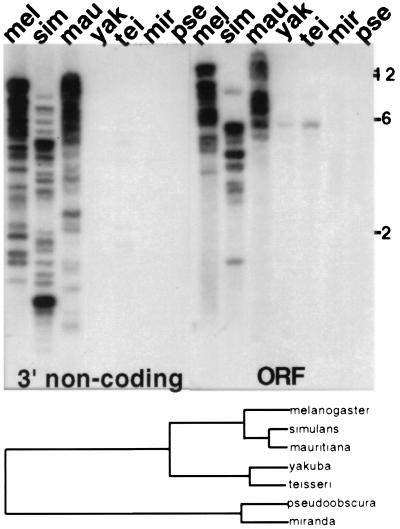
(Upper) Southern blot showing that HeT-Amel DNA cross-hybridization decreases sharply with evolutionary distance. 32P-labeled sequence from the 3′ noncoding region shows strong hybrdization to DNA from D. melanogaster (Oregon R stock), D. mauritiana, and D. simulans (separation 2–3 My). No hybridization is detected with more distantly related species. Sequence from the coding region (ORF) shows almost the same hybridization as the noncoding region but also reveals faint bands of hybridization to D. yakuba and D. teissieri (separation from D. melanogaster, 5–16 My). DNA was cut with EcoRI. The final wash of blot was 2× SSC at 65°C. Size markers (in kb) are from a DNA ladder. (Lower) Diagram of the evolutionary relationships of species used in this work (largely from ref. 13).
Figure 3
Figure 3
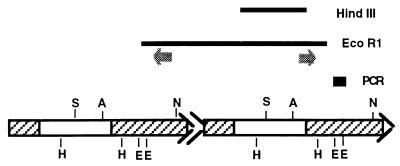
Diagram of cloned D. yakuba DNA fragments (bars HindIII, EcoRI, and PCR) showing their relation to the deduced organization of the HeT-A elements from which they were derived. The deduced head-to-tail elements are diagrammed below the three cloned fragments. 5′ and 3′ noncoding regions are striped and coding regions are open. Arrowheads at 3′ ends represent oligo(A) sequences. The double arrowhead between the two elements indicates the 25-bp 3′ end at the junction. The two dark arrows below the EcoRI clone indicate the location and orientation of PCR primers used to amplify the segment between the two EcoRI sites. The bar labeled PCR indicates only the new sequence in the PCR fragment and not the sequence that overlaps the two ends of the EcoRI clone. The PCR bar is arbitrarily placed below the right end of the EcoRI clone although it could have come from either end. S, SmaI; A, AlfIII; N, NdeI; H, HindIII; E, EcoRI.
Figure 4
Figure 4
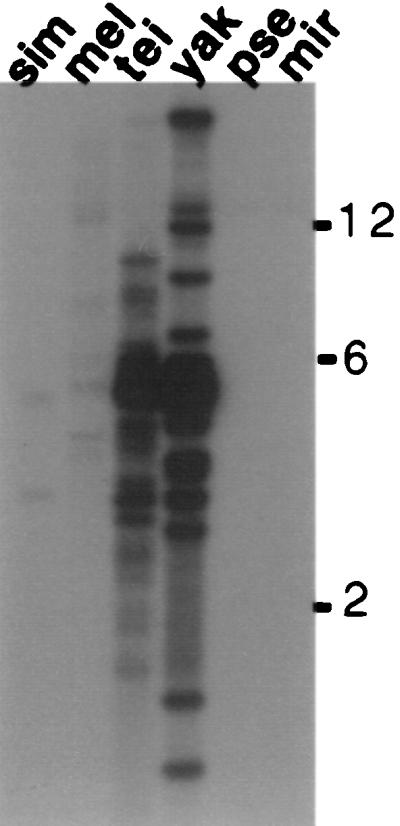
Southern blot showing that HeT-Ayak probes give strong hybridization to DNA from D. yakuba and D. teissieri but very little to DNA from more distantly related species. EcoRI-digested DNA from the species shown in Fig. 2 was probed with 32P-labeled coding sequence from HeT-Ayak. A long exposure is shown because faint hybridization to DNA from D. melanogaster and D. simulans can be detected. The final wash was 1× SSC at 65°C.
Figure 5
Figure 5
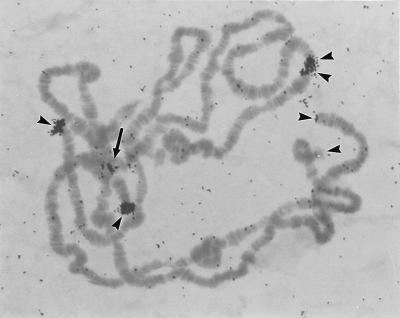
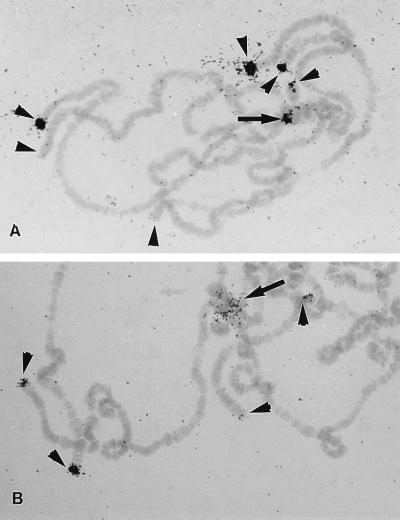
Autoradiograph of 3H-labeled HeT-Ayak 3′ noncoding probes hybridized with D. yakuba polytene chromosomes. Hybridization is seen on telomeres (arrowheads). The double arrowheads mark ectopically paired telomeres. The hybridization within the chromocenter (arrow) appears to represent the telomere of the short arm of chromosome 4 and perhaps also the short arm of the X chromosome. Probes for other regions of HeT-Ayak sequence show identical patterns of hybridization.
Figure 6
Figure 6
Autoradiographs of 3H-labeled HeT-Amel probes hybridized to D. simulans polytene chromosomes. (A) Coding region probes hybridize to telomeres (arrowheads) and to one spot in the pericentric heterochromatin (arrow). (As with D. melanogaster, there are different levels of hybrid over different chromosome ends. Amounts of hybridizing material tend to be chromosome-specific within a given stock.) The pericentric spot may represent telomeres of the short arms of chromosomes 4 and X. (B) Probes from the 3′ noncoding region hybridize to telomeres and generally over the pericentric heterochromatin, showing that in pericentric regions some 3′ noncoding sequence may exist free of the coding regions.
Figure 7
Figure 7
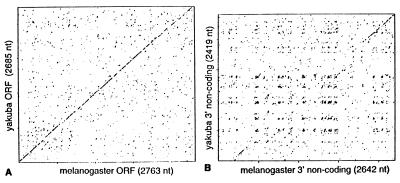
Dot matrix comparisons of HeT-Ayak with HeT-Amel nucleotide sequences. (A) The coding regions have 64% identity. Identical nucleotides are spread relatively evenly and thus give a nearly continuous diagonal line over the entire region. (B) The 3′ noncoding regions have only 48% identity. This identity is most pronounced in the most 3′ sequences (upper right) and a diagonal line is detected at this location. In most of the comparison, there is not enough sequence identity to yield a diagonal line; however, off-diagonal clusters indicate a pattern of sequence repeats that is conserved.

References

    1. Henderson E. In: Telomeres. Greider C, Blackburn E, editors. Plainview, NY: Cold Spring Harbor Lab. Press; 1995. pp. 11–34.
    1. Pardue M-L. In: Telomeres. Greider C, Blackburn E, editors. Plainview, NY: Cold Spring Harbor Lab. Press; 1995. pp. 339–370.
    1. Pardue M-L, Danilevskaya O N, Lowenhaupt K, Slot F, Traverse K L. Trends Genet. 1996;12:48–52. - PubMed
    1. Danilevskaya O N, Petrov D A, Pavlova M A, Koga A, Kurenova E V, Hartl D L. Chromosoma. 1992;102:32–40. - PubMed
    1. Biessmann H, Kasravi B, Bui T, Fujiwara G, Champion L E, Mason J M. Chromosoma. 1994;103:90–98. - PubMed

Publication types

LinkOut - more resources