. 1998 Mar 31;95(7):3857-61.
doi: 10.1073/pnas.95.7.3857.

C-C chemokines, pivotal in protection against HIV type 1 infection

Affiliations

C-C chemokines, pivotal in protection against HIV type 1 infection

D Zagury et al. Proc Natl Acad Sci U S A. .

Abstract

Exposure to HIV type 1 (HIV-1) does not usually lead to infection. Although this could be because of insufficient virus titer, there is now abundant evidence that some individuals resist infection even when directly exposed to a high titer of HIV. This protection recently has been correlated with homozygous mutations of an HIV-1 coreceptor, namely CCR5, the receptor for the beta-chemokines. Moreover, earlier results already had shown that the same chemokines markedly suppress the nonsyncitial inducing variants of HIV-1, the chief virus type transmitted from person to person. CCR5 mutation, as a unique mechanism of protection, is, however, suspect because HIV-1 variants can use other chemokine receptors as their coreceptor. Moreover, recent results have established that infection can indeed sometimes occur with such mutations. Here, we report on transient natural resistance over time of most of 128 hemophiliacs who were inoculated repeatedly with HIV-1-contaminated Factor VIII concentrate from plasma during 1980-1985 before the development of the HIV blood test. Furthermore, and remarkably, 14 subjects remain uninfected to this date, and in these subjects we found homozygous CCR5 mutations in none but in most of them overproduction of beta chemokines. In vitro experiments confirmed the potent anti-HIV suppressive effect of these chemokines.


Figures

Figure 1
Figure 1
Production of C-C chemokines by PBMC from seronegative individuals. T cell proliferation was assayed by 3H-thymidine test, and C-C chemokine production was measured by ELISA in culture SN. (a) Kinetics of T cell proliferation (—◊—) and of C-C chemokines secretion: MIP-1α (—•—), MIP-1β (—▪—), and RANTES (—▴—). Only background values of chemokines production (<0.5 ng/ml) and T cell proliferation (<500 cpm) were found for resting cells. A representative experiment is shown. (b) Variations of chemokines production by PBMC from five different seronegative donors. (c) Box plot analysis of C-C chemokine production in high risk HEH. HEH (white boxes) compared with control seronegative donors (black boxes). Box limits correspond to 50% percentile of each group, and the horizontal bar corresponds to the median. Asterisks refer to a statistical difference (P = 0.0063 for MIP-1α, P = 0.0223 for MIP-1β, and P = 0.0361 for RANTES).
Figure 2
Figure 2
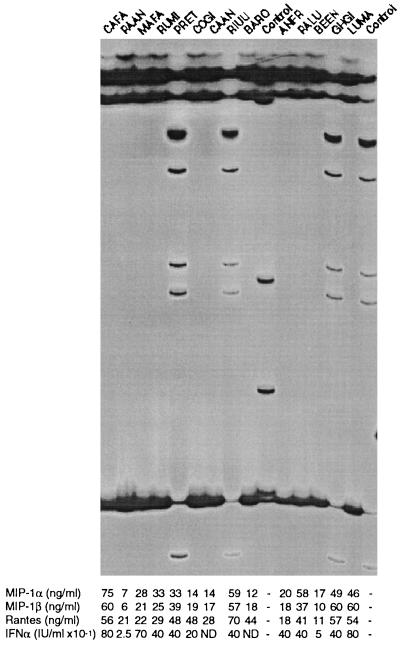
SSCP/HA analysis of CCR5 (formerly CKR5) among genotypes of 14 exposed uninfected individuals. The central portion (347–753 bp) of CCR5 was amplified and run on an SSCP/HA gel. The gel resolves the single-stranded molecules (ss) and heteroduplexes (Het), and double-stranded DNA is at the bottom of the gel. The heteroduplexes are formed in heterozygous individuals (PRET, RIUU, GHGI, and rt. control) by annealing of a strand of the wild-type allele with the complementary strand of the deletion allele. Lane 10 is a +/m control with a point mutation; all others are homozygous CCR5 +/+.
Figure 3
Figure 3
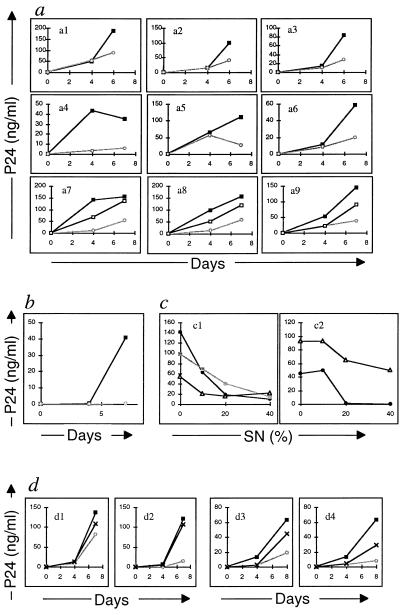
HIV-1 infection of activated PBMC from HEH. HIV-1 infection of PBMC in the presence of recombinant C-C chemokines (MMR) was assessed by p24 ELISA test. (a) Kinetics of HIV-1 infection of seronegative cells by HIV-1 NSI, in the absence (—▪—) or presence (—○—) of 40% of SN or of MMR (—□—). The assay included cells from three control seronegative (a1–a3); 3 HEH without Δ32 abnormality (+/+) (a4–a6); and 3 HEH with Δ32 abnormality (Δ32/+) (a7–a9) (a7 = RIUU; a8 = PRET; and a9 = GHGIO). (b) Kinetics of HIV-1 infection by primary isolate (AUD) in control cells in the absence (—▪—) or presence (—○—) of SN. (c) Dose-dependent inhibition of HIV-1 infection by autologous cell SN. This assay was performed for 7 days on cells from three HEH with Δ32 abnormality (—•—) RIUU; (—▪—) PRET and (—▵—) GHGIO. Cells were infected with either HIV-1 Z96 (c1) or HIV-1 AUD (c2). (d) Effect of a mixture of neutralizing Abs to MMR on HIV-1 infection of PBMC from one HEH subject with Δ32 abnormality (d1 and d2) and one control donor (d3 and d4). Cells were infected with either HIV-1 Z96 (d1 and d3) or HIV-1 AUD (d2 and d4). Absence of SN (—▪—); presence of SN (—○—); and presence of SN preincubated with neutralizing Abs (—x—).

References

    1. Cocchi F, DeVico A L, Garzino-Demo A, Arya S K, Gallo R C, Lusso P. Science. 1995;270:1811–1815. - PubMed
    1. Walker C M, Moody D J, Stites D P, Levy J A. Science. 1986;234:563–566. - PubMed
    1. Feng Y, Broder C C, Kennedy P E, Berger E A. Science. 1996;272:872–877.
    1. Alkhatib G, Combadiere C, Broder C C, Feng Y, Kennedy P E, Murphy P M, Berger E A. Science. 1996;272:1955–1958. - PubMed
    1. Deng H, Liu R, Ellmeier W, Choe S, Unutmaz D, Burkhart M, Di Marzio P, Marmom S, Sutton R E, Hill C M, et al. Nature (London) 1996;381:661–666. - PubMed