. 1998 Mar 31;95(7):4035-9.
doi: 10.1073/pnas.95.7.4035.

Decay of prepulse facilitation of N type calcium channels during G protein inhibition is consistent with binding of a single Gbeta subunit

Affiliations

Decay of prepulse facilitation of N type calcium channels during G protein inhibition is consistent with binding of a single Gbeta subunit

G W Zamponi et al. Proc Natl Acad Sci U S A. .

Abstract

We have examined the modulation of cloned and stably expressed rat brain N type calcium channels (alpha1B + beta1b + alpha2delta subunits) by exogenously applied purified G protein betagamma subunits. In the absence of Gbetagamma, barium currents through N type channels are unaffected by application of strong depolarizing prepulses. In contrast, inclusion of purified Gbetagamma in the patch pipette results in N type currents that initially facilitated upon application of positive prepulses followed by rapid reinhibition. Examination of the kinetics of Gbetagamma-dependent reinhibition showed that as the duration between the test pulse and the prepulse was increased, the degree of facilitation was attenuated in a monoexponential fashion. The time constant tau for the recovery from facilitation was sensitive to exogenous Gbetagamma, so that the inverse of tau linearly depended on the Gbetagamma concentration. Overall, the data are consistent with a model whereby a single Gbetagamma molecule dissociates from the channel during the prepulse, and that reassociation of Gbetagamma with the channel after the prepulse occurs as a bimolecular reaction.


Figures
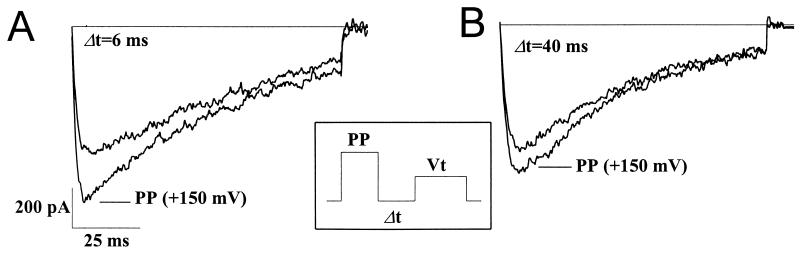
Figure 1
Figure 1
G protein-dependent modulation of α1B N type whole cell currents stably expressed in HEK 293 cells (coexpressed with β1b + α2δ subunits). Inclusion of 5 nM purified Gβγ in the patch pipette in the presence and the absence of a strong depolarizing prepulse (+150 mV for 50 ms). The cell was bathed in 20 mM barium, currents were elicited by stepping from a holding potential of −100 mV to a test potential of +5 mV with or without application of a strong depolarizing prepulse (+150 mV for 50 ms, see Inset). The records were leak- and capacitance-subtracted by using a standard p/5 protocol.
Figure 2
Figure 2
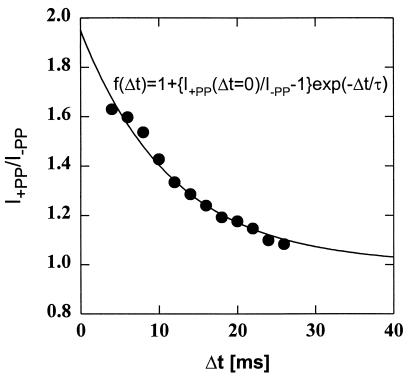
Time course of recovery from prepulse facilitation for a single cell with an intrapipette Gβγ concentration of 10 nM. The solid line is a monoexponential fit according to the equation I+PP/I−PP = 1 + Imax[exp(−Δt/τ)], where I+PP and I−PP are, respectively, the peak currents in the presence and absence of a prepulse, 1 + Imax is the maximum ratio of current facilitation, Δt is the interpulse duration, and τ is the time constant for the decay of the prepulse effect. The value for τ obtained from the fit was 11.7 ms.
Figure 3
Figure 3
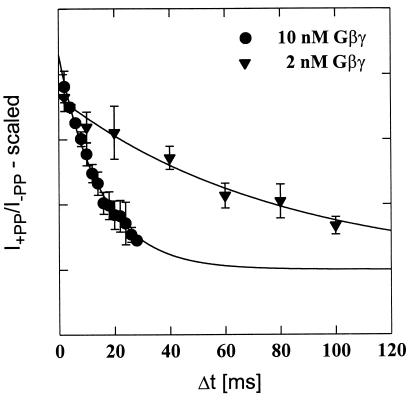
Time course of recovery from facilitation for Gβγ concentrations of 2 nM (triangles, n = 5) and 10 nM (circles, n = 6). To facilitate comparison, the data sets for each experiment were scaled to the same arbitrary value at an interpulse interval of 4 ms; hence, no I+PP/I−PP values are provided on the ordinate. Error bars indicate the SEM and the solid lines are fits as outlined in Fig. 2. Note that the time course of recovery from facilitation is considerably slowed when the Gβγ concentration is decreased from 10 nM (τ = 15.1 ms) to 2 nM (τ = 79.6 ms).
Figure 4
Figure 4
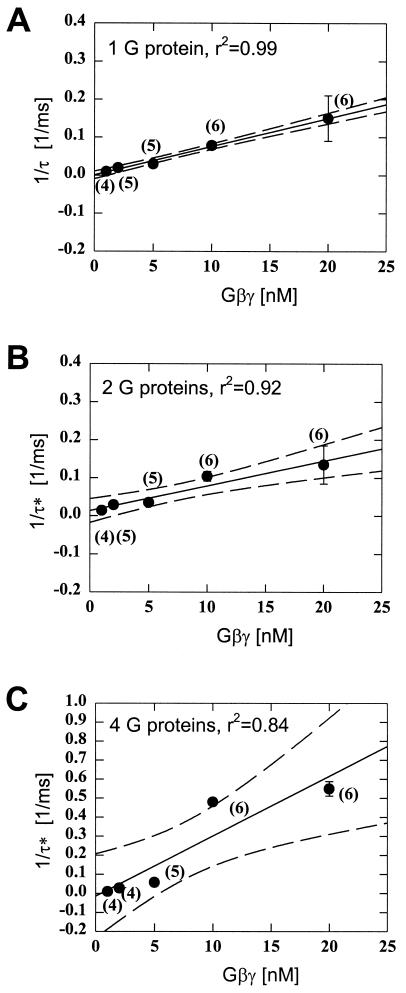
(A) Dependence of the inverse of the time constant for the decay of the prepulse effect τ on the concentration of Gβγ. Data from each individual cell were separately fitted according to the equation outlined in Fig. 2. The solid line is a linear regression (correlation coefficient = 0.99) to the data, the error bars indicate the SEM, and the dashed lines indicate 95% confidence intervals. If there is a bimolecular interaction between the channel, then τ is equivalent with the time constant for Gβγ rebinding. Thus, the inverse of τ is expected to linearly depend on the G protein concentration and the slope of the regression line reflects the G protein association rate constant (0.0074 ms−1⋅nM−1). (B) Dependence of the derived time constant τ* for Gβγ rebinding on Gβγ concentration for a model based on the binding of two G proteins. Data sets, such as that in Fig. 2, were fitted according to the equation I+PP/I−PP = 1 + Imax{1 − [1 − exp(−Δt/τ*)]2}. This equation reflects a scenario in which consecutive binding of two G proteins occurs with identical time constants, τ*. Note that τ* is different from the measured time constant τ shown in A, although similar to that for A, the inverse of τ* is expected to linearly depend on the G protein concentration. The regression line used to fit the data in B yielded a correlation coefficient of 0.92. (C) The data were obtained by fitting individual time courses of G protein reinhibition with a model assuming consecutive binding of four G proteins with identical time constants. The data were fitted by using the equation I+PP/I−PP = 1 + Imax{1 − [1 − exp(−Δt/τ*)]4}. As in B, 1/τ* is expected to depend linearly on the G protein concentration; however, the data are poorly described with a simple regression line (correlation coefficient = 0.84).

References

    1. Tsien R W, Lipscombe D, Madison D V, Bley K R, Fox A P. Trends Neurosci. 1988;11:431–438. - PubMed
    1. Bean B P. Annu Rev Physiol. 1989;51:367–384. - PubMed
    1. Stea A, Soong T W, Snutch T P. In: Handbook of Receptors and Channels: Ligand- and Voltage-Gated Ion Channels. North R A, editor. Boca Raton, Fl: CRC; 1995. pp. 113–152.
    1. Mori Y, Friedrich T, Kim M S, Mikami A, Naaki J, Ruth P, Bosse E, Hofmann F, Flockerzi V, Furuichi T, et al. Nature (London) 1991;350:398–402. - PubMed
    1. Sather W A, Tanabe T, Zhang J F, Mori Y, Adams M E, Tsien R W. Neuron. 1993;11:291–303. - PubMed

Publication types

LinkOut - more resources