Evaluation of previously assigned antibody concentrations in pneumococcal polysaccharide reference serum 89SF by the method of cross-standardization
- PMID: 9521143
- PMCID: PMC121358
- DOI: 10.1128/CDLI.5.2.199-204.1998
Evaluation of previously assigned antibody concentrations in pneumococcal polysaccharide reference serum 89SF by the method of cross-standardization
Abstract
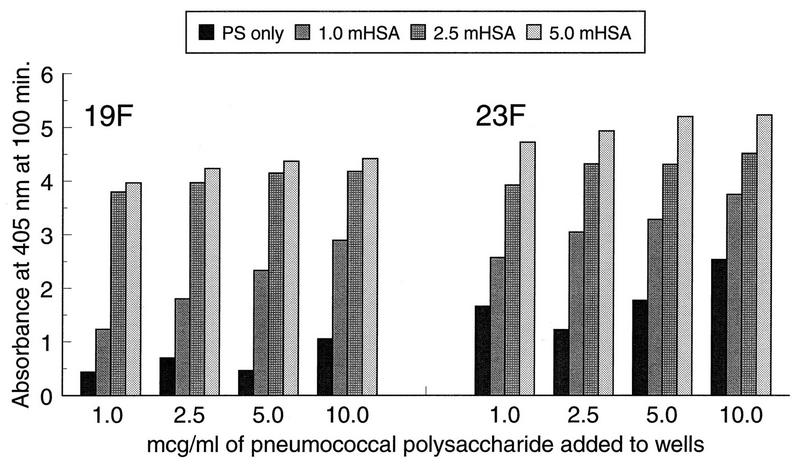
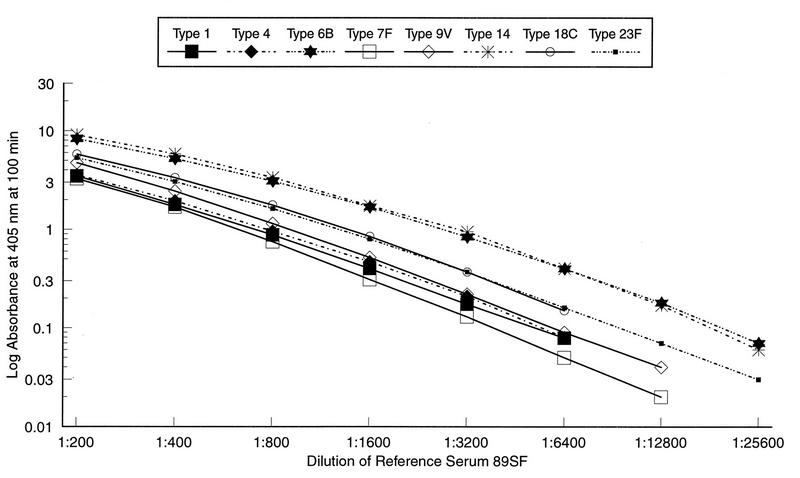
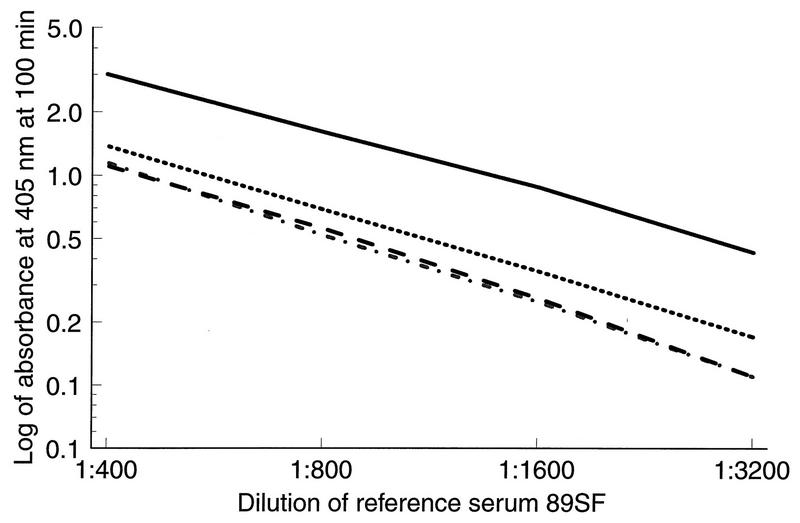
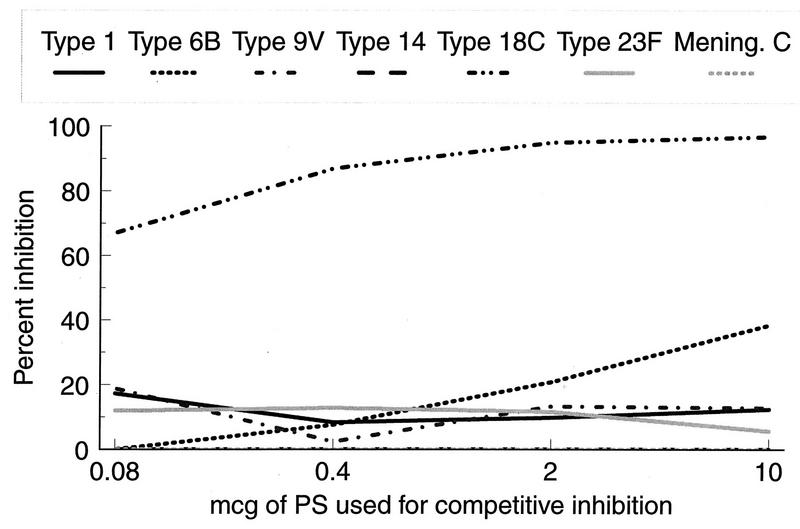
An enzyme-linked immunosorbent assay (ELISA) and the antibody concentrations assigned to different pneumococcal capsular polysaccharide types were used to estimate concentrations of antibody to additional pneumococcal types in reference serum 89SF and to confirm assigned antibody values. This was possible because the slopes of curves of antibody binding to all polysaccharide types evaluated (1, 3, 4, 5, 6B, 7F, 9V, 14, 18C, 19F, and 23F) were similar. The point estimates for total anti-pneumococcal antibody and immunoglobulin G (IgG) antibody determined by cross-standardization by an ELISA based on use of methylated human serum albumin (mHSA) to improve the efficiency of polysaccharide binding to the ELISA plate differed by less than 40% from those reported by Quataert et al. (Clin. Diagn. Lab. Immunol. 2:590-597, 1995) for types 1, 4, 6B, 7F, 9V, 14, 18C, and 23F. However, large differences were found between the assigned values and those obtained by our mHSA ELISA for types 3 and 19F. The mHSA ELISA and the direct polysaccharide coat ELISA may not measure antibodies to the same epitopes on polysaccharides of types 3 and 19F. The functional importance of these different antibody specificities is being investigated. We have thus confirmed the assigned IgG antibody values for most types by a different method and have extended antibody assignments to several additional types.
Figures
References
-
- Anonymous. Overcoming scientific and technical barriers: pneumococcal vaccines. In: Pearson G W, editor. The children’s vaccine initiative: continuing activities. Washington, D.C: National Academy Press; 1995. pp. 8–12.
-
- Division of Microbiology and Infectious Diseases. The Jordan report-accelerated development of vaccines 1995. Bethesda, Md: National Institute of Allergy and Infectious Diseases, National Institutes of Health; 1995. pp. 18–21.
-
- Frasch C E, Zahradnik J M, Wang L Y, Mocca L F, Tsai C-M. Antibody response of adults to an aluminum hydroxide-adsorbed Neisseria meningitidis serotype 2b protein-group B polysaccharide vaccine. J Infect Dis. 1988;158:710–718. - PubMed
MeSH terms
Substances
LinkOut - more resources
Full Text Sources
Other Literature Sources
Miscellaneous