doi: 10.1128/CDLI.5.2.251-253.1998.
Dehydroepiandrosterone sulfate treatment of mice modulates infection with Schistosoma mansoni
Affiliations
- PMID: 9521152
- PMCID: PMC121367
- DOI: 10.1128/CDLI.5.2.251-253.1998
Item in Clipboard
Dehydroepiandrosterone sulfate treatment of mice modulates infection with Schistosoma mansoni
Clin Diagn Lab Immunol.
1998 Mar.
Abstract
Female mice treated with dehydroepiandrosterone sulfate early during infection were partially protected (P < 0.05-0.005) from Schistosoma mansoni infection. Hormone treatment did not modify parasite-specific cellular or humoral responses. Serum dehydroepiandrosterone sulfate levels and testosterone infection were negatively correlated, r = -0.621 and r = -0.653, respectively, with schistosome worm burden. The partial resistance to schistosome infection in dehydroepiandrosterone sulfate-treated female mice may be due to the known antischistosomular activity of testosterone.
Figures
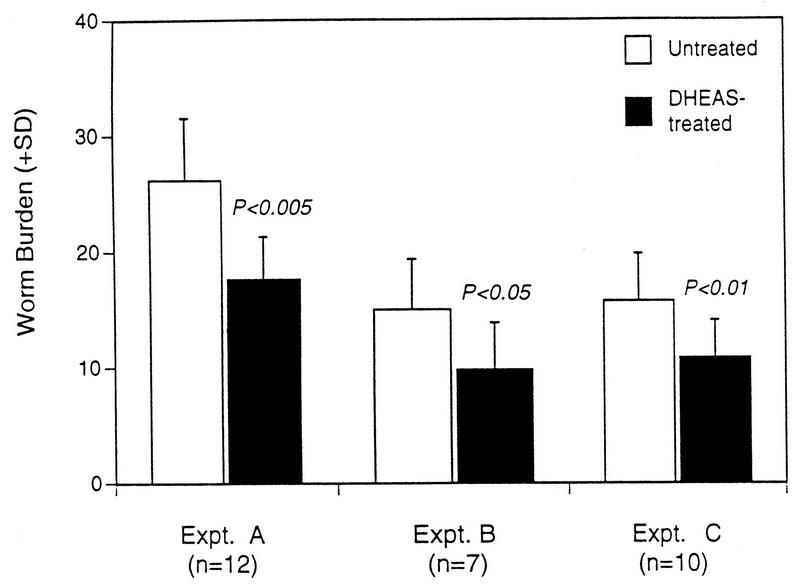
S. mansoni worm recovery in three separate experiments in DHEAS-treated and untreated mice. Student’s t test was used to determine statistical differences between hormone-treated and corresponding untreated groups. A total of 7 to 12 mice were used in each experimental group. SD, standard deviation.
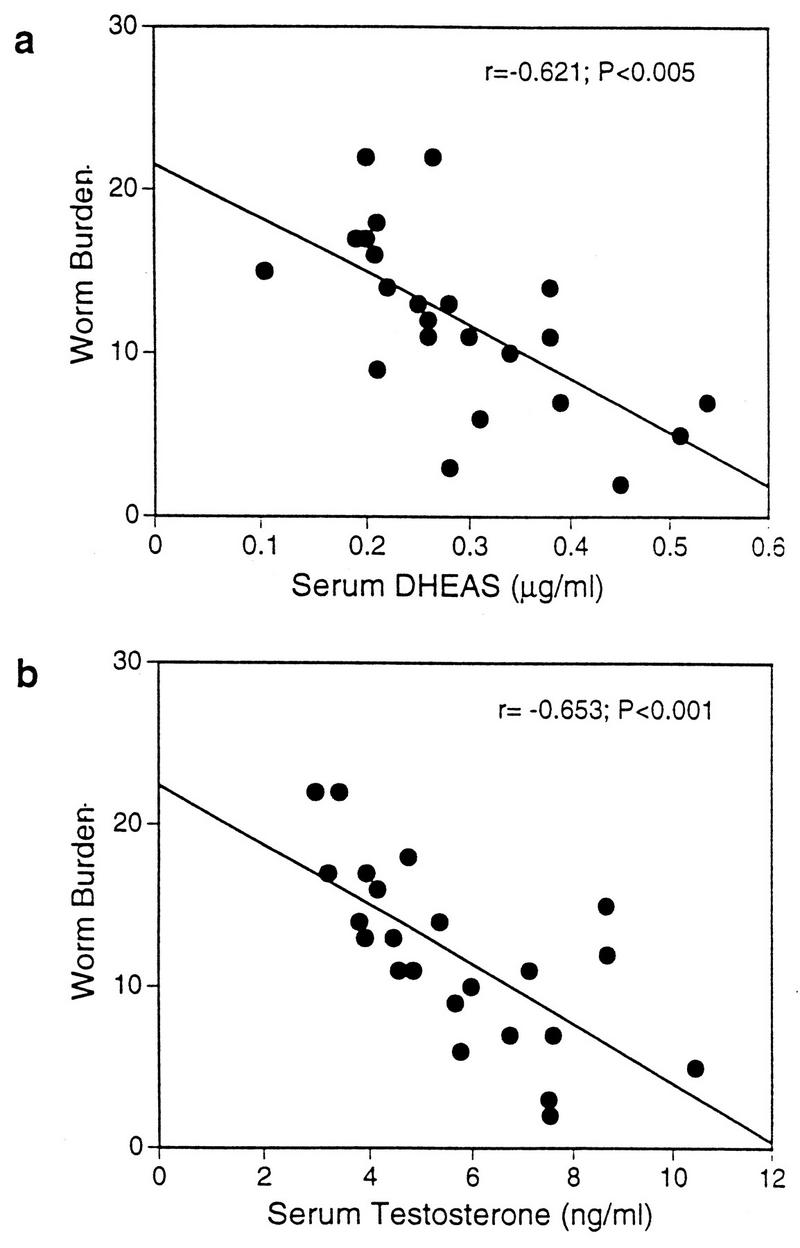
Correlation between the levels in serum of DHEAS (a) or testosterone (b) and worm burden in S. mansoni-infected mice that were treated with DHEAS. Serum was collected on the day prior to infection. Results are from 23 individual mice. DHEAS correlations are expressed as Pearson’s correlation coefficients, whereas nonparametric Spearman’s rank correlations were used for testosterone.
References
-
- Araneo B A, Woods M L, Daynes R A. Reversal of immunosenescent phenotype by dehydroepiandrosterone: hormone treatment provides an adjuvant effect on the immunization of aged mice with recombinant hepatitis B surface antigen. J Infect Dis. 1993;167:830–840. - PubMed
-
- Daneberg H D, Ben-Yehuda A, Zakay-Rones Z, Friedman G. Dehydroepiandrosterone (DHEA) treatment reverses the impaired immune response of old mice to influenza vaccination and protects from influenza infection. Vaccine. 1995;13:1445–1448. - PubMed
-
- Ebeling P, Koivisto V A. Physiological importance of dehydroepiandrosterone. Lancet. 1994;343:1479–1481. - PubMed
-
- Eloi-Sanots S, Olson N J, Correa-Oliveira R, Colley D G. Schistosoma mansoni: mortality, pathophysiology and susceptibility differences in male and female mice. Exp Parasitol. 1992;75:168–175. - PubMed
-
- Loria R M, Inge T H, Cook S S, Szakal A K, Regelson W. Protection against acute lethal viral infections with the native steroid dehydroepiandrosterone (DHEA) J Med Virol. 1988;26:301–314. - PubMed
Publication types
MeSH terms
Substances
Grants and funding
LinkOut - more resources
Full Text Sources