. 1998 Feb;42(2):209-15.
doi: 10.1128/AAC.42.2.209.

Aminoglycoside 6'-N-acetyltransferase variants of the Ib type with altered substrate profile in clinical isolates of Enterobacter cloacae and Citrobacter freundii

Affiliations

Aminoglycoside 6'-N-acetyltransferase variants of the Ib type with altered substrate profile in clinical isolates of Enterobacter cloacae and Citrobacter freundii

I Casin et al. Antimicrob Agents Chemother. 1998 Feb.

Abstract

Three clinical isolates, Enterobacter cloacae EC1562 and EC1563 and Citrobacter freundii CFr564, displayed an aminoglycoside resistance profile evocative of low-level 6'-N acetyltransferase type II [AAC(6')-II] production, which conferred reduced susceptibility to gentamicin but not to amikacin or isepamicin. Aminoglycoside acetyltransferase assays suggested the synthesis in the three strains of an AAC(6') which acetylated amikacin practically as well as it acetylated gentamicin in vitro. Both compounds, however, as well as isepamicin, retained good bactericidal activity against the three strains. The aac genes were borne by conjugative plasmids (pLMM562 and pLMM564 of ca. 100 kb and pLMM563 of ca. 20 kb). By PCR mapping and nucleotide sequence analysis, an aac(6')-Ib gene was found in each strain upstream of an ant(3")-I gene in a sulI-type integron. The size of the AAC(6')-Ib variant encoded by pLMM562 and pLMM564, AAC(6')-Ib7, was deduced to be 184 (or 177) amino acids long, whereas in pLMM563 a 21-bp duplication allowing the recruitment of a start codon resulted in the translation of a variant, AAC(6')-Ib8, of 196 amino acids, in agreement with size estimates obtained by Western blot analysis. Both variants had at position 119 a serine instead of the leucine typical for the AAC(6')-Ib variants conferring resistance to amikacin. By using methods that predict the secondary structure, these two amino acids appear to condition an alpha-helical structure within a putative aminoglycoside binding domain of AAC(6')-Ib variants.


Figures

FIG. 1
FIG. 1
In vitro killing kinetics for the three clinical strains and their respective transconjugants producing AAC(6′)-Ib variants. (A) ECl562; (B) ECl563; (C) CFr564; (D) HB101(pLMM562); (E) HB101(pLMM563); (F) HB101(pLMM564). The concentrations (in micrograms per milliliter) of amikacin (Ami), isepamicin (Ise), and gentamicin (Gen) used were four times the MICs for the respective strains.
FIG. 2
FIG. 2
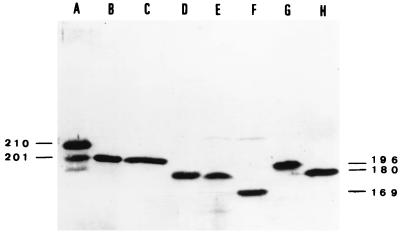
Immunoblot of the AAC(6′)-Ib variants. Lane A, KPn88(pLMM6) producing AAC(6′)-Ib2 of 210 amino acids (4); lane B, DH5α(pAZ505) producing AAC(6′)-Ib of 200 amino acids (42); lane C, ECl563 producing AAC(6′)-Ib8; lane D, CFr564; lane E, ECl562 producing AAC(6′)-Ib7; lanes F, G, and H, in vitro-truncated AAC(6′)-Ib variants coded for by PCR-generated fragments derived from the natural plasmid pLMM6 and cloned into pBTac2 (3, 4). The numbers of amino acids of the reference variants are given at the margins: lane F, 169 amino acids; lane G, 196 amino acids; lane H, 180 amino acids.
FIG. 3
FIG. 3
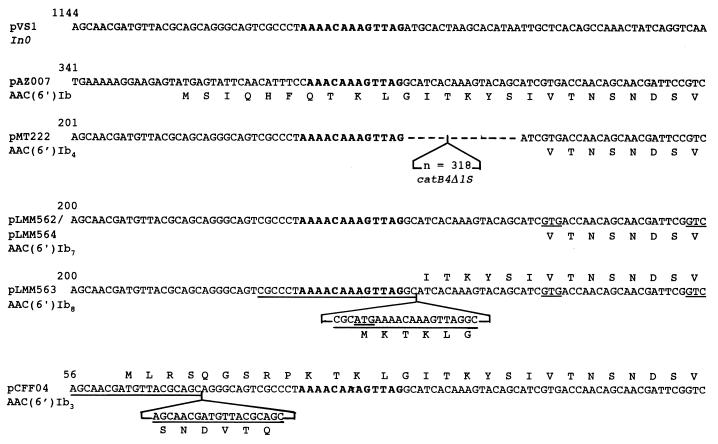
Nucleotide sequences at the 5′-common-segment regions of integration of aac gene cassettes. These data were compiled from the sequences obtained from plasmids pVS1 (2), pCFF04 (23), pMT222 (41), and pAZ007 (43) and those analyzed here. Numbering of the nucleotides is according to the respective references. The conserved motif of the recombination sites is shown in boldface. The duplicated sequences and the possible start codons are underlined. Amino acids are designated by the single-letter code.
FIG. 4
FIG. 4
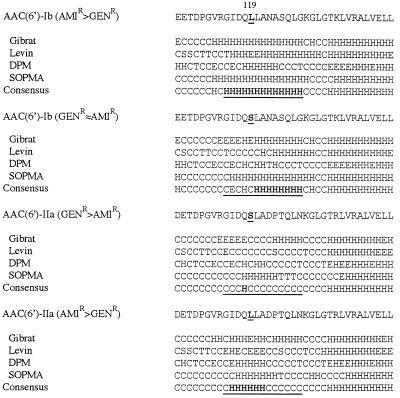
Partial secondary structure prediction for AAC(6′)-Ib variants based on the methods indicated at the left, as described by Gourgeon and Delage (11, 12). AAC(6′)-Ib (AMIR > GENR), sequence of AAC(6′)-Ib conferring resistance to amikacin but not to gentamicin (43); AAC(6′)-Ib (AMIR = GENR), sequence of AAC(6′)-Ib variants conferring similar low levels of resistance to gentamicin and amikacin in members of the family Enterobacteriaceae (this study); AAC(6′)-IIa (GENR > AMIR), AAC(6′)-IIa conferring resistance to gentamicin but not amikacin (35); AAC(6′)-IIa (AMIR > GENR), AAC(6′)-IIa variant obtained after replacement of Ser119 with Leu conferring resistance to amikacin but not gentamicin (31). Abbreviations: C, coil; E, β-sheet; H, helix; S, bend; T, turn.

References

    1. Ausubel F M, Brent F, Kingston R E, Moore D D, Smith J A, Seidman J G, Struhl K. Current protocols in molecular biology. New York, N.Y: John Wiley & Sons, Inc.; 1993.
    1. Bissonnette L, Roy P H. Characterization of In0 of Pseudomonas aeruginosa plasmid pVS1, an ancestor of integrons of multiresistance plasmids and transposons of gram-negative bacteria. J Bacteriol. 1992;174:1248–1257. - PMC - PubMed
    1. Bordon-Pallier F, Collatz E. Program and abstracts of 32nd Interscience Conference on Antimicrobial Agents and Chemotherapy. Washington, D.C: American Society for Microbiology; 1992. Structural and functional analysis of naturally occurring variant of AAC(6′)-Ib and in vitro truncated derivatives. abstr. 440; p. 194.
    1. Bordon-Pallier, F. Unpublished results.
    1. Bunny K L, Hall R M, Stokes H W. New mobile gene cassettes containing an aminoglycoside resistance gene, aacA7, and a chloramphenicol resistance gene, catB3, in an integron in pBH301. Antimicrob Agents Chemother. 1995;39:686–693. - PMC - PubMed

Publication types

MeSH terms

Associated data

LinkOut - more resources