. 1998 Apr;18(4):1774-82.
doi: 10.1128/MCB.18.4.1774.

SWI-SNF complex participation in transcriptional activation at a step subsequent to activator binding

Affiliations

SWI-SNF complex participation in transcriptional activation at a step subsequent to activator binding

M P Ryan et al. Mol Cell Biol. 1998 Apr.

Abstract

The SWI-SNF complex in yeast and related complexes in higher eukaryotes have been implicated in assisting gene activation by overcoming the repressive effects of chromatin. We show that the ability of the transcriptional activator GAL4 to bind to a site in a positioned nucleosome is not appreciably impaired in swi mutant yeast cells. However, chromatin remodeling that depends on a transcriptional activation domain shows a considerable, although not complete, SWI-SNF dependence, suggesting that the SWI-SNF complex exerts its major effect at a step subsequent to activator binding. We tested this idea further by comparing the SWI-SNF dependence of a reporter gene based on the GAL10 promoter, which has an accessible upstream activating sequence and a nucleosomal TATA element, with that of a CYC1-lacZ reporter, which has a relatively accessible TATA element. We found that the GAL10-based reporter gene showed a much stronger SWI-SNF dependence than did the CYC1-lacZ reporter with several different activators. Remarkably, transcription of the GAL10-based reporter by a GAL4-GAL11 fusion protein showed a nearly complete requirement for the SWI-SNF complex, strongly suggesting that SWI-SNF is needed to allow access of TFIID or the RNA polymerase II holoenzyme. Taken together, our results demonstrate that chromatin remodeling in vivo can occur by both SWI-SNF-dependent and -independent avenues and suggest that the SWI-SNF complex exerts its major effect in transcriptional activation at a step subsequent to transcriptional activator-promoter recognition.


Figures
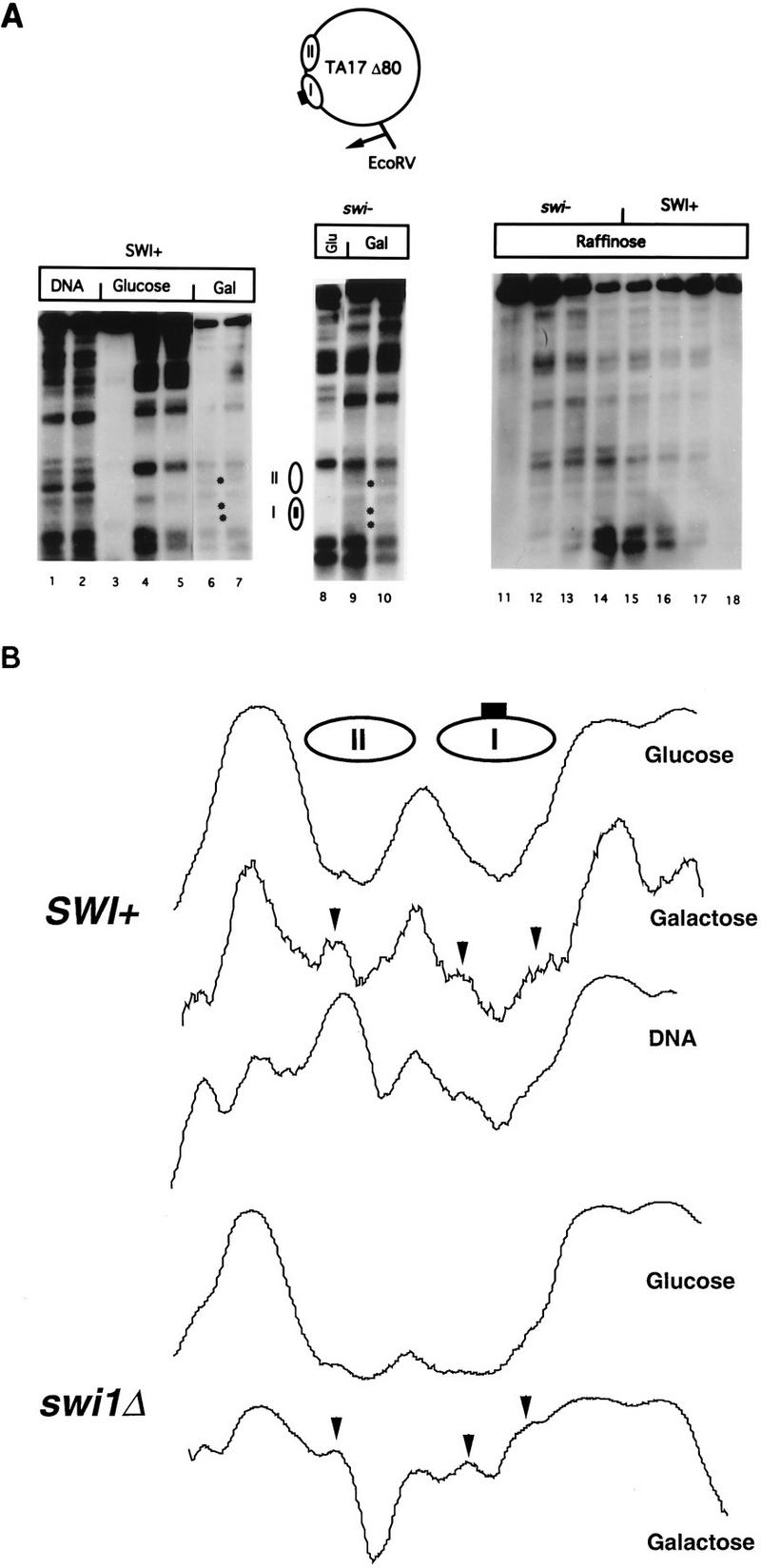
FIG. 1
FIG. 1
Perturbation of positioned nucleosomes in the yeast episome TA17Δ80 by GAL4 binding in SWI+ and swi1Δ yeast cells. (A) MNase cleavage sites in chromatin from SWI+ and swi1Δ cells grown in glucose, raffinose, or galactose medium were mapped relative to the EcoRV site as indicated. Samples were digested with MNase at 4 U/ml (lane 1), 10 U/ml (lane 2), 0 U/ml (lanes 3, 11, and 18), 2 U/ml (lanes 4, 6, 12, and 17), 5 U/ml (lanes 5, 7, 8, 10, 13, and 16), or 20 U/ml (lanes 9, 14, and 15). Bands cleaved in chromatin from cells grown in galactose are marked by asterisks to the right of lanes 6 and 9. Locations of nucleosomes I and II in cells grown in glucose are indicated; the box in nucleosome I represents the GAL4-binding site. (B) Densitometric scans of MNase cleavage patterns in the vicinity of nucleosomes I and II. Scans represent, in descending order, lanes 4, 6, 1, 8, and 10 in panel A. Arrowheads indicate cleavage sites induced in galactose. Note that the cleavage sites in the region of nucleosome I, which are cleaved weakly in chromatin from cells grown in galactose, are also weakly cut in naked DNA.
FIG. 2
FIG. 2
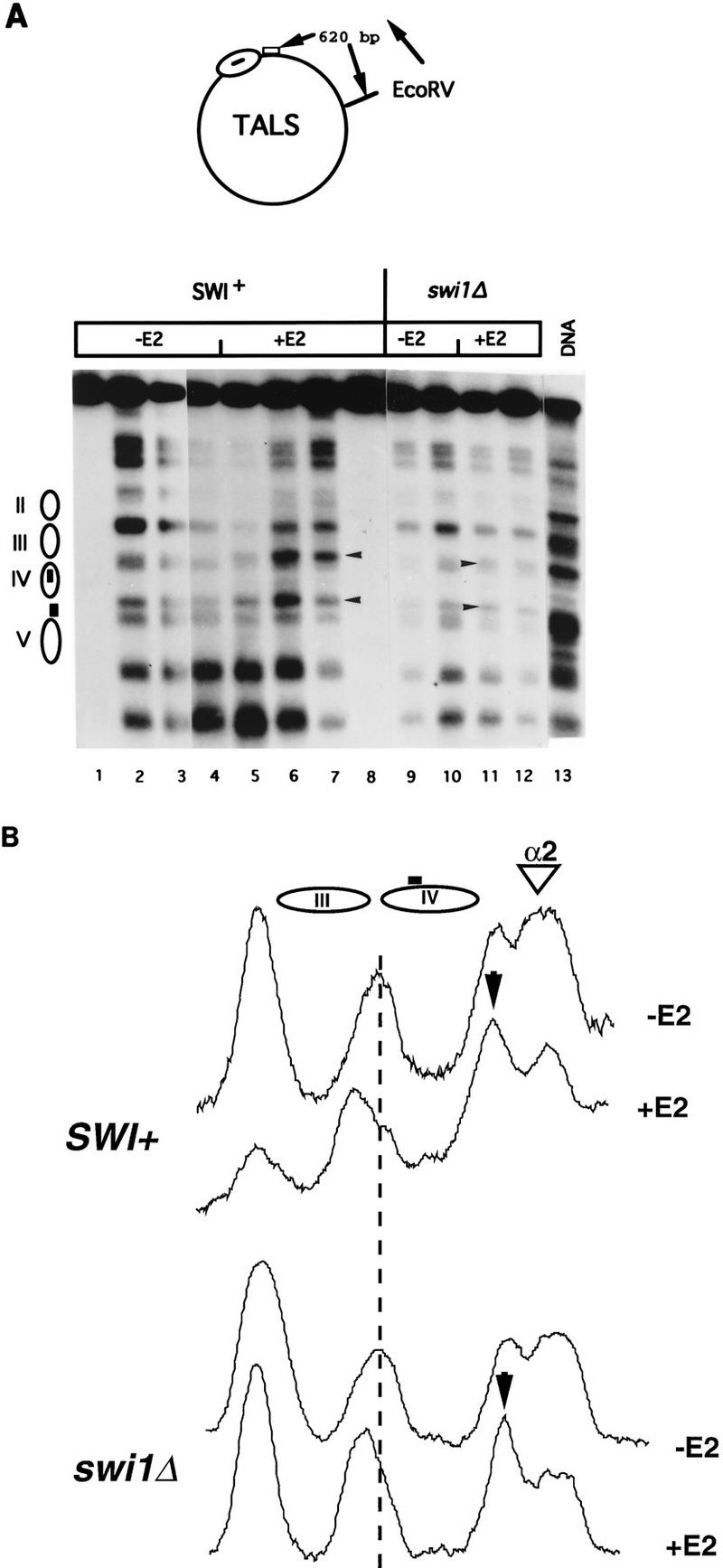
(A) Perturbation of TALS chromatin by the GAL4·ER·VP16 activation domain in SWI+ and swi1Δ yeast haploid α cells. MNase cleavage sites in cells harboring TALS and expressing GAL4· ER·VP16, either incubated for 4 h with 0.1 μM β-estradiol (+E2 lanes) or not (−E2 lanes), were mapped relative to the EcoRV site as indicated. Samples were digested with MNase at 0 U/ml (lanes 1 and 8), 5 U/ml (lanes 2 and 7), 20 U/ml (lanes 3, 6, 9, and 12), 50 U/ml (lanes 4, 5, 10, and 11), or 10 U/ml (lane 13). Control samples (0 U/ml) for the swi1Δ samples were identical in appearance to those shown for the SWI+ samples (data not shown). Arrowheads indicate bands cleaved preferentially under activating (+E2) conditions. The locations of nucleosomes II to V are indicated; the box in nucleosome IV represents the GAL4-binding site, and the box between nucleosomes IV and V represents the α2/MCM1 operator. (B) Densitometric scans of MNase cleavage patterns from lanes 4, 5, 10, and 11. The arrowhead indicates the lower of the two hormone-induced enhanced cleavage sites seen in the panel A, and the dotted line allows visualization of the slight shift in position of the cleavage site corresponding to the upper arrowhead in panel A.
FIG. 3
FIG. 3
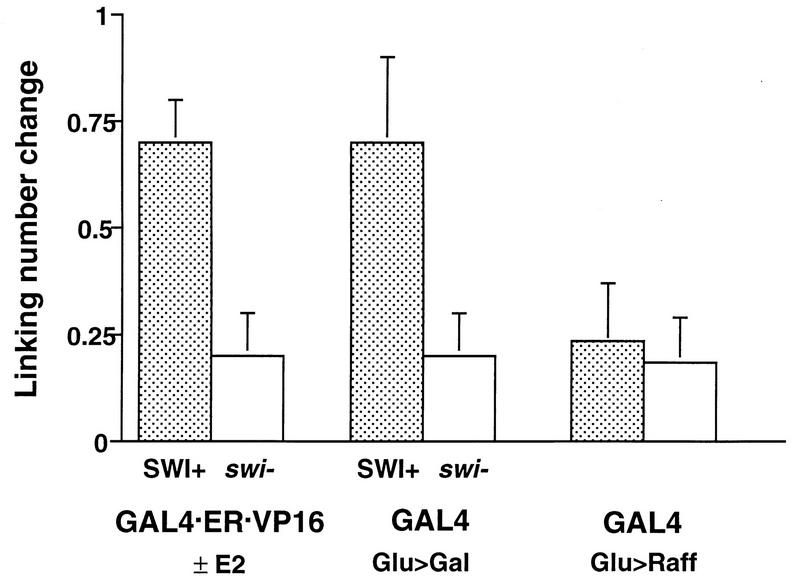
Topological perturbation of TALS chromatin in SWI+ and swi1Δ yeast cells by GAL4 and by GAL4 · ER · VP16. Linking-number changes induced by hormone addition in the presence of GAL4·ER·VP16 or by growth in galactose (Gal) or raffinose (Raff) compared to glucose (Glu) in the presence of the endogenous GAL4 gene are indicated along with standard errors.
FIG. 4
FIG. 4
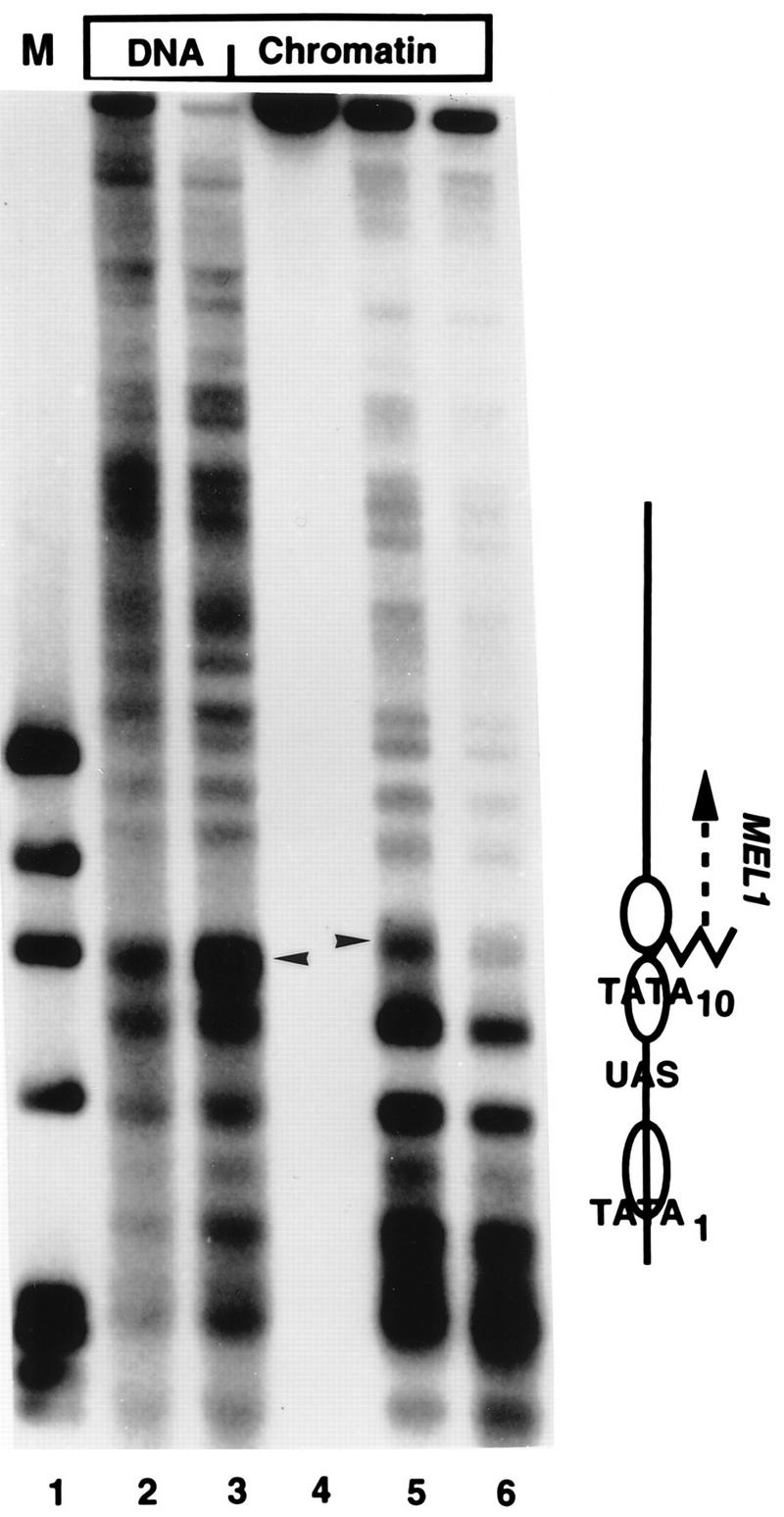
Indirect end-label analysis of the chromatin structure of the GAL10-MEL1 gene fusion. MNase cleavage sites in naked DNA or chromatin, as indicated, were mapped relative to a SalI site 830 bp upstream of the GAL10 TATA element, on the GAL1 side of the promoter in plasmid pBM150SKMEL1. Samples were digested with 4 (lane 2), 10 (lane 3), 0 (lane 4), 150 (lane 5) or 300 (lane 6) U of MNase per ml. Note the strong cleavage in naked DNA (arrowhead, lanes 2 and 3), which is protected in chromatin; a new cleavage (arrowhead, lanes 5 and 6) is present slightly higher on the gel, corresponding to the nucleosome-sized protected region containing the GAL10 TATA element. The overall pattern of cleavages in the vicinity of the UAS and GAL10 TATA is identical to that seen in the endogenous GAL1-10 promoter (data not shown). The locations of relevant promoter elements are indicated on the right; the jagged line represents the site of the fusion between the GAL10 promoter and the MEL1 coding sequence. Lane 1 contains ΦX/HaeIII markers.
FIG. 5
FIG. 5
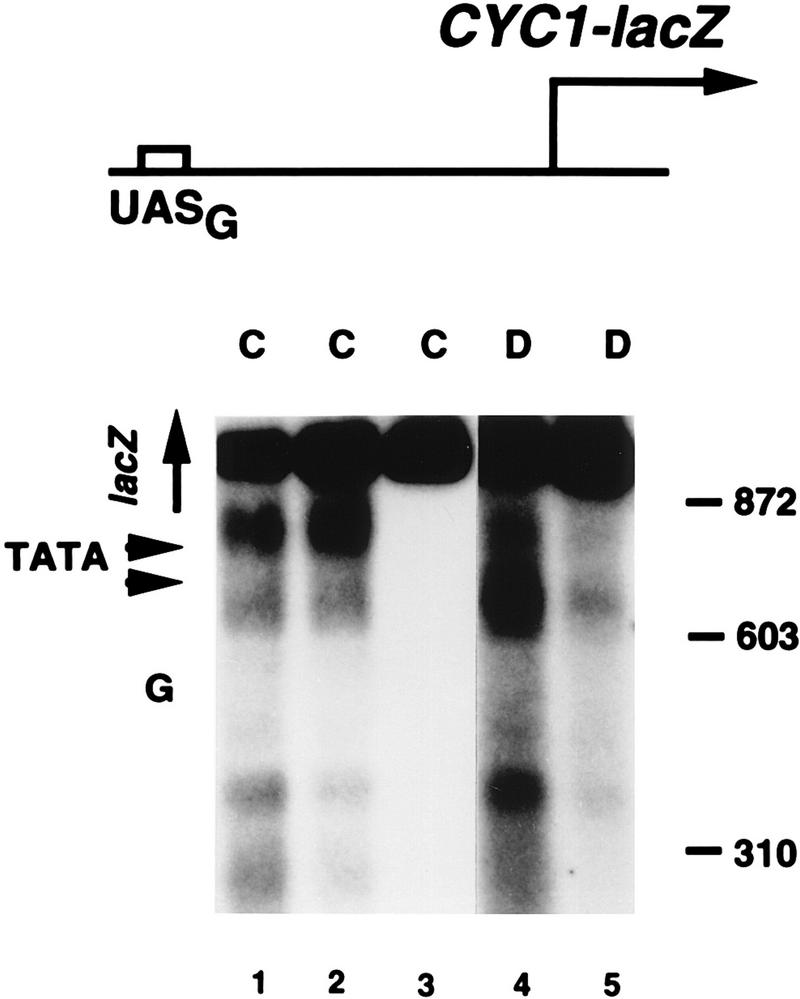
Indirect end-label analysis of chromatin structure of 314-17Δ80lacZΔNco, which bears the GAL4-CYC1-lacZ reporter gene. MNase cleavage sites in chromatin (lanes C) and DNA (lanes D) were mapped relative to a PvuII site that is 400 bp upstream of the GAL4-binding site (UASG). Cell lysates (32) or DNA was digested with MNase at 20 U/ml (lane 1), 5 U/ml (lane 2), 0 U/ml (lane 3), 4 U/ml (lane 4), or 10 U/ml (lane 5). The location of the GAL4 site is indicated by G, and the locations of the two major TATA elements in the CYC1 promoter (45) and the lacZ gene are also indicated. Lanes 1 to 3 and lanes 4 and 5 were taken from separate gels which ran identically (as shown by size markers).
FIG. 6
FIG. 6
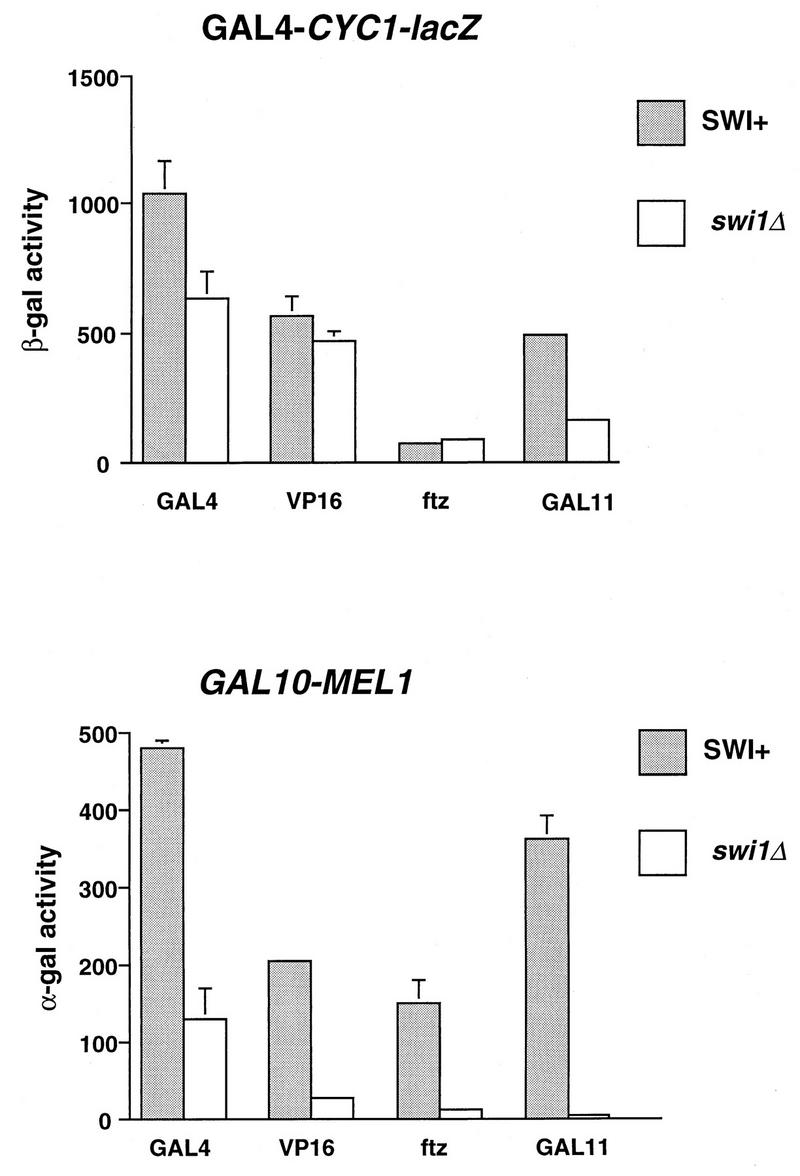
Activity of the two reporter genes, GAL4-CYC1-lacZ and GAL10-MEL1, induced by different activation domains in SWI+ (strain CY296) and swi1Δ (strain CY297b) cells. The activators used were GAL4, GAL4·ER·VP16, GAL4·ftz, and GAL4·GAL11. Activities were measured for at least three independent clones for each sample. Some standard errors were too small for the error bars to be seen in the graphs.

References

    1. Alani E, Cao L, Kleckner N. A method for gene disruption that allows repeated use of URA3 selection in the construction of multiply disrupted yeast strains. Genetics. 1987;116:541–545. - PMC - PubMed
    1. Arndt K M, Ricupero-Hovasse S, Winston F. TBP mutants defective in activated transcription in vivo. EMBO J. 1995;14:1490–1497. - PMC - PubMed
    1. Bajwa W, Torchia T E, Hopper J E. Yeast regulatory gene GAL3: carbon regulation; UASGAL elements in common with GAL1, GAL2, GAL7, GAL10, GAL80, and MEL1; encoded protein strikingly similar to yeast and Escherichia coli galactokinases. Mol Cell Biol. 1988;8:3439–3447. - PMC - PubMed
    1. Barberis A J, Pearlberg J, Simkovich N, Farrell S, Reinagel P, Bamdad C, Sigal G, Ptashne M. Contact with a component of the polymerase II holoenzyme suffices for gene activation. Cell. 1995;81:359–368. - PubMed
    1. Brown S A, Imbalzano A N, Kingston R E. Activator-dependent regulation of transcriptional pausing on nucleosomal templates. Genes Dev. 1996;10:1479–1490. - PubMed

Publication types

MeSH terms

LinkOut - more resources