. 1998 Apr;66(4):1482-91.
doi: 10.1128/IAI.66.4.1482-1491.1998.

Identification of a gene involved in assembly of Actinomyces naeslundii T14V type 2 fimbriae

Affiliations
Free PMC article

Identification of a gene involved in assembly of Actinomyces naeslundii T14V type 2 fimbriae

M K Yeung et al. Infect Immun. 1998 Apr.
Free PMC article

Abstract

The nucleotide sequence of the Actinomyces naeslundii T14V type 2 fimbrial structural subunit gene, fimA, and the 3' flanking DNA region was determined. The fimA gene encoded a 535-amino-acid precursor subunit protein (FimA) which included both N-terminal leader and C-terminal cell wall sorting sequences. A second gene, designated orf365, that encoded a 365-amino-acid protein which contained a putative transmembrane segment was identified immediately 3' to fimA. Mutants in which either fimA or orf365 was replaced with a kanamycin resistance gene did not participate in type 2 fimbriae-mediated coaggregation with Streptococcus oralis 34. Type 2 fimbrial antigen was not detected in cell extracts of the fimA mutant by Western blotting with anti-A. naeslundii type 2 fimbrial antibody, but the subunit protein was detected in extracts of the orf365 mutant. The subunit protein detected in this mutant also was immunostained by an antibody raised against a synthetic peptide representing the C-terminal 20 amino acid residues of the predicted FimA. The antipeptide antibody reacted with FimA isolated from the recombinant Escherichia coli clone containing fimA but did not react with purified type 2 fimbriae in extracts of the wild-type strain. These results indicate that synthesis of type 2 fimbriae in A. naeslundii T14V may involve posttranslational cleavage of both the N-terminal and C-terminal peptides of the precursor subunit and also the expression of orf365.


Figures
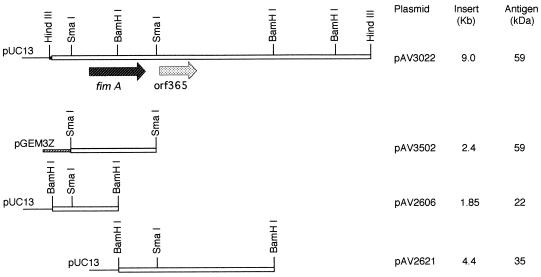
FIG. 1
FIG. 1
Restriction endonuclease maps of recombinant cosmid pAV1402 and its derivatives. The size of the inserted A. naeslundii T14V DNA in each plasmid and the apparent molecular weights of the plasmid-encoded proteins detected by immunostaining with the anti-A. naeslundii T14V type 2 fimbriae antibody are indicated. Selected restriction endonuclease recognition sites are included for reference. Symbols: ▪, pHC79 DNA; _____, pUC13 DNA; ▨, pGEM3Z DNA; and □, A. naeslundii T14V DNA.
FIG. 2
FIG. 2
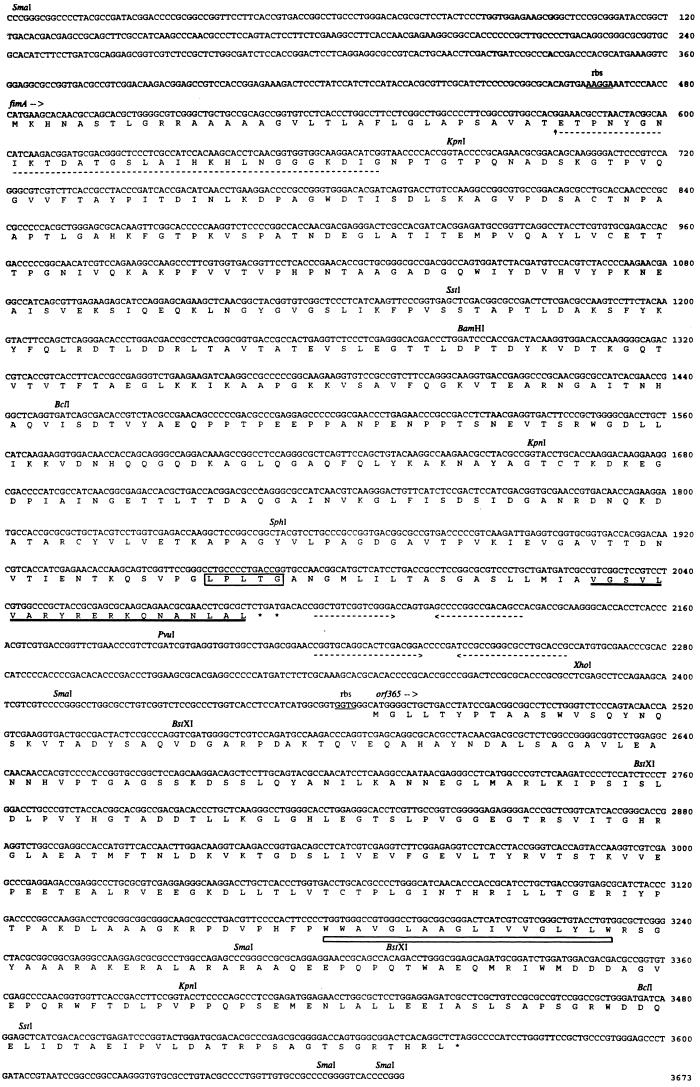
Nucleotide sequence of a 3.67-kb A. naeslundii T14V chromosomal DNA region containing the type 2 fimbrial subunit gene, fimA, and a putative gene, orf365, involved in fimbrial biogenesis. The presumptive ribosomal binding site (rbs; underline), two inverted repeats (arrow and dotted underline) downstream of the termination codon, TGA (∗), of fimA, the amino-terminal amino acid sequence of type 2 fimbriae (dotted underline) determined by Edman degradation, the leader peptide processing site (upward arrow) of the subunit precursor, the conserved cell wall anchoring motif (LPXTG; boxed), the 20-amino-acid carboxyl-terminal sequence (thick underline) of FimA used to prepare a rabbit antipeptide antibody, and the putative transmembrane segment in ORF365 (open bar) are indicated. Selected restriction endonuclease recognition sites are included for reference.
FIG. 3
FIG. 3
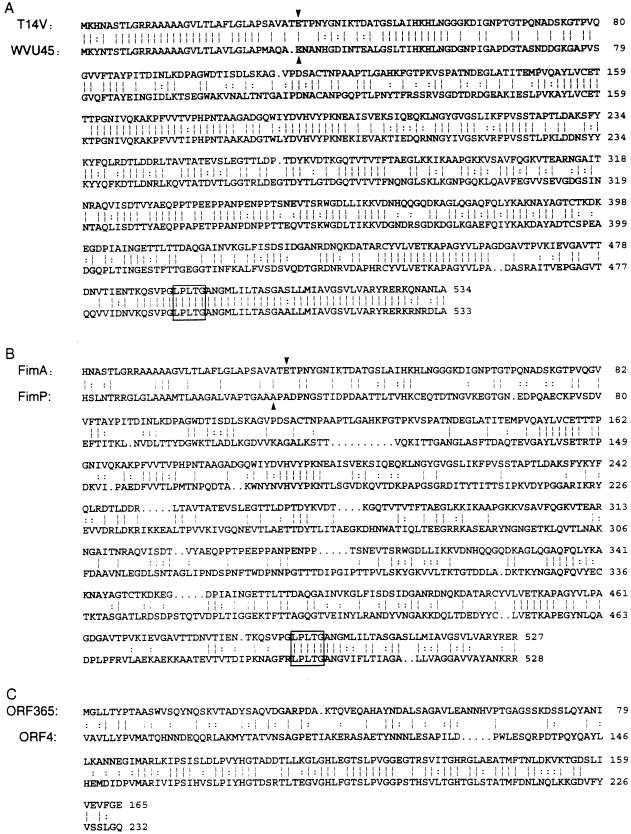
Sequence homology between the deduced amino acid sequences of type 2 fimbrial subunits of A. naeslundii T14V and A. naeslundii WVU45 (A), type 2 (FimA) and type 1 (FimP) fimbrial subunits of A. naeslundii T14V (B), and the N-terminal portion of the protein encoded by orf365 flanking fimA and the central portion of the protein encoded by orf4 flanking fimP of the type 1 fimbrial gene cluster (C). Identical (|) and conserved substituted (:) amino acid residues are indicated. The N-terminal amino acid (downward arrow) determined by Edman degradation of purified fimbriae and the consensus cell wall anchoring motif (LPXTG; boxed) are indicated.
FIG. 4
FIG. 4
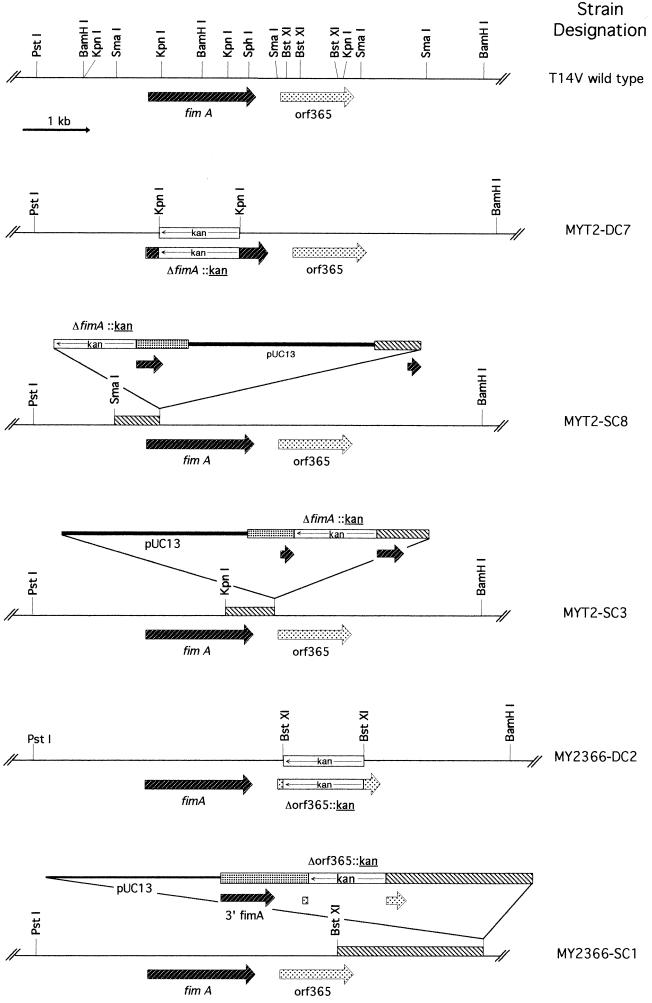
Restriction endonuclease maps of A. naeslundii wild-type strain T14V and isogenic mutants generated by allelic replacement of fimA (strain MYT2-DC7) or orf365 (strain MY2366-DC2) and those generated by single crossover with the integration plasmid pMY2201 (strains MYT2-SC8 and MYT2-SC3) or pMY2366 (strain MY2366-SC1). Only the chromosomal DNA region flanking fimA and orf365 and selected restriction endonucleases are included. Symbols: _____, A. naeslundii T14V DNA; ——, pUC13 DNA; □, kan gene; formula image, fimA; formula image, orf365. The chromosomal region where plasmid integration occurred as mediated by the Campbell insertion-duplication mechanism is also indicated (▧).
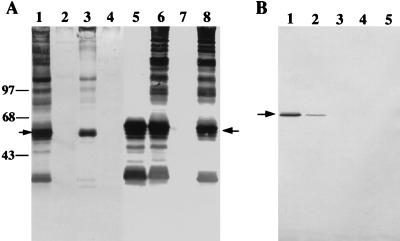
FIG. 5
FIG. 5
(A) Composite of Western blots of sonicated cell extracts of A. naeslundii T14V (wild type), mutant strains MYT2-DC7, MYT2-SC3, MYT2-SC8, MY2366-DC2, and MY2366-SC1, strain 147, and strain 5951 with anti-A. naeslundii T14V type 2 fimbrial antibody (lanes 1 through 8, respectively). Proteins were separated by SDS-PAGE, and transferred proteins on nitrocellulose were immunostained with anti-A. naeslundii T14V type 2 fimbrial antibody. The apparent molecular sizes (in kilodaltons) are indicated on the left. (B) Western blot of cell extracts of A. naeslundii mutant strains MY2366-DC2, MYT2-SC3, 147, and 5951 and wild-type strain T14V (lanes 1 through 5, respectively). Transferred proteins on nitrocellulose were immunostained with rabbit anti-peptide antibody prepared against the predicted C-terminal sequence of FimA. Arrows indicate the 59-kDa type 2 fimbrial subunit.

References

    1. Altschul S F, Gish W, Miller W, Myers E W, Lipman D J. Basic local alignment search tool. J Mol Biol. 1990;215:403–410. - PubMed
    1. Campbell A M. Episomes. Adv Genet. 1962;11:101–145.
    1. Cisar J O. Fimbrial lectins of the oral actinomyces. In: Mirelman D, editor. Microbial lectins and agglutinins: properties and biological activity. New York, N.Y: John Wiley & Sons, Inc.; 1986. pp. 183–196.
    1. Cisar J O, Barsumian E L, Curl S H, Vatter A E, Sandberg A L, Siraganian R P. Detection and localization of a lectin on Actinomyces viscosusT14V by monoclonal antibodies. J Immunol. 1981;127:1318–1322. - PubMed
    1. Cisar J O, Curl S H, Kolenbrander P E, Vatter A E. Specific absence of type 2 fimbriae on a coaggregation-defective mutant of Actinomyces viscosusT14V. Infect Immun. 1983;40:759–769. - PMC - PubMed

Publication types

Associated data

LinkOut - more resources